
Whether nominal or real, India's investment rate needs to increase by 3 to 4 percentage points of GDP to support 8 per cent real growth, recommends Nikhil Gupta.

Pakistan's current account deficit (CAD) increased to a 4-year high of $17.4 billion in the fiscal year of 2021-22, indicating more troubles for the ailing economy of the cash-strapped country. The State Bank of Pakistan (SBP) on Wednesday reported that the country recorded a CAD of $17.406 billion in FY22 compared to a gap of just $2.82 billion in FY21. According to Dawn newspaper, the massive CAD speaks a lot about the severe problem of the balance of payments.

Nayagam PP, a certified career counsellor and the founder of EduJob360, lists the top and emerging career streams in engineering.
Merchandise exports to the US jumped 23.5 per cent year-on-year (Y-o-Y) to $8.3 billion in June, even as India's overall outbound shipments witnessed contraction during the month, according to the data released by the commerce department on Tuesday. The increase in outbound shipments to the US was largely driven by the rush among exporters to utilise America's pause on its plans to impose country-specific reciprocal tariffs.

The Reserve Bank of India (RBI) on Friday cut the repo rate by 25 basis points to 6.25 percent, marking the first reduction in five years. The central bank also projected GDP growth for fiscal year 2026 at 6.7 percent and inflation to come down to 4.2 percent in FY26 from 4.8 percent in FY25. The RBI said the global economic backdrop remains challenging but the Indian economy continues to remain strong and resilient.

Research and ratings agencies like Icra and Moody's have said the CAD in 2018-19 would be much higher than 2017-18

The deficit increased to $ 57.2 billion or 2.1 per cent of gross domestic product (GDP) in 2018-19 as against 1.8 per cent in the previous year.

Reserve Bank Governor Raghuram Rajan on Tuesday said the government's target of reducing the current account deficit (CAD) to $70 billion or 3.7 per cent of the GDP in 2013-14 is "imminently reachable".

India's widening current account deficit (CAD), driven by the massive spike in commodity prices led by crude oil, is set to put pressure on the fragile recovery, warns a brokerage report that has revised upwards its CAD forecast to $45 billion or 1.4 per cent of GDP by March. According to a report by British brokerage Barclays, the worries arise from the fact that the trade deficit has been jumping continuously since July. From an average monthly trade deficit of $12 billion till June, it has jumped to $16.8 billion in July-October, with September showing the highest-ever trade deficit on record at $22.6 billion, the report said.
.jpg)
India's CAD -- the gap between inflow and outgo of foreign exchange -- widened to a record high of $88 billion or 4.8 per cent of the gross domestic product for the fiscal ended March 31, from $78.2 billion in 2011-2012, about 4.2 per cent of the Gross Domestic Product.

CAD refers to the difference between inflow and outflow of foreign exchange that has a bearing on exchange rate.

So far, her appeal's limited to OTT but with Kesari 2, the 26 year old charms the big screen as well.

CAD, which is the difference between outflow and inflow of foreign currency, touched a historic high of 6.7 per cent in the third quarter.

The Prime Ministry's Economic Advisory Council Chairman also said fiscal deficit is a concern too and suggested raising domestic oil prices to restrict it to the budget target of 4.8 per cent of the gross domestic product in this fiscal.

Finance Minister P Chidambaram on said that financing current account deficit (CAD) year after year is a challenge and the only way to deal with the problem is by increasing exports.

The government would also take steps to promote exports and restrict non-essential imports, said Jaitley

India's balance of payments in negative territory.

Leading brokerages Nomura and Barclays on said current account deficit, which unexpectedly improved to 4.8 per cent in 2012-13, but still at a historic high, could moderate further this fiscal on slowing gold imports and cheaper commodities.

The gold and currency had arrived on an Air Canada flight from Zurich, Switzerland, to Pearson International Airport in Toronto.

When the outflows are more than the inflows, a deficit occurs in the current account of the nation, which is widely known as the Current Account Deficit.

Gold imports had totalled 335.1 tonne in the April-June quarter, but have declined to 58.37 in the second quarter (up to September 25).
.jpg)
As per the latest data, India's CAD sharply narrowed to 1.7 per cent of the gross domestic product or $32.4 billion in 2013-14 from a record high of 4.7 per cent in FY'13.
Moody's assigns 'Baa3' rating on India, with a stable outlook.
The country's current account deficit is likely to decline to 1.1-1.2 per cent of the gross domestic product in the third quarter, say rating agencies.

The central bank is of the view that rise in external debt a concern but rating outlook revision reassuring.

The RBI left key policy rates unchanged and cut the GDP growth estimate for this fiscal to 5.5 per cent from 5.7 per cent.

The current account deficit is the difference between inflow and outflow of foreign exchange.

If there is a decline in the number of Indian students pursuing higher studies in Canada due to the ongoing diplomatic tensions between the two countries, it may have implications for Indian banks operating in the North American country, senior bank officials said.

Gold imports, which peaked at 162 tonnes in May, came down to 19.3 tonnes in November.
Expressing serious concerns over the current account deficit touching a record 4.8 per cent in 2012-13, India Inc on Thursday asked the government to take all policy measures, including boosting exports and foreign exchange inflows to bring down CAD.

The government's initiative to migrate SEZ data from NSDL software to ICEGATE system for streamlined reporting of import data caused double counting of gold imports, resulting in inflated figures and the issue has now been largely rectified, government sources said. The downward revision has provided the actual picture of trade deficit (difference between imports and exports), which was earlier looking very high. The deficit for November will now be revised downwards from $37.84 billion to about $32.8 billion. Similarly, there will be a revision in overall import numbers as well.

The government has revised gold import data, bringing down numbers for November by $5 billion to $9.84 billion, possibly to rectify double accounting of inbound shipments. According to revised data of the commerce ministry arm Directorate General of Commercial Intelligence and Statistics (DGCIS), gold import numbers have been slashed since April 2024, revealing excess imports of about $11.7 billion during the first eight months of 2024-25.

The government has hiked import duty on gold three times in a year and recently raised it by 2 per cent to 8 per cent to curb demand.

Exports increased by 10.6 per cent in the first quarter of 2014-15 to $81.7 billion. Imports moderated by 6.5 per cent to $116.4 billion. The CAD, which is the difference between the inflow and outflow of foreign currency, had touched a record high of $ 87.8 billion (4.8 per cent) in 2012-13 fiscal mainly on account of steep increase in gold imports.

The government is committed to restrict the fiscal deficit at 3.4 per cent of GDP as envisaged in the Budget.
According to SBI Ecowrap, every $10/barrel increase in oil price results in additional import bill of $8 billion.

The Budget should undertake further reductions in import tariffs and seriously consider an announcement of India's intention to join one or both of the two Asian mega-regional free trade agreements, suggests Shankar Acharya, former chief economic adviser to the Government of India.

He said while bringing in investments, it is also necessary to manage the high current account deficit.

'Making sure that you're getting enough sleep, that your weight is maintained correctly and you exercise regularly.'
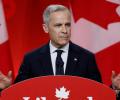
In a dramatic shift in Canada's foreign policy, Prime Minister Mark Carney on Thursday declared that the long-standing economic and security relationship between Canada and the United States has ended, responding to US President Donald Trump's announcement of new auto tariffs that could severely impact Canada's economy, Politico reported.
