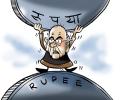
Fiscal deficit in first half of FY19 has already reached 95.3 per cent of full-year budget estimates.

Rajan says, this is a time where countries should be focusing on getting the macro stability in order

India's net oil import bill could widen to $101-104 billion in current fiscal from $96.1 billion in 2023-24 and any escalation in the Iran-Israel conflict could impart an upward pressure on the value of imports, ICRA said on Tuesday. The domestic rating agency said based on its analysis, lower value of Russian oil imports is estimated to have led to savings of $7.9 billion in 11 months (April-February) of 2023-24, up from $5.1 billion in 2022-23.

India's current account deficit which narrowed in the second quarter of this fiscal, however, is likely to widen during the second half of FY 2013-14 as seasonal demand bring in more imports, an HSBC report says.
It added that industrial output is on decline due to poor demand and lack of infrastructure.
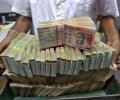
The largest component in computing CAD is trade deficit. India's trade deficit widened to $13.35 billion in October as exports contracted 5.04 per cent and gold imports surged

Nadaaniyan's lack of charm, chemistry and cheek fails to create any ripples sighs Sukanya Verma.

India's current account deficit (CAD) is likely to ease to 4.4 per cent of the GDP in the current fiscal year on lower oil and gold prices, Bank of America Merrill Lynch (BofA-ML)said in a research note.
.jpg)
Narrowing of the current account deficit will help arrest depreciation of the rupee and ease inflation concerns, industry groups said.

'Thirty per cent of the world's deaths in young people, due to heart disease, are encountered by people in India.'

India's current account deficit narrowed sharply to just $300 million

RBI Governor Rajan on Wednesday said significant progress made in curbing current account deficit.

According to the report by the global financial services major, the FY2013-14 CAD is expected to be within $36 billion or 2 per cent of GDP, and this fiscal year CAD is likely to be slightly higher but contained at 2.3 per cent of GDP.
The CAD has been narrowing since 2012 to an estimated 1.6% of GDP in 2014

The finance ministry expects a broad-based moderation in inflationary pressures on the back of an anticipated reduction in food prices as a result of the uptick in summer sowing. The retail inflation rate remained stubbornly clung to the 5 per cent mark in seven of the past eight months. "Core inflation is trending downwards, indicating a broad-based moderation in price pressures... Driven by strong domestic growth and benign global commodity prices, core inflation is declining continuously.

Gold imports more than doubled in August to a record high of $10.06 billion, mainly on account of a drastic cut in customs duty and ongoing festive demand, according to the Commerce Ministry data. Gold imports stood at $4.93 billion in August 2023. On record high imports, Commerce Secretary Sunil Barthwal said that the tariff rates on gold have been reduced drastically so that smuggling and other activities can come down.

Connect with professionals in your field through LinkedIn, industry events and workshops. Attend job fairs, conferences and meetups to expand your network. Apply for internships or short-term projects to gain practical experience, suggests rediffGURU Aasif Ahmed Khan.
Huge gold imports have put pressure on the country's CAD, which in turn is affecting the value of rupee.
.jpg)
Analysts see FY16 CAD at 0.5-0.6% of GDP.

India recorded a current account surplus of $5.7 billion or 0.6 per cent of GDP in the March quarter, the Reserve Bank of India said on Monday. This is the first time in ten quarters that the crucial metric of the country's external strength has turned into surplus mode. In the year-ago period, the current account deficit stood at $1.3 billion or 0.2 per cent of GDP, and the same was $8.7 billion or 1 per cent of GDP in the preceding quarter ending December 2023.

India's gold imports, which have a bearing on the country's current account deficit (CAD), increased 26.7 per cent to $35.95 billion during the April-December of this fiscal due to healthy demand, according to government data. The imports stood at $28.4 billion during the same period a year ago. In December 2023, imports of the precious metal jumped by 156.5 per cent to $3 billion, as per the data released by the commerce ministry.

The country's current account deficit widened to 4.4 per cent of the GDP in the quarter ended September, from 2.2 per cent GDP during the April-June period, due to higher trade gap, as per data released by the Reserve Bank on Thursday. "India's current account balance recorded a deficit of $36.4 billion (4.4 per cent of GDP) in Q2:2022-23, up from $18.2 billion (2.2 per cent of GDP) in Q1:2022-23 and a deficit of $9.7 billion (1.3 per cent of GDP) a year ago [i.e., Q2:2021-22]," the RBI said.

With the prediction of an above normal monsoon in 2024, the government is expecting food prices to come down, the finance ministry's monthly economic report for March has said. The report, released on Thursday, said robust foreign inflows and comfortable trade deficits were expected to keep the rupee within a comfortable range. "Further easing of food prices is on the anvil as IMD (India Meteorological Department) has predicted above-normal rainfall during the monsoon season, which is likely to lead to higher production, assuming good spatial and temporal distribution of the rainfall," the monthly report, released by the Department of Economic Affairs, said.

Call Me Bae is a spirited new addition in guilty pleasures for the fashion-loving, rom-com starved soul, applauds Sukanya Verma.
.jpg)
The trade deficit stood at $6.54 billion in February this year.

Lead indicators suggest that domestic current account deficit (CAD) is likely to reduce in 2023, while macro-economic stability has received a boost from inflation being brought back to the official tolerance band, according to the Reserve Bank of India's (RBI's) January 2023 Bulletin. "With the merchandise trade deficit reaching an all-time high of $83.5 billion in a quarter, and a rise in net outgo from the income account, the current account deficit increased to 4.4 per cent of GDP in Q2FY23," the State of the Economy article in the bulletin said. "It is noteworthy, however, that the CAD for Q1 was revised down from 2.8 per cent to 2.2 per cent on account of downward adjustment in Customs data.

The broader NSE Nifty too fell below the 10,100 level by dropping 100.10 points to end at 10,094.25

India's economy is projected to slow to 6.5 per cent in the fiscal year starting April but will remain the fastest growing major economy in the world as it fared better in dealing with the extraordinary set of challenges the globe has faced, the Economic Survey 2022-23 said on Tuesday. India's gross domestic product (GDP) growth of 6.5 per cent in 2023-24 compares with an estimated 7 per cent expansion in current fiscal year (April 2022 to March 2023) and 8.7 per cent in the previous year. Like the rest of the world, India too faced an extraordinary set of challenges in tightening financial conditions and supply chain disruptions from a prolonged war in Europe but "withstood them better than most economies", the annual document detailing the state of the economy said.

Following are the highlights of the Economic Survey 2022-23 tabled in Parliament on Tuesday

Investors cheered a sharp decline in the Current Account Deficit, which stands at a 4 year low as exports picked up and gold imports reduced.

'Gurashman's death is being treated as unexpected, and while there is nothing to suggest it was suspicious, we will ensure our investigation is as thorough as possible to confirm this'

It was primarily due to a higher trade deficit ($41.6 billion) brought about by a larger increase in merchandise import.

India's gold imports, which have a bearing on the country's Current Account Deficit (CAD), rose 6.4 per cent to $12.9 billion during April-July this fiscal due to healthy demand, according to government data. The imports stood at $12 billion during the same period a year ago. In July 2022, however, imports of the precious metal fell sharply by 43.6 per cent to $2.4 billion, as per the latest data released by the commerce ministry.

The Indian rupee is expected to trade between 80 and 84 against dollar in the first three months of 2023 with support from overseas inflows though worsening current account deficit (CAD) and reduced interest rate differential between the US and India pose challenges. According to a Business Standard Poll of 10 participants, most said the rupee could gain strength in January due to foreign inflows, and the Reserve Bank of India (RBI) is not expected to allow the currency to depreciate ahead of the Union Budget scheduled on February 1. The rupee depreciated 10.15 per cent in 2022, its worst performance since 2013 as the war in Europe and the interest rate increase by the US Federal Reserve prompted investors to flee emerging markets.
The Reserve Bank has told the International Monetary Fund (IMF) that the objective of frequent interventions in the forex market is to curb excessive volatility, dismissing the Fund's rationale for reclassifying India's exchange rate regime. The IMF, following the Article IV consultation with the Indian authorities, reclassified the status of the exchange rate regime to "stabilised arrangement" from "floating" for period between December 2022 to October 2023. India's Executive Director at IMF K V Subramanian and Senior Advisors Sanjay Kumar Hansda and Anand Singh questioned the selection period adopted by the Fund for analysis and also reclassification of the country's exchange rate regime.

In a recent note, the global brokerage firm said India now commands a weight of 19 per cent in the above-mentioned portfolio as compared to 18.2 per cent in September 2023. India, it said, is a large liquid market and remains a counter-weight to North Asia if a slowdown in the West occurs and China's recovery disappoints.

Amid fast-depleting forex reserves, the Finance Ministry on Wednesday signalled that it was not in favour of selling the dollar to defend any particular level of the rupee. "Let it (rupee) reach whatever levels it has to reach. We can't fritter away reserves on defending some artificial, imaginary rate of exchange," a senior finance ministry official told Business Standard. Forex reserves declined to a near two-year low of $545.65 billion as on September 16, down $85.88 billion from the level that existed on February 25, a day after Russia invaded Ukraine.

On the back of sound macroeconomic policies and softer commodity prices, India's growth momentum is likely to be sustained in 2023-24 in an atmosphere of easing inflationary pressures, said the Reserve Bank's annual report released on Tuesday. It, however, added that slowing global growth, protracted geopolitical tensions and a possible upsurge in financial market volatility following new stress events in the global financial system could pose downside risks to growth. "On the back of sound macroeconomic policies, softer commodity prices, a robust financial sector, a healthy corporate sector, continued fiscal policy thrust on quality of government expenditure, and new growth opportunities stemming from global realignment of supply chains, India's growth momentum is likely to be sustained in 2023-24 in an atmosphere of easing inflationary pressures," it said.

Without naming India, S&P said it expects that in regions where inflation already exceeds targets, or which are vulnerable to capital flight, central banks will be forced to raise interest rates.

The Indian rupee may remain under depreciation pressure on account of plateauing of exports and subsequent widening of the current account deficit, said the Economic Survey 2022-23 tabled in Parliament on Tuesday. It said the "risks to the current account balance stem from multiple sources". The country's current account deficit (CAD) widened to 4.4 per cent of the GDP in the quarter ended September from 2.2 per cent in April-June due to higher trade gap, as per latest data of the Reserve Bank of India.
