
She posed for the traditional 'briefcase' picture outside her office along with her team of officials before heading to meet the President. She, however, was holding a tablet instead of a briefcase to present the Budget in a digital format.

Five things you did not hear the finance minister Pranab Mukherjee say in the budget speech.

Accusing the Centre of setting a new trend of playing "dirty politics" for votes through the budget, an editorial in Sena mouthpiece 'Saamana' said the allocation of more funds to poll-bound states is a kind of "bribery".
First, the Insolvency and Bankruptcy Code, much-lauded as a game changer, needs serious reform. Second, some vital policy choices would need to be made as far as competition law is concerned., says Somasekhar Sundaresan.
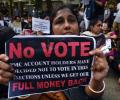
The government on Wednesday said that all urban cooperative banks and multi-state cooperative banks will come under the supervision of the Reserve Bank of India, a development aimed at providing comfort to depositors and prevent repeat of PMC Bank like scams. The President of India will promulgate an ordinance to this effect, Information and Broadcasting Minister Prakash Javadekar told reporters after the meeting of the Union Cabinet.

Inputs by the Petroleum Ministry were found among stolen documents.

Senior citizens of 75 years and above having pension income and interest from fixed deposit in the same bank would not be required to file income tax returns for the financial year beginning April 1.

On the Sensex chart, IndusInd Bank was the top gainer, rallying over 11 per cent, followed by ICICI Bank, SBI, HDFC, M&M and Axis Bank. On the other hand, Dr Reddy's, Tech Mahindra and TCS were among the laggards.

'The finance ministry's decision to accept the deficit target of 4.5 per cent in 2025-2026 appears to have emanated from its endorsement of the Finance Commission's view that the Indian economy will continue to remain impacted by the pandemic, adversely undermining its growth potential,' notes A K Bhattacharya.

The Department of Investment and Public Asset Management (Dipam) has asked ministries, government departments, and public sector undertakings (PSUs) to send a list of assets that can be monetised under the proposed National Monetisation Pipeline. The list will be used for creation of an asset monetisation dashboard, which will keep a track of such assets. The government, meanwhile, has asked CRISIL to prepare a road map for monetising assets of PSUs and government departments.

Finance Minister Nirmala Sitharaman on Tuesday said the interest of all employees of state-owned banks which are likely to be privatised will be protected, even as bank unions observed a two-day strike against the government's privatisation decision. Replying to a query during a press conference, she clarified that public sector presence will continue in the banking space. "...we have announced public enterprise policy based on which we have identified those four areas in which we said government presence, public sector presence will be there, and bare minimum presence is what we have said, in that financial institutions are also there. "Meaning, even in financial sector we will still have the presence of public sector enterprise...not all of them are going to be privatised," she said.
From referencing "josh" of Bollywood flick 'Uri', to chants of "Modi, Modi" from the Bharatiya Janata Party, there were varied reactions in Lok Sabha as Finance Minister Piyush Goyal gave his interim budget speech on Friday.

While no specific state-oriented sops were rolled out, a strong thread of political wellness ran through the Budget.

Congress leader and ex-finance minister P Chidambaram on Tuesday said the Union Budget was the "most capitalist" with nothing for the poor and farmers while sops were being provided to big industrialists turning India into a very "unequal country". At a press conference after Union Finance Minister Nirmala Sitharaman unveiled a Rs 39.45 lakh crore Budget, he said because of the ruling party's "brute majority" the Lok Sabha pass the Budget but people will reject it. He claimed the Bharatiya Janata Party was going to elections, scheduled in five states, not with their performance or with the promises and assurances to the people, but solely "with the agenda of dividing the country and bringing Hindutva back to power".

Five years after demonetisation, which sought to curb black money and reduce cash circulation in the economy, 70 per cent of respondents said they paid a large component of the total payment towards a real estate transaction in cash. About 16 per cent said they paid over half the amount in cash, observes Shyamal Majumdar.
The prime minister was often seen vigorously thumping the desk, prompting his Cabinet colleagues and NDA MPs to follow suit.

The Budget announcement of taxing 'virtual digital assets' or crypto currencies will help the income-tax department measure the "depth" of this trade in the country, know the investors and the nature of their investments and it does not "attach any legality" to these transactions, Central Board of Direct Taxes chairman J B Mohapatra said.

In the Union Budget presented in Parliament by Finance Minister Nirmala Sitharaman, a total of Rs 1,52,369 crore has been set aside for capital expenditure that includes purchasing new weapons, aircraft, warships and other military hardware.

While she primed up spending on infrastructure to create jobs and boost economic activity, Sitharaman did not tinker with income tax slabs or tax rates. Her Budget for the fiscal year beginning April 2022 proposed a massive 35 per cent jump in capital expenditure to Rs 7.5 lakh crore, coupled with rationalisation of customs duty, an extension of time for setting up new manufacturing companies and plans for starting a digital currency and tax crypto assets.

'The clubbing of policy announcements in the Budget speech creates policy surprises.' 'Economic actors dislike policy surprises because they throw their plans off track,' points out Alok Tiwari.
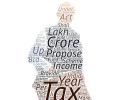
The words that appeared more often in the speech included tax, income, lakh and crore.

The demand for extension of the GST cess regime among others was made by several state finance ministers at a pre-budget consultation called by Union Finance Minister Nirmala Sitharaman in New Delhi. Besides, many states also demanded raising the share of the Union government in the Centrally Sponsored Schemes (CSS). Currently, the central government and state government share in some CSS is 60:40 while in others it is 75:25.

Pranab Mukherjee takes pride in being cautious.

In a bid to check generation of domestic black money, the government will soon issue a notification making quoting of PAN mandatory for all cash transactions beyond Rs 200,000.

The calculator, with a comparative table to compare taxes in the old and the new tax regime, for resident individuals (financial year 2020-21) has been hosted on the official e-filing website of the department -- https://www.incometaxindiaefiling.gov.in.

"Of the structural reforms, the GST has been the most historic in our country. Its chief architect is not with us today. I pay homage to the visionary leader late Arun Jaitely. GST has been gradually maturing into a tax that has integrated the country economically," she said during her budget speech.

Congress leader Prithviraj Chavan claimed that Modi held 13 pre-Budget consultation meetings which were attended by top industrialists, but to none of these meetings Sitharaman was invited.

No fare hike was announced in the Railway Budget for 2019.

The Union Budget 2021-22 has made it easier for sovereign wealth funds and pension funds to invest in Indian infrastructure projects, but some of the new rules may need more clarity, experts said. The proposed regime requiring investments through holding companies may have adverse tax implications for such funds and may create an arbitrage between the new and old projects, they said. Besides, the ownership structure of holding companies through which investments are to be made requires further clarification, they added.
'The finance minister in her Budget speech should spell out how exactly she intends to get back to the 7% track, and the hard decisions she intends to take in order to adjust to the realities of a slowing economy until growth momentum returns,' suggests T N Ninan.
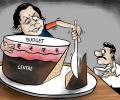
Niti Aayog will prepare the next list of central public sector companies for disinvestment in the next few weeks, its vice chairman Rajiv Kumar said on Thursday and expressed hope that the proposed asset reconstruction and management companies to address banks' bad loan woes will do a good job like the UTI. Days after Finance Minister Nirmala Sitharaman announced the Union Budget for 2021-22 laying out various measures (including disinvestment proposals) to bolster the pandemic-hit economy, Kumar also emphasised that the Modi government has shown consistent commitment for the welfare of farmers and for the improvement of the agriculture sector. "Now the process has begun... We will complete preparation of the next list in the next few weeks, we have got the marching order," Kumar said about the list of public sector companies for the next round of stake sales.

The government on Monday budgeted Rs 1.75 lakh crore from stake sale in public sector companies and financial institutions, including 2 PSU banks and one general insurance company, in the next fiscal year beginning April 1. The amount is lower than the record Rs 2.10 lakh crore which was budgeted to be raised from CPSE disinvestment in the current fiscal year. However, the COVID-19 pandemic impacted the government's CPSE stake sale programme, and the target has been lowered to Rs 32,000 crore in the Revised Estimates.

Finance Minister Nirmala Sitharaman on Monday used her trademark 'bahi-khata', a ledger wrapped in a red-coloured cloth, to carry Budget documents as she arrived in Parliament House to present her third straight Budget. Sitharaman, India's first full-time woman finance minister, had in July 2019 ditched the colonial legacy of a Budget briefcase for the traditional 'bahi-khata' to carry Union Budget papers. She used the same last year and again on Monday.
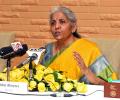
Macroeconomic management is usually a lot more comfortable with lower fiscal deficits. The sooner we get there, the better for the economy, says former Chief Economic Adviser to the Government of India Shankar Acharya.

The main sectors that receive the maximum foreign inflows include services, computer software and hardware, telecommunications, trading, construction, automobile, and power.
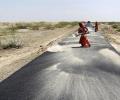
Accelerated development of highways will be taken up with 2,500 km access controlled highways and 9,000 km of economic corridor. In addition, there will be 2,000 km each of strategic highway projects and port connectivity projects, she said.

"The underlining theme with which we have been working till now is that we trust the taxpayers and from purely an enforcement agency, we are shifting our focus to being a service-oriented department," says CBDT chairman Pramod Chandra Mody.

Finance Minister Nirmala Sitharaman on Tuesday said monetisation of Central Public Sector Enterprises (CPSE) assets is based on the principle of value creation for the government and investors and would bring about a paradigm shift in infrastructure augmentation and maintenance. Chairing the National Workshop with the states/UTs on Asset Monetisation organised by Niti Aayog, the minister sought the collaboration of states for the holistic development of infrastructure. She said India can become a $5 trillion economy, while striking the right balance between fiscal imperatives and socio-economic welfare, through active collaboration between the public and private sector.

The challenges before the coming Budget are more daunting than those in 2021, reveals A K Bhattacharya.
 © 2026 Rediff.com - Advertise with us - Disclaimer - Privacy Policy - Sitemap - Feedback - About us - Terms of use - Grievances