
Bharat Petroleum made the grade from Pool Y of the semi-final league stage on goal difference.

'It was more than ego.' 'It carried with it a sincere belief that he was the quintessence of the country, that the country's destiny was irrevocably intertwined with his destiny.' An excerpt from T J S George's The Dismantling of India: In 35 Portraits.
Bharat Petroleum scored a 2-1 victory over the defending champions to improve their chances of making it to the final of the 44th Bombay Gold Cup Hockey Tournament.
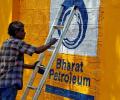
Fitch Ratings on Monday said uncertainty over the bidder consortiums and process complexity, including valuation, may lead to potential delays in privatisation of India's second-largest fuel retailer, Bharat Petroleum Corporation Ltd (BPCL). Affirming BPCL's rating at 'BBB-' with a negative outlook, Fitch said it continues to treat the potential divestment of the company by the Indian government as an event risk. "Bidders are conducting due diligence, but uncertainty over the bidder consortiums and process complexity, including valuation, may lead to potential delays.
India's third biggest state-owned refiner Bharat Petroleum may invest in oil and gas blocks in South East Asia as it expands it production assets, especially in the view of soaring demand for fuel.
Punjab and Sind Bank will lock horns with Indian Oil in the final of the Surjit hockey tournament.
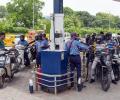
Petrol and diesel price hikes are likely to resume after state elections get over next week to bridge the Rs 9 a litre gap created by international oil prices soaring past $100 a barrel. International crude oil prices shot above $110 a barrel for the first time since mid-2014 on fears that oil and gas supplies from energy giant Russia could be disrupted, either by the conflict in Ukraine or retaliatory western sanctions. The basket of crude oil India buys rose above $102 per barrel on March 1, the highest since August 2014, according to information from the Petroleum Planning and Analysis Cell (PPAC) of the oil ministry.
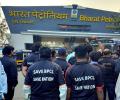
The sale is key to meeting the government's disinvestment target of Rs 2.1 trillion in the financial year 2020-21. So far, the disinvestment exercise has fetched the government Rs 34,845 crore during the current financial year.

Diesel rates had gone up by Rs 12.55 a litre between June 7, when oil firms resumed revising prices in line with cost, and July 25.

Companies are ranked by total revenues.

10 stocks which are most popular with brokerages right now and are expected to deliver maximum upside over the next 12 months.

The Centre is likely to privatise profit-making enterprises, reversing its previous position of first closing or merging loss-making state-run units. The NITI Aayog, which is in the process of selecting public sector units for privatisation, is likely to put out its first list, focusing on companies in non-strategic sectors, along with those that have got Cabinet approval for stake sale, or are in final stage of due diligence. "The shortlisted firms will be put out in three-four tranches, with the first list comprising non-strategic ones, followed by strategic sectors with a focus on privatisation and not divestment," said a senior government official privy to the plan. He said the first report was expected in early April. The think tank approach is in sync with the government's new strategies on privatisation and asset monetisation.

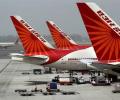
The Centre's push to sell Air India on priority has led to delays in other strategic divestment proposals, such as privatising United India Insurance, as well as ongoing transactions, such as Shipping Corporation of India (SCI) and Bharat Petroleum Corporation (BPCL), revealed multiple officials involved in the process. The Department of Investment and Public Asset Management (DIPAM) is yet to take new privatisation recommendations of the NITI Aayog to the core group of secretaries on disinvestment (CGD) headed by the Cabinet secretary, said one of the officials. The priority now is to ensure all approvals for Air India are in place since the government intends to hand over the national carrier as early as this month.

Processes are at an advanced stage for a number of assets of the Centre and central public sector enterprises (CPSEs) to be monetised. The assets include office space, apartments, factories, land, power transmission assets, sports stadia, gas pipelines, and telecom assets.

India is back on the diplomatic table pushing oil producing countries to raise production in a bid to cool down runaway oil prices. Brent crude oil prices traded above $90 a barrel, on Thursday, for the first time since 2014. Brent is the most popular marker for crude oil trade. It is used as a benchmark for two-thirds of the world's internationally traded crude oil.
The state-run Oil and Natural Gas Corporation may buy stake in Bharat Petroleum Corporation's 6 million tonne Bina Refinery.

RBML - the joint venture of Reliance Industries Ltd and supermajor BP - has told the government that fuel retailing for the private sector in India has become unsustainable after market-controlling public sector firms frequently froze petrol and diesel prices at rates way below the cost, sources said. Despite a surge in oil prices, state-owned Indian Oil Corporation (IOC), Hindustan Petroleum Corporation Ltd (HPCL) and Bharat Petroleum Corporation Ltd (BPCL) first froze petrol and diesel rates for a record 137 days beginning early November 2021 when five states including Uttar Pradesh went to the polls, and last month again went into a hiatus that is now 47 days old. "They (Reliance BP Mobility Ltd) has written to the petroleum ministry over the fuel pricing issue," a highly placed source in the government, who didn't want to be quoted, told reporters.
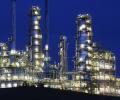
BPCL's impending privatisation and RIL's stake sale to Saudi Aramco raise questions about the future of the West Coast Refinery, once touted as the world's largest.

The tank, designed, developed, and manufactured by the Defence Research and Development Organisation's Combat Vehicles Research and Development Establishment and made in Tamil Nadu, will be used to protect northern borders.
In December 2019, the India arm of Deloitte Touche Tohmatsu surprised many with its ultra-competitive bid to become the transaction advisor for the country's largest strategic divestment in Bharat Petroleum Corporation (BPCL). The multinational major quoted just Rs 1; the second-highest bidder, SBI Caps, reportedly quoted Rs 15-17 crore. For Deloitte, the motivation was to bag a prestigious deal adding a national energy company to its portfolio. No doubt, it expected BPCL to go to a marquee buyer in quick time.
The government will press ahead with its stalled privatisation programme and sell stakes in two refiners, Hindustan Petroleum Corp Ltd and Bharat Petroleum Corp Ltd, Divestment Minister Arun Shourie said.
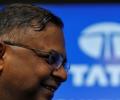
The Tata group companies are now more valuable than all the listed central public sector undertakings (CPSUs) or companies in the country. The key 20 listed Tata companies ended the 2021 calendar year with a combined market capitalisation of Rs 23.36 trillion, ahead of the 70 listed CPSUs, which had a combined m-cap of Rs 23.2 trillion. In comparison, these CPSUs had a combined market capitalisation of Rs 16.7 trillion at the end of December 2020 against the Tata group firms' combined m-cap of Rs 15.7 trillion.
Officials said there had been no official word or indication from the top yet. The expectation from officials is to do what they can, but it is understood that all fiscal and budgetary targets don't matter anymore.
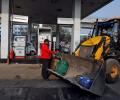
Petrol price in the national capital neared the Rs 85 a litre mark while diesel rates in Mumbai were close to Rs 82 as fuel prices were raised by 25 paise per litre each on Monday. Petrol now costs a lifetime high of Rs 84.95 per litre in Delhi while diesel comes for Rs 75.13, according to a price notification from oil marketing companies. The price hike on Monday came after three days of unchanged rates. Prices were last hiked by 50 paise a litre in two instalments on January 13 and 14.

'The signal is crude oil prices will rise, I am cutting my subsidy. Be prepared, prices will rise.'
While presenting her 2021-22 Union Budget, Finance Minister Nirmala Sitharaman had set a fiscal deficit target of 6.8 per cent of nominal gross domestic product (GDP) against the 2020-21 Revised Estimate of 9.5 per cent. The fiscal correction in the upcoming 2022-23 Union Budget is unlikely to be that steep. Even as discussions among top Budget-makers are ongoing, the fiscal deficit target for 2022-23 may likely be in the range of 6.5-6.8 per cent.
The price of diesel sold to bulk users has been hiked by about Rs 25 per litre in line with a near 40 per cent rise in international oil prices, but retail rates at petrol pumps remain unchanged, sources said. Petrol pump sales have jumped by a fifth this month after bulk users like bus fleet operators and malls queued up at petrol bunks to buy fuel rather than the usual practice of ordering directly from oil companies, widening the losses of retailers. Worst hit are private retailers like Nayara Energy, Jio-bp and Shell, who have so far refused to curtail any volume despite a surge in sales.
CNG price in the national capital and adjoining cities on Tuesday was hiked by Rs 0.50 per kg, while an imminent increase in petrol and diesel price has been put on wait-and-watch mode for more clarity on global oil prices. CNG price in NCT of Delhi has been increased to Rs 57.51 per kg from Rs 56.51, according to the information posted on the website of Indraprastha Gas Ltd - the firm which retails CNG and piped cooking gas in the national capital. Following the firming up of international gas rates, IGL has been raising CNG rates by up to 50 paise (Rs 0.50) per kg periodically. Prices have gone up by about Rs 4 per kg this year alone.

Stocks of public sector companies, especially the oil refining and marketing companies (OMCs) - Bharat Petroleum Corporation Limited (BPCL), Hindustan Petroleum Corporation Limited (HPCL) and Indian Oil Corporation Limited (IOC) - logged gains on Tuesday in a weak market. While the Nifty lost nearly 1 per cent in trade on Tuesday, the Nifty CPSE index - a gauge of performance of central public sector enterprises on the National Stock Exchange (NSE) - gained over 3 per cent in intra-day trade. The rally in PSU stocks comes on the back of the BPCL chairman, Arun Kumar Singh suggesting in the company's annual general meeting (AGM) on Monday that the government intends to complete the divestment process in the OMC by March 2022.
If IOC is not allowed to run its own affairs, then we can see it close down in the next 10 to 15 years, warns Sudhir Bisht.

LPG customers of Bharat Petroleum Corporation Limited (BPCL) will continue to get cooking gas subsidy post-privatisation of the nation's second-biggest fuel retailers, Oil Minister Dharmendra Pradhan said on Friday. "Subsidy on LPG is paid to consumers directly and not to any company. So the ownership of the company that sells LPG is not of any material consequence," Pradhan told PTI. The government gives 12 cooking gas (LPG) cylinders of 14.2-kg each to households in a year at a subsidised rate.
As many as 20 central public sector enterprises and their units are at various stages of strategic disinvestment, while six are being considered for closure or are under litigation, Minister of State for Finance Anurag Singh Thakur said on Monday.
Petrol price on Wednesday touched a new high of Rs 84.45 per litre in the national capital after state-owned fuel retailers hiked prices after a five-day hiatus. Petrol and diesel prices were hiked by 25 paise per litre each, according to a price notification from oil marketing companies. In Delhi, petrol now costs Rs 84.45 per litre and diesel is priced at Rs 74.63. In Mumbai, petrol comes for Rs 91.07 a litre and diesel for Rs 81.34. This is the highest ever price of petrol in Delhi, while diesel is at a record high in Mumbai.
US private equity firm I Squared Capital is dropping out of the race to buy India's second-largest state oil firm, Bharat Petroleum Corporation Ltd (BPCL) owing to a complex deal structure and lack of financial backers for the transaction, sources said. I Squared Capital through its Indian arm, Think Gas was among the three suitors that had evinced interest in buying the government's near 53 per cent shareholding in BPCL. "The company has made a decision not to participate in the financial bidding," a source with direct knowledge of the development said.

"Financial bids for Air India disinvestment received by Transaction Adviser. Process now moves to concluding stage," DIPAM Secretary Tuhin Kanta Pandey tweeted.

Indian Oil Corporation (IOC) and two other public sector oil firms will install 22,000 electric vehicle (EV) charging stations over the next 3-5 years to support the nation's target to reduce its carbon intensity and reach net zero emissions by 2070. IOC, the country's largest state-controlled refiner by capacity, will set up EV charging facilities at 10,000 fuel outlets over the next three years, chairman Shrikant Madhav Vaidya said. Bharat Petroleum Corporation Ltd (BPCL) said it will set up 7,000 stations over the next five years while Hindustan Petroleum Corporation Ltd (HPCL) has plans for 5,000 stations.

The government has merged the Department of Public Enterprises (DPE) with the finance ministry to give it a better control over state-owned firms and facilitate its ambitious privatisation programme. Finance ministry will now have six departments while DPE's hereto parent ministry, the ministry of heavy industries and public enterprises will now be called the ministry of heavy industries. Previously, the disinvestment ministry - created under the Atal Bihari Vajpayee government - was merged with the finance ministry and is now a department under it. Also, Foreign Investment Promotion Board (FIPB) was abolished and administration of foreign investments was given to the finance ministry (FinMin).
Finance Minister Nirmala Sitharaman will present the much-awaited 2022-23 Union Budget on February 1. While there has been strong recovery in some sectors, touch services like hospitality, tourism and leisure continue to suffer after two Covid-19 waves. Household savings have been hit due to increased spending on health care. Consumption has still not reached pre-pandemic levels.

At the same time, the Cabinet approved reducing government's stake in select PSUs such as IOC to below 51 per cent while continuing to retain management control.

As the Tata group inches closer to taking over Air India in January 2022, the $242-billion conglomerate will also inherit a stake in Kerala's Cochin airport. The Tatas would become the only airline to have an operational stake in a major Indian airport. The airport is a strategic hub connecting India to Middle East nations - home to the largest share of Indian migrant workers. In addition to Air India and Air India Express, private carrier Indigo also uses Cochin to ferry the lucrative 'Malayali Gulf traffic' to multiple locations like Jeddah, Riyadh, Sharjah, Dubai, Abu Dhabi, Doha, Kuwait and Bahrain, among others. According to regulatory filings, Air India has a three per cent stake in Cochin International Airport.
