
The RSS-affiliated Swadeshi Jagran Manch (SJM) has urged the government to reconsider imposing a merchant discount rate (MDR) on UPI transactions above Rs 2,000, arguing that the costs do not warrant such a move. This comes after the government announced a 0.4 per cent fee on merchant transfers over Rs 2,000 from October 15, while assuring that person-to-person and small payments remain free. SJM co-convener Ashwani Mahajan highlighted that banks have not demanded MDR and that UPI has reduced their transaction costs.

The government is introducing a 0.4% Merchant Discount Rate (MDR) on UPI person-to-merchant payments above Rs 2,000, effective October 15. This move ends the zero-MDR regime, aiming to fund UPI infrastructure and sustainability, as the previous government subsidy was insufficient to cover operational costs. Payments between individuals and most everyday merchant transactions will remain free.

The Reserve Bank of India (RBI) has introduced a new framework allowing banks to offer differential interest rates on bulk deposits based on their liquidity characteristics under the Liquidity Coverage Ratio (LCR) framework, while maintaining the principle of uniform pricing across similar deposits.

Himachal Pradesh Chief Minister Sukhvinder Singh Sukhu congratulated the State Cooperative Bank on successfully migrating its core banking system to the 'Finacle 10.2.25' platform. This upgrade aims to provide faster, more transparent, and secure financial services, enhancing customer experience and operational efficiency across its 262 branches.

Economists widely anticipate the Reserve Bank of India's Monetary Policy Committee will increase the repo rate by 50 basis points, likely split between the October and December meetings, as retail inflation is projected to peak at 6.1 per cent in the third quarter, exceeding the RBI's tolerance limit.
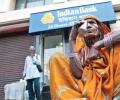
State Bank of India (SBI) is developing an innovative solution to assess the creditworthiness of small businesses lacking GST registration by utilising UPI transaction data. This initiative aims to provide end-to-end digital loans within a day, addressing the financial exclusion of many small enterprises.

The Enforcement Directorate (ED) has informed the Bombay High Court that former liquor baron Vijay Mallya continues to evade Indian law, and the recovery of debts by banks does not absolve him of money laundering charges.

The challenge for India lies in navigating complex landscape to its best advantage. The BRICS Summit will test its navigation skills, asserts former foreign secretary Shyam Saran.

The Enforcement Directorate has arrested Kirshanu Sharda, an alleged middleman for suspended Punjab Police DIG Harcharan Singh Bhullar, in a money laundering case. Sharda is accused of facilitating illegal gratification for Bhullar, with investigations revealing unexplained cash deposits and frozen assets worth over Rs 1.42 crore.

The Enforcement Directorate has arrested Deepesh Bajoria, a principal bookie from Guwahati, in connection with a large-scale money-laundering investigation linked to an illegal T20 cricket-betting syndicate operating during IPL seasons across the Northeast. Bajoria allegedly used online platforms and encrypted channels to facilitate betting, routing over Rs 28 crore through a non-operational firm's bank account.

RBI Deputy Governor S C Murmu stated that the introduction of merchant discount rate (MDR) on UPI transactions is unlikely to cause a shift back to cash, despite some concerns, emphasising that MDR will help the payments ecosystem recover costs.

Potential external candidates include Anup Bagchi, Rajiv Sabharwal and CSB Bank's Pralay Mondal.

Indian benchmark indices, Sensex and Nifty, experienced a significant downturn, with Sensex tanking 778 points and Nifty closing at a five-month low, driven by surging crude oil prices, geopolitical tensions, and fears of further interest rate hikes by major central banks.

The Indian government has introduced a 0.4 per cent Merchant Discount Rate (MDR) on UPI payments exceeding Rs 2,000 made to merchants, effective from October 15, with a comprehensive framework set to take full effect by October 15, 2026. This policy aims to regulate transaction fees while protecting small merchants and person-to-person transactions.

'PowerBank-50 is now space proven, made in India, and ready for every satellite builder in the world.'
State-run Punjab National Bank (PNB) is strategically planning to enter the wealth management segment by early 2027 and significantly expand its credit card portfolio, aiming to tap into lucrative markets largely dominated by private-sector banks.

India's proposal to link BRICS payment systems, including central-bank digital currencies (CBDCs), was notably absent from the grouping's New Delhi Declaration, despite being a key agenda item for India's chairmanship. This omission leaves the 16-year effort for trade in local currencies without a settled payment architecture, with the declaration only 'acknowledging' the work of the BRICS Payment Task Force.

Indian benchmark indices, Sensex and Nifty, ended marginally lower after recovering from sharp intraday losses, driven by cooling crude oil prices and buying interest in HDFC Bank and IT sector stocks.
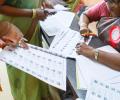
Former RBI Governor Bimal Jalan, ex-IAF Chief NAK Browne, and other prominent figures in Delhi have received notices regarding discrepancies in their voter details during the ongoing Special Summary Revision (SIR) of the electoral rolls. Over 33 lakh electors have been identified for such notices, with a deadline of September 30 for responses.

Congress leader Rahul Gandhi has accused the Modi government of quietly paving the way for imposing fees on UPI transactions, alleging it's a surrender to American pressure. The government's recent notification exempts charges only up to Rs 2,000, sparking concerns that higher value transactions and eventually all UPI payments could incur fees. Finance Minister Nirmala Sitharaman, however, clarified that Merchant Discount Rate (MDR) applies to merchants, not customers, and supports digital infrastructure.

The Indian government has introduced a 0.4 per cent charge on UPI payments exceeding Rs 2,000 made to merchants, with a cap of Rs 300 for transactions of Rs 75,000 and above. This policy shift ends the zero-MDR regime, which was previously criticised by financial institutions. While essential sectors and capital markets have specific fee structures, small merchants with monthly UPI QR code earnings up to Rs 1 lakh remain exempt. Person-to-person transfers are unaffected, and measures are in place to prevent merchants from passing these costs to customers.

A high-level committee, including representatives from banks and payment associations, is set to decide on Merchant Discount Rate (MDR) for UPI transactions exceeding Rs 2,000 to merchants. While person-to-person and person-to-merchant transactions up to Rs 2,000 remain free, the move follows a recent amendment to the Payment and Settlement Systems Act, sparking debate and clarification from the Finance Minister that only certain high-value merchant transactions might incur charges.

Within days of the RBI's letter to Tata Sons that its CIC deregistration application had been rejected, the regulator filed a caveat in the Bombay High Court so that it could be heard before any order is passed on the matter in case there's a petition challenging its listing directive.

The Congress party has criticised the government's recent notification regarding UPI transactions, alleging it paves the way for users to be charged fees, particularly for transactions above Rs 2,000. The party claims the government lacks transparency and questions if the move is to benefit American firms. The government, however, states that charges are necessary for the system's sustainability and infrastructure upgrades, with the Finance Minister clarifying that Merchant Discount Rate (MDR) applies to merchants, not customers.
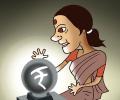
The Reserve Bank of India (RBI) has endorsed the introduction of a Merchant Discount Rate (MDR) on UPI transactions exceeding Rs 2,000, effective October 15. This move, which levies a 0.4 per cent fee on merchant payments above the threshold, aims to bolster the long-term sustainability and growth of India's digital payments ecosystem. The RBI clarified that person-to-person (P2P) transactions and small person-to-merchant (P2M) payments below Rs 2,000 will remain free for users, ensuring no direct charge on customers.
Indian benchmark indices Sensex and Nifty ended flat on Tuesday, with the Sensex dipping nearly 70 points, as investor sentiment turned cautious ahead of crucial global central bank policy meetings and a significant sell-off in Asian markets.

The Reserve Bank of India (RBI) has rejected Tata Sons' application to surrender its non-banking finance company (NBFC) licence, a decision that mandates a public markets listing for the conglomerate's holding company as it is classified as an upper-layer NBFC.

The Indian government has mandated that banks and payment providers cannot levy charges on UPI transactions up to Rs 2,000 or on payments made via RuPay debit cards. This directive follows an amendment to the Payment and Settlement Systems Act, 2007, aiming to sustain and expand the digital payments ecosystem.

Indian benchmark indices, Sensex and Nifty, closed higher on Thursday, breaking a three-day losing streak, driven by late buying in financial heavyweights like HDFC Bank and Axis Bank, despite persistent geopolitical tensions and crude oil prices exceeding USD 100 per barrel.

Indian benchmark indices Sensex and Nifty saw a rebound in early trade, driven by a moderation in crude oil prices, despite persistent selling by Foreign Institutional Investors (FIIs) and mixed global market cues.

Indian benchmark equity indices, Sensex and Nifty, rallied in early trade, driven by positive global market trends and easing crude oil prices, despite the US Federal Reserve's hawkish stance tempering overall sentiment. Track Sensex, Nifty on September 18.

'This rise in foreign exchange reserves was expected given the amount of FCNR(B) flow.'

India's foreign exchange reserves have surged by a record USD 44.903 billion to a new lifetime high of USD 785.706 billion for the week ended September 4, driven by the Reserve Bank of India's concessional forex swap initiatives.

The CBI has registered a case against USA-based Christian missionary group The Timothy Initiative (TTI) and its associates for allegedly misusing Rs 92.55 crore in foreign funds for missionary activities, violating the Foreign Contribution (Regulation) Act, 2010. The case, based on a Union Home Ministry complaint and ED investigation, highlights the alleged use of foreign debit cards and attempts to conceal identities.

Indian stock market benchmark indices Sensex and Nifty recorded their second consecutive day of decline, with the Sensex dropping 555.23 points and the Nifty falling 144.05 points, primarily due to rising crude oil prices and ongoing US-Iran hostilities in West Asia.

Indian benchmark indices Sensex and Nifty opened higher, extending gains from the previous session, driven by a rally in global markets and a slight cooling in crude oil prices. Optimism around a potential meeting between US and Iranian presidents also contributed to positive sentiment.Later both indices pared gains and were trading in red. Track Sensex, Nifty on September 22.

The Congress party has criticised the government's new 0.4% charge on UPI transactions above Rs 2,000 for merchants, terming it a "Modi tax". Opposition leaders, including Rahul Gandhi and Mallikarjun Kharge, allege that this move will ultimately burden consumers through price hikes and accuse the government of succumbing to American pressure to dilute India's zero-MDR policy. The government states the charge will support banks and fintechs.

Shimla Police have seized assets worth Rs 4.13 crore from 19 drug traffickers and their associates, believed to be acquired through illegal drug trade. The action followed an arrest in August 2026, leading to a detailed financial investigation under the NDPS Act. This seizure is part of a larger effort in 2026, where assets worth Rs 12.52 crore have been confiscated in 15 NDPS cases.

Hospital chain Fortis Healthcare has filed a special leave petition in the Supreme Court against a Delhi High Court order directing a forensic audit into the alleged erosion of assets by its former promoters, Malvinder and Shivinder Singh, during enforcement proceedings initiated by Japanese drugmaker Daiichi Sankyo.

Can't afford the new iPhone 18 Pro in that very tempting burgundy shade? We're facing the same tragedy. But before you start taking out a personal loan for a phone, may we suggest a more financially sensible alternative? Wear the colour instead.
