
American online major Amazon seems to be almost doubling its India investment going by the company's recent announcement during Prime Minister Narendra Modi's state visit to the US. From the time the Seattle-headquartered company started its India journey in 2013, its investment into the country is pegged at $11 billion or roughly $1.1 billion a year. By committing a fresh round of $15 billion by 2030, the Jeff Bezos-founded company's investment would go up to more than $2 billion a year over the next seven years.

During a sale, many store windows invite the shopper with impossible-to-miss visuals announcing '50% Discount'. Only upon entering does the shopper realises that the one rack which fulfils this promise sells items she'd never purchase.
In 2013, weeks after getting bail in a case of alleged cheating in Kerala, Amway India's then managing director, William Scott Pinckney, declared that the company was aiming to hit revenues of Rs 10,000 crore in India in a decade. Fast forward to 2021, and Milind Pant, Amway's global CEO, announced that the company has designated India as one among the top three markets for growth and investment (after US and China), and is now looking at hitting revenues of Rs 20,000 crore over the long term.

It is the season of cooking and baking, but with Amul Butter in short supply, consumers aren't like the cat that got the cream. A shortage only means market shelves without butter on them. "There is a supply-side deficit. "We are now able to procure only two packs of butter a day, as opposed to three packs (each containing 30 packets of butter) in a day," says a salesman at Modern Bazaar, a departmental store in New Delhi's Greater Kailash.

At the 45th Annual General Meeting of Reliance Industries (RIL) in August, chairman and managing director (CMD) Mukesh Ambani described the company as an "unputdownable book" with never-ending chapters of success. "Reliance grew from strength to strength because we internalised the founder's mindset of purpose, philosophy and passion," he said. Wednesday marked the 90th birth anniversary of RIL founder Dhirubhai Ambani.

Britannia's foreign presence is low; share of global operations to total revenues is just 5-8%.

A few days ago, Reliance Retail surprised the market by acquiring the Campa brand from Delhi-based Pure Drinks Ltd for Rs 22 crore. A successful cola brand in the eighties, especially in North India, Campa Cola thrived when Coke exited India in the late seventies. When the Atlanta-based major returned and PepsiCo set base in India, it went down fighting.

India, or at least Indian economy, seems to be shining bright like never before.

As new, modern shopping centres come up in more than 100 cities across the country, shoppers of all strata will happily desert the congested, filthy and shopper-convenience-unfriendly traditional markets in those cities.

One of the most important implications will be on account of a rapid increase of women in the workforce in the coming years, leading to an unprecedented economic and social empowerment for them and thereby a dramatic redefinition of their roles and influence.

It will be a sad day when most of India will shop only inside enclosed, characterless shopping malls.

Why strategic initiatives should be taken based more on a vision and entrepreneurial "gut-based" decision process in India, writes Arvind Singhal

There are no easy solutions except that MBA colleges have to reinvent themselves and their programmes immediately before they add more capacity, and all new aspirants for an MBA programme should keep in mind that an MBA degree from even a high-ranking institute may not translate into a dream job in the near future!

India has just about 5,500 ITIs and 1,745 polytechnics, compared to 500,000 similar institutes in China.

Wistron, which earlier pegged the losses at Rs 437 crore, later notified the Taiwan stock exchange that the total losses were around Rs 50 crore.

There is a pressing need for developing high-calibre talent focused on 'Food & Agriculture' technology and management.

India first needs to innovate the solution itself, and then focus on the product.

Organised players have been the biggest beneficiaries after the lockdowns were lifted. Given real estate is not as expensive now, players want to take advantage of the trend.
There is obvious competition at the front-end, but cash-and-carry will benefit the kirana as well, apart from the impact on supply chain and agriculture.

Despite the failure of most e-commerce players to meet orders through the first week of the lockdown, there has been no serious crisis, thanks to supplies from 11 million small kirana and mom-and-pop stores across the country with the support of over 300,000 distributors and wholesalers.

Real estate experts say rentals have corrected by 5-10 per cent across formats, including office, retail and housing, with a pick-up expected over the next few quarters as the economy recovers.

Among the options being weighed are discounts on existing rentals, short-term deferrals, and 50 per cent waivers.

Patanjali Ayurved's rise has prompted most other babas to go back to the drawing board. Most of them are either scripting or re-jigging their business plans, says Arvind Singhal.

A deal, where a founder has brought back stake from early investors before an initial public offering, is unheard of in India or pretty much anywhere else, analysts pointed out.

Kataria, 49, an IIT-XLRI alumnus, was quick to implement a number of initiatives during the Covid-19 crisis including launching D2C initiatives such as mobile stores, WhatsApp messaging, video calling and home deliveries. Kataria was also swift to recognise that stay-at-home consumers were keen to buy informal rather than formal footwear, launching new collections quickly to take advantage of this trend, says Viveat Susan Pinto.
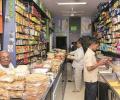
The power of the small neighbourhood retailer can barely be ignored as organised players look to leverage their last-mile connectivity and reach, luring them by promising support in technology, inventory and tax management.

While festive season spends by consumers did contribute to the uptick seen in Q3, experts said greater aggression displayed by retailers to corner a larger share of the shopper's wallet also worked.

The sale of Nature's Basket, Godrej's chain of food stores in west India, is the second exit by a big group in a year in the category

Reliance has around 100 Delight stores in the country.

Online retail in the country is expected to grow to $200 billion by 2026, up from $15 billion in 2016.

As part of this strategy, the e-commerce major has launched a programme to manage the entire business-to-business inventory supply and management for kirana stores in three cities in Karnataka.

Saks sells luxury brands such as Jimmy Choo, Giorgio Armani, and Tod's, besides premium brands such as Fila and Puma.

Ola Cabs acquires TaxiForSure in $200-mn deal.

From auto, refrigerator, and mobile handset makers to real estate firms, companies are tying up with banks to dole out attractive finance schemes and discounts to make buying more affordable.

Besides malls and high-street stores, there's a rush of discounts while you are flying or holidaying in fancy hotels.

The company's Indian operation, a joint venture with Tata Global Beverages, has got a new CEO.

As much as 20 per cent of the gross merchandise value (GMV) of sales made on e-commerce platforms is being financed through the no-cost EMI route, up from 4-5 pc two years ago.
 © 2026 Rediff.com - Advertise with us - Disclaimer - Privacy Policy - Sitemap - Feedback - About us - Terms of use - Grievances