
Prime Minister Narendra Modi on Tuesday said India will become the growth engine for the world in the coming years, and the ease of doing business has improved with "mission-mode" reforms being undertaken by his government. Speaking at the BRICS Business Forum Leaders' Dialogue in Johannesburg, Modi also said India soon will become a $5 trillion economy.

The economy may grow by around 7 per cent this financial year as estimated by the Monetary Policy Committee (MPC) of the Reserve Bank of India (RBI), say economists with various organisations. The first advance estimates for 2023-24 will be released on Friday by the National Statistical Organisation (NSO), an exercise done for calculating ratios such as the fiscal deficit. The interim Budget will be presented on February 1.

'The role reversal of those in favour of GST and those opposing it is troubling.'

States are apprehensive of losing their rights to raise revenue during emergencies.

The government should scrap the windfall profit tax on domestically produced crude oil as the levy is adversely impacting the capex-intensive exploration of oil and gas, the industry said in its recommendation for the forthcoming annual Budget. India first imposed windfall profit taxes on July 1, joining a growing number of nations that tax super normal profits of energy companies. At that time, a Rs 23,250 per tonne ($40 per barrel) windfall profit tax on domestic crude production was levied.
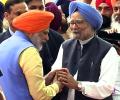
Whether it was the MGNREGS or the NFSA or the Aadhaar-based DBT scheme for cash transfer, the Modi government has built on the basic architecture created by the Singh government. Policy makers in the Modi government, instead of discarding them as products of the previous political regime, worked on them, expanded their scope and reach, and used new tools to improve their performance, explains A K Bhattacharya.
Congress preparing a dissent note on the issue
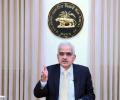
The challenge for the RBI in 2024 is likely to be less about containing elevated inflation and more about curbing excessive financial market exuberance and a 'problem of plenty', notes Sajjid Chinoy, Chief India Economist JP Morgan.

Strong gains in Vedanta Ltd, Adani Ports, Bharti Airtel and Maruti Suzuki helped the index touch record levels.

They will hold discussions on the requirement of a constitution amendment bill for rolling out the proposed GST, which is all set to miss even the revised deadline of April one, 2011.

The challenges before the government, he said, is to put public sector banks back on track and continue to operationalise stalled infrastructure projects

Arvind Subramanian will hold classes for a week on applied economics at IIT Delhi

Criticising various provisions in the proposed GST regime, Moily said it will be a "technological nightmare" and the anti-profiteering provisions in it are "far too draconian."

He said it was not only a tax reform but 'is a measure that lends strength to the new culture of honesty'.

Apple Inc has announced the India prices of the new variants of its bestselling smartphones - launched on Tuesday - as it assembles the device in the country. The new iPhone 15 range starts at Rs 79,900 for the 128 GB variant (the same price as the iPhone 14 when it was launched last year) and goes up to Rs 199,900 for the top-end Pro Max with a 6.7 inch screen and 1 TB (terabyte) storage. The world's most valuable company also launched three new upgraded Apple watches, starting with the SE at Rs 29,900 and going up to Ultra 2 at Rs 89,900.

'In a country like ours, people talk about wanting to be like Singapore, but when it comes to paying taxes, they start criticising.' 'The medicine is bitter, but the long term effect is good,' Senthil Natarajan, who runs Kovai Pazamudhir Nilayam, a one of its kind fruit and vegetable chain in Tamil Nadu, tells Rediff.com's Archana Masih.

Experts said the slowdown could be attributed to adjustments leading to destocking and the offering of discounts by companies as the government ushered in the new indirect taxation system on July 1.

The Rajya Sabha on Wednesday took up the four bills related to the GST, with the Opposition urging the government to insulate taxpayers from harassment and questioning how the new regime was "ideal" when 40 per cent of the revenue base of the GDP was kept out of its purview.
Top Congress sources said they would not hold up the Bill.

The most important lesson is that you have to build your political proposition, and sell it yourself. You can't leave it to the courts, media, NGOs and civil society and expect them to play the role of the Opposition. That's precisely what Mr Modi's challengers have been doing and we know the results, notes Shekhar Gupta.
In a first, Opposition-ruled states on Saturday got the Centre to delete from the records three minutes of the last GST Council meeting that provided for tweaking of agreed criteria for division of taxpayers under the Goods and Service Tax regime.

'The RBI is not releasing Rs 2,000 notes for the last 10 days; probably they have stopped printing it.'

The move will help address apprehensions as well as potential disputes on various computational and transitional issues such as the loss of input credits and pricing that were bound to arise on account of the change.

As wholesalers largely failed to meet GST norms, companies were in a fix. According to industry veterans like Sunil Duggal, chief executive of Dabur, the hazard led many to look beyond third-party distribution and take the leap to cover unattended markets directly.

'If because of El Nino, the monsoon is affected adversely in the current year, naturally it will affect income projections and consequently Budget numbers.'

Being mandatory, these recommendations will have to be immediately built into the Budget for 2015-16.
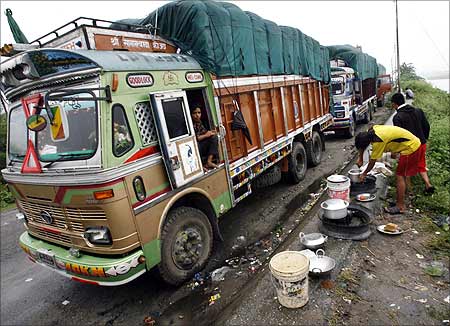
A strong proponent of the GST, Adi Godrej has been saying for five years or more that it will add one per cent to India's gross domestic product (GDP).

Their favourite alternatives: Malaysia, Vietnam and the Philippines. Note, India is missing from that list. And this is despite an attractive financial incentive scheme for OSAT players. The reason, said a senior executive of a US chip company who had a meeting in Taiwan just a few weeks ago, is that "they want more predictability in government policy because they plan to put in big money."

The Congress filed a dissent note on eight provisions.

Some also demanded empowering of local bodies.

The Central Sales Tax is imposed by the Centre but revenue goes to the states.

This growth seen by the consumer goods was led mainly by the durables market, which rose 17.6%, the highest in 11 months

Moody's has a 'positive' outlook on its 'Baa3' rating on India.
As many as 267 of 453 companies from the BSE500 index are trading above their consensus price targets, according to the data compiled by Bloomberg. Not all companies in the BSE500 index are tracked by analysts.

Rishi Piparaiya lists three simple steps to manage the impact of rising prices and protect your financial future

'Those who are starving need not go to watch the match'

'Modi had not discussed demonetization with me prior to his announcement on 8 November 2016. 'I learnt of it along with the rest of the country. 'I was not surprised when he did not discuss the issue with me prior to making the public announcement. 'It fitted in with his style of making dramatic announcements.' A fascinating excerpt from Pranab Mukherjee's The Presidential Years: 2012-2017.

The finance ministry is looking at a reworked proposal from mobile device makers on how to fight the rampant and growing smuggling of very high end phones. The proposal suggests reducing the basic customs duty (BCD) on phones which have a CIF (cost, insurance and freight or price at landing in the port) value of over Rs 35,000-Rs 40,000. The retail value of these phones is upwards of Rs 70,000.

The cement sector may be looking at better realisations and higher volume offtake going by the trends of the October-December quarter of the 2022-23 financial year (Q3FY23), a recent price hike, and the promise of a continued infrastructure thrust in FY24. In Q3, revenues rose by an aggregate of 17 per cent year-on-year (YoY), but Ebitda (earnings before interest, tax, depreciation and amortisation) per tonne, fell by 14 per cent YoY while profit after tax (PAT) rose by 23 per cent YoY. Expenses were up 30 per cent per tonne YoY - power and fuel costs in particular - and that's no surprise given the rise in fossil fuel prices.

Finance Minister Arun Jaitley appealed to parties to rise above partisan considerations to support it.
 © 2026 Rediff.com - Advertise with us - Disclaimer - Privacy Policy - Sitemap - Feedback - About us - Terms of use - Grievances