United States Charge d'Affaires Natalie Baker on Wednesday met Deputy Prime Minister and Foreign Minister Ishaq Dar as part of efforts to de-escalate tensions with India following the Pahalgam terror attack on April 22 in which 26 people were killed.

'The digital age has forced diplomats to be less formal and more accessible, reaching out to ordinary people both within and outside their countries, combining statecraft with streetcraft,' says former foreign secretary Ambassador Shyam Saran.

Their shared brief: To assert India's case with clarity, rebut hostile narratives, and secure enduring partnerships for global counter-terror cooperation.
'Unfortunately, India and Pakistan could learn a 'lesson' from this conflict that will make them more likely to use these weapons against each other in the future.' 'Rounds of missile and drone attacks could be more routine features of their hostility, just like artillery fire has become a familiar fact of life along the Line of Control.'
'I said, fellas, come on, let's make a deal, let's do some trading, let's not trade nuclear missiles, let's trade the things that you make so beautifully, and they both have very powerful leaders, very strong leaders, smart leaders, and it all stopped.'

Tirumurti said India 'has been in touch with all concerned parties. It is our considered view that the issue can only be resolved through diplomatic dialogue.'

UN Secretary-General Antnio Guterres expressed concern over the heightened tensions between India and Pakistan, calling for maximum restraint and urging both countries to step back from the brink. Guterres offered his "good offices" to both governments in the service of peace and condemned the recent terror attack in Pahalgam, emphasizing the need to bring those responsible to justice. He also stressed that a military confrontation would be detrimental and could easily spin out of control. His remarks came hours before a closed consultation of the UN Security Council on the matter, requested by Pakistan. The UN Secretary-General highlighted the need for de-escalation, diplomacy, and a renewed commitment to peace.
Tharoor had earlier criticised India's stance when Russia attacked Ukraine and called for condemnation of the aggression.
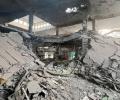
'I am worried that Pakistan will still feel compelled to take substantive military action beyond this apparent drone activity.' 'If so, the crisis could persist for a while more and dangerous days are still ahead.'
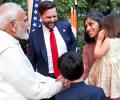
Prime Minister Narendra Modi and US Vice President JD Vance have expressed satisfaction with the progress made in negotiations for a bilateral trade agreement. The two leaders met in New Delhi and discussed a range of bilateral issues, including cooperation in energy, defense, strategic technologies, and other areas. They also exchanged views on regional and global issues of mutual interest.
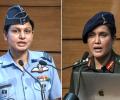
India conducted precision strikes on nine terror targets in Pakistan and Pakistan-Occupied Kashmir, targeting terrorist infrastructure to deter further attacks. The operation, codenamed 'Operation Sindoor', was detailed by two women military officers, Col Sofiya Qureshi and Wing Commander Vyomika Singh, at a press briefing in New Delhi. The officers highlighted the precise nature of the strikes, emphasizing the use of "niche technology weapons" to ensure no collateral damage. The briefing showcased India's military prowess and the growing role of women in the armed forces.

India on Saturday said it was deeply concerned over the 'evolving escalation' in West Asia and urged all sides to exercise restraint and return to the path of dialogue and diplomacy.
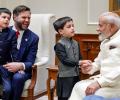
US Vice President JD Vance described the evolving US-India relationship as a family-like bond that transcends diplomacy, highlighting how his children have become fond of Prime Minister Narendra Modi during their trip to India. Vance shared a heartfelt account of his family's experience, revealing the significance of personal connections in strengthening bilateral ties. He said his three kids have developed rapport with both President Donald Trump and Modi, with Modi's warm reception and gestures impressing the family. Vance also spoke about the hospitality he received from Modi, including a dinner at his residence, and his wife Usha Vance's surprising celebrity status in India.
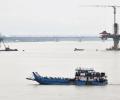
'China could intentionally release excess water.' 'The North East is already flood-prone during the monsoon, and even a controlled release from Chinese dams (during the monsoon) could worsen flooding.'
Congress MP Shashi Tharoor on Saturday (local time) highlighted how India responded in a measured and calibrated manner towards terror bases and headquarters in Pakistan, following the dastardly Pahalgam terror attack in which 26 people were killed.
Foreign Secretary Vikram Misri, who faced trolling on social media in the wake of India and Pakistan reaching an understanding on May 10 to halt all military actions, has received support from veteran diplomat Nirupama Menon Rao, a body of Indian diplomats and a host of politicians from several parties.

Lee Jae-myung's decisive victory in South Korea's snap presidential election marks a major political shift driven by public backlash against authoritarian, with significant implications for domestic reform and the future of the US-South Korea alliance, observes Dr Rajaram Panda.

Pakistan on Thursday said that no back channel diplomacy was going on with India after the neighbouring country refused to send its cricket team for the Champions Trophy

What is foreign policy worth if it stands disconnected from domestic realities? Make no mistake, the horrifying visuals of the human suffering in metropolitan India is only the tip of the iceberg. The vast swathes of the hinterland are heaving with untold sorrows, notes Ambassador M K Bhadrakumar.

'Like me there are crores of Marathi people in the state hoping for this miracle to work.'

The opposition party's attack came after Shashi Tharoor, not part of the four leaders nominated by the Congress, was named as the head of a delegation to key partner countries to convey India's message of zero tolerance against terrorism following Operation Sindoor.
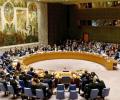
Pakistan was waiting for an opportunity to bring the Jammu and Kashmir issue to the global agenda and resorted to the terrorism route to provoke India, observes Ambassador T P Sreenivasan.
The United Nations Security Council held closed-door consultations on rising tensions between India and Pakistan, with envoys calling for restraint and dialogue. The consultations, requested by Pakistan, lasted for about an hour and a half. UN Secretary-General Antonio Guterres expressed concern over the tensions, urging both countries to avoid a military confrontation. India's former Permanent Representative to the UN, Syed Akbaruddin, said that no consequential outcome could be expected from the discussion.

Chief of Defence Staff (CDS) General Anil Chauhan has highlighted the emergence of space as a new domain of warfare and emphasized the need for developing a "space culture" to prepare for future conflicts. He called for dedicated space warfare schools and research institutions to generate ideas, develop doctrines and strategies, and create new capabilities for space warfare. Chauhan believes that space will be crucial for future warfare, impacting all traditional domains of land, sea, and air. The CDS's remarks were made at the Indian DefSpace Symposium, where he also highlighted the importance of space research and its role in shaping the future of warfare.
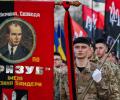
'We will never recognise any part of territories occupied by the Russians.'

Australian Deputy PM Marles to watch India-Australia World Cup cricket final in Ahmedabad
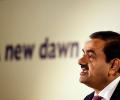
Hindenburg Research, the forensic financial firm that challenged the Adani Group, took its name from the infamous airship that burst into flames upon arriving in New Jersey in 1937. And the counter to its damning report against the conglomerate was dubbed 'Operation Zeppelin,' named after the German dirigible airships used for reconnaissance and bombing during the First World War.

An India-Japan joint statement said the two leaders expressed serious concern over the conflict and the unfolding humanitarian crisis in Ukraine.

'There is no question that Putin's preference will be to avoid unpleasantness with Trump, leave alone a collision course,' observes Ambassador M K Bhadrakumar.

Prime Minister Narendra Modi on Tuesday underlined the need for not promoting any restrictions on the supply of energy and called for ensuring stability while once again emphasising on resolving the Ukraine conflict through diplomacy.

The BJP has lauded the extradition of Tahawwur Rana, a key accused in the 26/11 Mumbai terror attack, as a testament to "New India's" zero-tolerance stance against terrorism under Prime Minister Narendra Modi. However, the Congress has countered the claim, stating that the extradition was the result of diplomatic efforts initiated during the UPA government's tenure. The BJP highlighted Rana's return as a tribute to security personnel who lost their lives fighting Pakistan-sponsored terrorism and a step towards justice for victims of the attack. The Congress, however, asserted that the Modi government did not initiate the extradition process but benefited from the UPA's groundwork. The exchange of accusations has added a political dimension to Rana's extradition, with both parties vying for credit for the development.
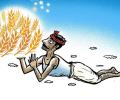
India's policy for agriculture trade must move commodity-by-commodity to gain maximum benefits as US President Donald Trump's 26 per cent tariff on exports from the country take effect, said agriculture economist Ashok Gulati in a recent policy paper.
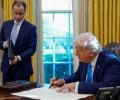
The stage may be set for a recalibrated US-Iran relationship, suggests Ambassador M K Bhadrakumar.

Congress MP Shashi Tharoor has defended his praise for Prime Minister Narendra Modi following his meeting with US President Donald Trump, stating that he spoke with India's interests in mind. Tharoor said that Modi's US visit had yielded some positive outcomes for the Indian people and noted that Modi being the fourth world leader to meet Trump after he took office underscored India's growing importance on the global stage. However, he also pointed out that the visit left some questions unanswered, such as why the issue of how illegal immigrants were returned to India was not addressed. Tharoor also criticized the tendency of political parties to oppose each other reflexively, saying that there has to be some give and take in a democracy.

'If his health was good he would have become CM again after polls.' 'Those who are with Nitish Babu today will remain with him till the elections to use his name for votes and would definitely play games with him after the polls.'

Prime Minister Narendra Modi on Tuesday conveyed to Russian President Vladimir Putin that India stands ready to provide all possible cooperation towards ending the Russia-Ukraine conflict and that dialogue and diplomacy is the only way to bring peace to the region.
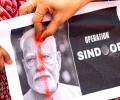
World leaders, including the UN Secretary-General and US President Donald Trump, have urged India and Pakistan to exercise restraint and seek peaceful solutions to the ongoing tensions. The calls for calm come after India conducted airstrikes in Pakistan-occupied Kashmir in response to a recent terrorist attack. Leaders from the US, Russia, UK, China, UAE, Qatar, and Japan have expressed concern over the escalating situation and emphasized the need for dialogue and de-escalation.

The heated exchange between Trump and Zelenskyy and the resulting outpouring of support for the Ukrainian leader highlighted the deep fissures that have emerged between America and Europe over Ukraine.

The PM emphasised that he has himself met leaders of both Russia and Ukraine and also pointed to his 'this is not an era of war' remark that he made in the presence of Russian President Putin.
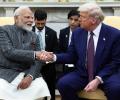
The real intention of the 'Tariff Man' (as Trump calls himself) may not even be to put the 'Tariff King' (as he describes India) on the mat with a knockout punch but to arm-twist the Indian leadership to agree to some multi-billion dollar mega arms deal, argues Ambassador M K Bhadrakumar.
