
China firmly opposes the Trump administration's 50 percent tariffs on India as it is "unfair and unreasonable" and New Delhi and Beijing should scale up economic ties to jointly counter the challenge, Chinese ambassador Xu Feihong said on Monday.

India's exports jumped by 19.37 per cent to $38.13 billion in November, while imports dipped by 1.88 per cent to $62.66 billion, according to government data released on Monday.

New Delhi, while opting not to retaliate yet to the American tariffs, has in recent weeks sought to reinforce its friendship with Moscow, and recalibrate its ties with Beijing rather than surrender to Washington's diktats.

Foreign investors fled Indian equities in 2025 at a scale never seen before, pulling out a record Rs 1.6 lakh crore (USD 18 billion) as volatile currency movements, global trade tensions, especially potential US tariffs, and stretched valuations eroded risk appetite, though flows are expected to turn sustainably positive in 2026.

India has managed high government debt-to-GDP, a slowing domestic revenue engine, lower household savings and a more hostile geopolitical environment separately in the past. But together, they threaten to undo the growth narrative on which today's optimism rests, warns Debashis Basu.

Russian President Vladimir Putin announced his upcoming visit to India in December and expressed his intention to address the trade imbalance between the two countries, particularly concerning India's crude oil imports from Russia. He also lauded India's independent stance on international issues and highlighted the strong relationship between the two nations.

Foreign portfolio investors have started 2026 on a cautious note, extending their selling streak from last year by withdrawing Rs 7,608 crore ($846 million) from Indian equities in the first two trading sessions of January. The withdrawal of funds followed the largest outflow of Rs 1.66 lakh crore ($18.9 billion) recorded in 2025, triggered by volatile currency movements, global trade tensions and concerns over potential US tariffs, and stretched market valuations.
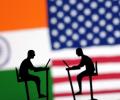
After recording negative growth for two consecutive months, India's merchandise exports to the US rose 22.61 per cent to $6.98 billion in November despite steep 50 per cent tariffs on domestic goods, according to commerce ministry data. Imports during the month grew 38.29 per cent to $5.25 billion, the data showed.

'Only four or five original companies remain; the rest have been replaced every decade as sectors evolve or leadership shifts.' 'Companies that fail to adapt -- like many textile mills from the 1970s and shipping firms from the 1980s -- disappear.' 'Benchmark indices reward those who reinvent themselves in line with economic demands.'

The rupee slumped 5 per cent in 2025 as persistent capital outflows from foreign investors, alongside heightened dollar demand from importers, making it one of the worst-performing Asian currencies.

Equity benchmark indices Sensex and Nifty fell on Friday, extending their downward journey to the third day, as investors continued to reel under pressure caused by the imposition of high tariffs and relentless foreign fund outflows.

US President Donald Trump's announcement of 25 per cent tariff on all goods coming from India starting August 1, plus an unspecified penalty, is expected to impact Apple's plans to expand iPhone manufacturing in India as well as export of other electronics to the US. The move comes at a time when Indian electronics production is reeling under pressure due to restrictions imposed by China on supply of several critical components, capital goods and even skilled technology professionals.

India's micro, small and medium enterprises (MSMEs) - which contribute over 45 per cent to outbound shipments - are facing a major disruption following the United States (US) decision to impose 50 per cent additional tariffs on the country's exports. MSME industry bodies have raised an alarm over the deep impact, seeking immediate government intervention.
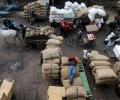
Despite a strong 7.8 per cent growth in the first quarter, the Indian economy is expected to grow at 6.5 per cent in the current financial year as the impact of US tariffs on Indian exports will reduce prospects, particularly in the second half, ADB said on Tuesday.

Indian envoy Vinay Mohan Kwatra discussed fair, balanced and mutually beneficial trade ties with US lawmakers amid ongoing tariff tensions between New Delhi and Washington.
US President Donald Trump has announced a 25 per cent plus tariff on India from Aug 1. Trump, describing India as a "friend", said the US has done relatively "little business" with the country because of its high tariffs.

Among major engagements in 2026 is the visit of the European Union leadership, chief guests at the Republic Day parade.

Economic Advisory Council to the Prime Minister (EAC-PM) member Sanjeev Sanyal on Thursday said he is not concerned about the rupee at all, arguing that even China and Japan witnessed exchange rate weaknesses during their high growth phases.

India was being evaluated for a potential weight of around 1 per cent in the index, an allocation that could have translated into $25 billion of inflows, spread over roughly 10 months.

This is the second-worst performance by the pack during this period over the last five years since CY20.
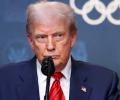
President Trump claims American tariffs imposed on India for purchasing Russian oil have negatively impacted Russia's economy, referring to India as Russia's major oil buyer. He also mentioned plans to meet with Putin and Zelenskyy, and claimed to have solved several wars, including the conflict between India and Pakistan.

India has protected the interest of domestic farmers and MSMEs by not extending any duty concessions on products across several sectors, including agricultural items such as dairy, as well as chocolates, gold, silver, jewellery, footwear, and sports goods, under the trade pact with Oman.

India's manufacturing sector activity eased to a nine-month low in November, mainly owing to softer rise in sales and production amid reports of challenging market conditions, a monthly report said on Monday. The seasonally adjusted HSBC India Manufacturing Purchasing Managers' Index (PMI) falling to 56.6 in November from 59.2 in October, highlighted the slowest improvement in operating conditions since February.

The key question is how much of the latest growth record represents recovery from the 2020-2021 downturn, and what is the sustainable growth rate now, asks T N Ninan.

Under the defence partnership, India and the UAE are eyeing defence industrial collaboration and cooperation in advanced technologies, cyberspace training, special operations, interoperability of their militaries and counter terrorism.

A neutral monetary policy stance, heavy government borrowing, and issuers adjusting to a higher-for-longer yield environment have set the stage for a largely stable corporate bond market in 2026.
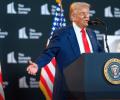
The comments come ahead of Trump's high-profile meeting with Russian President Vladimir Putin, scheduled for Friday in Anchorage, Alaska.

'...a mix of asset classes.' 'Include equities for growth (across market caps), debt for stability and liquidity, gold as a hedge against macro and currency risk, and global assets for geographical and economic diversification.'

The US's recent 50 per cent tariff on Indian exports will have a trickledown effect on India's affordable housing, potentially derailing demand as well as supply in this segment, according to experts. Pointing to worker incomes and jobs in micro, small and medium enterprises (MSMEs), and small and medium enterprises (SMEs) that typically make up majority of the customer base of affordable housing, would take a hit in the near terms due to the tariff change, further crippling India's affordable housing sector, already reeling from the impact of the Covid-19 pandemic.

'The longer India hangs out to dry, the worse the New Delhi-Washington relationship gets.'

The 25 per cent US tariffs, plus a penalty for Russian imports, could dent India's GDP growth by 30 basis points in the current fiscal, but the higher duty is unlikely to significantly affect India's domestic demand-driven economy, Barclays said on Thursday. If the 25 per cent tariff, announced by US President Donald Trump on Wednesday, is implemented from August 1, the effective average US import tariff on Indian goods will rise to 20.6 per cent in trade-weighted terms, as per Barclays estimates.

'Calibrated depreciation will help rebalance external fundamentals, offset some of the tariff differentials with competitors, improve the competitiveness of domestic substitutes vis-a-vis Chinese imports, and contribute to the easing of financial conditions at a time when the inflation rate is unusually low,' explains Sajjid Z Chinoy, head of Asia Economics at JP Morgan.
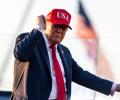
President Trump threatens to impose a 10% tariff on countries aligning with BRICS anti-American policies. This follows BRICS criticism of increased tariffs. Trump also announced tariff letters to various countries.

The Bill is likely to pave the way for amending two existing legislations -- the Atomic Energy Act 1962, and the Civil Liability for Nuclear Damage Act 2010.

'The bigger unknown remains global geopolitics, which is inherently unpredictable, including developments in our neighbourhood.' 'Another concern is the increasing tilt of government finances towards welfare subsidies, especially at the state level.' 'This could constrain capital expenditure, which is critical for long-term growth.'
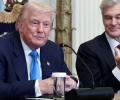
US President Donald Trump announced a deal with Pakistan to develop its oil reserves, suggesting Pakistan might sell oil to India in the future.
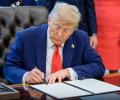
The collective West has always opposed strong leaders and economic development in India, asserts Colonel Anil A Athale (retd).

In their talks, Modi and Merz are likely to deliberate on trade and investment ties as New Delhi is looking at deepening economic engagement with Europe against the backdrop of Washington's 50 percent tariff on Indian goods, people familiar with the matter said.

Vance also hinted that the US may drop additional tariffs on countries if the US make a deal with Russia, and also apply more tariffs on the countries to bring this war to a close.

Commerce Minister Piyush Goyal assures Parliament that India will take necessary steps to protect its national interests following the US announcement of tariffs on Indian goods. The government is assessing the implications and engaging with stakeholders.
 © 2026 Rediff.com - Advertise with us - Disclaimer - Privacy Policy - Sitemap - Feedback - About us - Terms of use - Grievances