

As she looked down at the Thames, she thought of the Brahmaputra. As she landed, smiling, it was clear that flying had never left her.

At 85, Dhira Chaliha Hazarika returned to the cockpit this year -- reminding India how far one woman once flew ahead of her time.
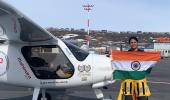
Strapped into an open-cockpit Tiger Moth aircraft, wind rushing past her face as the English countryside stretched below, Dhira Chaliha Hazarika felt something she has known all her life. As the plane lifted off from the White Waltham airfield and traced the River Thames, memories come flooding back -- of green Assam, of the Brahmaputra, of a time when flying meant instinct, courage, and little else.
For Dhira Chaliha Hazarika, this is not nostalgia tourism. It is a return. More than six decades after she first flew solo, Assam's first woman pilot is back where she always belonged: In the sky.
A girl who looked up
Dhira Chaliha grew up in Assam during the years around the Second World War, when aircraft occasionally crossed the skies near the Burma front. Those fleeting shapes overhead planted a fascination that never faded.
She was not inclined to stay within prescribed limits. She climbed trees, played outdoors, and resisted the idea that curiosity and courage were reserved for boys. At home, she had a rare advantage for her time -- encouragement. Her father believed, simply and firmly, that women were capable of anything men could do.
That belief would become her runway.
Learning to fly when flying was hard
Dhira's aviation training began at Borjhar (Gauhati airport, now the Lokpriya Gopinath Bordoloi international airport) in the late 1950s, in an era when flying demanded far more from the pilot than from the machine.
There was no GPS, no digital cockpit, and often no radio contact. Emergency landings were part of routine training. Weather judgement was a skill learned through experience and nerve.
Her instructor, a flight officer from Delhi, trained her for worst-case scenarios -- because in those days, help was not always an option.
Alone in the cockpit
Her first solo flight, from Borjhar to Tezpur in 1961, remains a defining moment. There was no radio communication. No co-pilot. Just a young woman, an aircraft, and her training.
It was exhilarating -- and terrifying.
That flight confirmed what she already suspected: She belonged in the air.
1961: When Assam saw a woman fly
In April 1961, at just 21, Dhira Chaliha earned her Pilot's A Licence, becoming Assam's first woman pilot.
The moment was quietly historic. People gathered at the airfield not for ceremony, but curiosity. An Assamese woman flying an aircraft was something they had never seen before.
She did not make speeches. She did not frame her achievement as rebellion. She simply took off -- and in doing so, expanded what women in the region could imagine for themselves.

The fearlessness people still talk about
Dhira's flying years produced stories that would later grow into legend.
One of the most retold involves her flying close to the pillars of the Saraighat bridge while it was still under construction -- an audacious manoeuvre that reflected absolute confidence in her skill.
There were also moments of intense technical challenge: Battling severe monsoon turbulence, holding the aircraft steady as wind and rain battered it, climbing until she reached the calm air above the storm.
These were not stunts. They were proof of command.
When life changed the flight plan
Dhira worked steadily toward a commercial pilot licence, hoping to turn her passion into a profession. But life, especially for women of her generation, often came with detours.
Marriage to Kamal Hazarika and a move to London interrupted that path. The dream of a full commercial aviation career remained unfinished.
She speaks of it without bitterness. There are no dramatic regrets -- only quiet reflections on the places she might have flown to, the routes she never charted.
What mattered more was this: She never stopped flying.
Flying on her own terms
In the UK, Dhira joined flying clubs and continued to take to the skies. One incident captures her spirit perfectly.
Arriving at a British airfield wearing a traditional mekhela chador, staff assumed the pilot must be her husband. He corrected them. It was his wife who had come to fly.
The moment needed no explanation.
Back in the sky at 85
Her 2025 Tiger Moth flight feels like a full circle. The open cockpit, the exposed wind, the landscape unfolding below -- it all echoed the simplicity of the aircraft she flew in her youth.
As she looked down at the Thames, she thought of the Brahmaputra. As she landed, smiling, it was clear that flying had never left her.
Age had only paused the journey.

Why Dhira Chaliha Hazarika still matters
Dhira Chaliha Hazarika's legacy is not just that she was first.
She challenged assumptions without confrontation. She showed that tradition and ambition could coexist. And she reminded us that dreams do not have expiry dates.
Her return to the cockpit at 85 resonated far beyond aviation circles. Reacting to her flight, Anand Mahindra, chairperson, Mahindra and Mahindra, posted on X: 'She deserves a place in India's Aviation Hall of Fame simply for being a trailblazer. But for flying again at 85, she belongs in a global Hall of Fame for her courage, her resilience, and her life-affirming spirit.'
Long before conversations about representation entered public discourse, Dhira Chaliha Hazarika quietly redrew the horizon.
She did not just fly aircraft. She changed the view from the ground.
Feature Presentation: Aslam Hunani/Rediff







 © 2026