

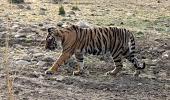
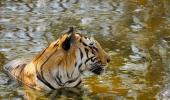
Golden tigers -- also known as strawberry tigers -- owe their pale-gold coats and faint stripes to a rare genetic mutation.

Assam Chief Minister Himanta Biswa Sarma tweeted: 'Majestic Beauty! Kaziranga's Golden Tigers Roar on Global Stage'. Photograph: Kind courtesy Himanta Biswa Sarma/X
The Kaziranga National Park, famed for its rhinos and sweeping grasslands, has once again captured global attention -- this time for its extraordinarily rare golden tigers, whose striking appearance has elevated the park into one of the world's most intriguing tiger habitats.
Inputs from forest officials, wildlife photographers and conservation researchers indicate a renewed surge of interest as these elusive big cats continue to make appearances on camera traps and during safaris.
Golden tigers -- also known as strawberry tigers -- owe their pale-gold coats and faint stripes to a rare genetic mutation.
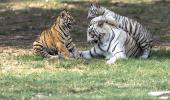
They are so uncommon that National Geographic estimates only around 30 such tigers exist worldwide, making every sighting in Kaziranga nothing short of sensational.
One such sighting that amplified the global buzz came when wildlife photographer Gaurav Ramnarayanan from Coimbatore captured remarkable images of a golden tiger on January 24, 2024, during a safari in Kaziranga.
His photographs, showing the tiger's shimmering coat against the park's dense vegetation, spread rapidly among wildlife communities, reaffirming Kaziranga's reputation as a sanctuary for rare natural wonders.
'A Golden Tiger Sighting Feels Unreal'

Forest officers say they are taken aback when these tigers show up on camera traps.
One official noted, "Even for us, a golden tiger sighting feels unreal. It's a reminder of how much mystery survives in the wild."
Photographers who have seen the animals in person recount the experience with awe.
One described a moment in the grasslands: "It looked like sunlight moving through the tall grass. Only when it turned did I realise it was a tiger -- but glowing."
Conservation experts emphasise that golden tigers are not a separate species.
They are Bengal tigers carrying a recessive gene, and their survival in the wild indicates robust habitat conditions, a strong prey base and well-enforced protection measures inside Kaziranga.
Tourism operators say that curiosity has spiked footfall significantly.
Safari guides report that visitors now ask specifically about the golden tiger, often before mentioning rhinos or the park's well-known population of Bengal tigers.
"People come with a sense of anticipation," one guide said.
"The golden tiger has become a legend here."

However, officials caution that heightened attention must not translate into undue pressure.
The exact zones where these tigers roam are kept under strict confidentiality to prevent disturbance.
Conservation, they insist, remains the first priority.
Kaziranga -- already one of India's most biodiverse landscapes -- now stands out for harbouring not just a thriving tiger population but some of the world's rarest big cat colour variants.
As one researcher put it, "A golden tiger isn't just a visual marvel. It's a symbol of why these forests must be protected -- for the known, and for the extraordinary."
With the wildlife season in full swing, Kaziranga's golden felines are set to keep drawing worldwide fascination, reaffirming Assam's place on the global conservation and wildlife tourism map.
Photographs curated by Manisha Kotian/Rediff
Feature Presentation: Ashish Narsale/Rediff




 © 2026