

'If this region destabilises, then we are not far away. This region should not destabilise.'

Key Points
- Pakistan is deflecting blame for internal security lapses by targeting Afghanistan.
- Pakistan is pressuring the Taliban regime to hand over TTP and Baloch militants.
- Regional destabilisation poses indirect risks to India.
The Tehrik-e-Taliban Pakistan (TTP) has re-emerged as one of the most serious security threats to the Pakistani State.
Its renewed strength is closely linked to the geopolitical upheaval that followed the United States' withdrawal from Afghanistan in August 2021.
What Islamabad once viewed as a controllable militant spillover has now evolved into a direct and escalating challenge to its authority, particularly in Khyber Pakhtunkhwa and the former tribal belt.
The roots of the crisis go back to 9/11. After the September 11, 2001 attacks, the US invaded Afghanistan to dismantle al-Qaeda and remove the Taliban regime that sheltered it.
Although the Taliban government was toppled quickly, the insurgency regrouped across the Afghanistan-Pakistan border and fought American and Afghan forces for two decades.
During this period, several jihadist groups operated in the region, including the TTP, formed in 2007, which targeted the Pakistani State for siding with Washington.
When US forces withdrew in August 2021 and the Taliban swiftly returned to power in Kabul, the regional security balance shifted dramatically.
The Taliban's victory emboldened allied militant networks, including the TTP. Pakistan expected the new Afghan Taliban government to rein in or extradite TTP leaders.
Instead, Kabul has resisted taking decisive action against them.
The Afghan Taliban's reluctance stems from ideological affinity, battlefield ties forged during the anti-US insurgency, and deep tribal linkages across the Durand Line (the border between Afghanistan and Pakistan).
Many TTP fighters had fought alongside the Afghan Taliban. Moving against them risks internal rifts within the Taliban's ranks.
After Pakistan air force jets bombed Kabul and Kandahar on Thursday, February 26, 2026, Syed Firdaus Ashraf/Rediff spoke to Avinash Mohananey, a retired Intelligence Bureau officer who spent a considerable time in Pakistan on security assignments for his assessment of Pakistan's declared 'open war' against Afghanistan.
The concluding segment of two-part interview:
- Part 1 of the Interview: 'Pakistan Treats Afghanistan As Its Province'
What is the reason for Pakistan bombing Kabul now?
Two reasons.
First, the attack in Islamabad on a Shia Imambara by a suspected ISKP (Islamic State – Khorasan Province) bomber. ISKP owned responsibility for the same. The attack raised serious questions on the Pakistan security establishment's capability to prevent such attacks.
Second, the recent attack by the TTP in Khyber Pakhtunkhwa, killing a serving Pakistan army colonel.
For its own failures, Pakistan is now blaming Afghanistan without realising that the Taliban are also fighting the ISKP.
This is not the first time Pakistan has bombed Afghanistan, but the third or fourth time they have done it.
Pakistan can take punitive action, but sadly it is the common citizens of Afghanistan who die in such attacks.
TTP cadres remain unaffected.
What will Pakistan achieve by these attacks?
They are pressuring the Afghan Taliban to accept their terms and conditions for surrendering TTP cadres and suspected Baloch separatists, who Pakistan alleges are based in Afghanistan.
The attack in Islamabad by ISKP has shaken the Pakistan security establishment.
It fears that soon the TTP may also expand its operations in other major cities of Pakistan like Lahore and Karachi.
As of now, the TTP is restricting itself to targets in Khyber Pakhtunkhw, but for sure it has the capability to carry out attacks anywhere in Pakistan.

Can the TTP achieve its goal of implementing Sharia in the FATA region as envisaged by them?
This is their political goal, but right now it seems difficult to achieve the same. However, the TTP has created such a scare that no one travels outside Dera Ismail Khan at night.
The TTP cadres set up check posts to collect money. They have also started giving extortion calls to members of the national assembly.
Aimal Wali Khan, president of the Awami National Party, openly stated at a press conference that the TTP extorts money from rich and powerful people after which his security was withdrawn by the Pakistani establishment. He had to keep mum after that.
The entire region has become lawless.
It suits the Afghan Taliban, but has become difficult for Pakistan to hold that place. The TTP is now even using quadcopters (unmanned aerial vehicles) to hurl bombs at Pakistan army vehicles.
Besides Afghanistan Taliban, who funds the TTP?
There is no concrete proof of that yet. Pakistan has not shared any concrete proof of TTP's presence in Afghanistan. Afghanistan is repeatedly asking for the same.

'The region should not destabilise'
What should India do in such a situation?
If this region destabilises, then we are not far away. This region should not destabilise. Right now, we are not a target of the TTP and this is a well-known fact.
But we are target of the ISKP. If anarchy continues in the region, the ISKP can expand its footprint beyond Afghanistan and Pakistan.
What can one do about the demented and lunatic IKSP?
The problem is that lack of empowerment and scientific education in Pakistan and Afghanistan has strengthened the hands of mullahs and helped spread religious extremism.
Pakistan has used extremist ideology to target neighbours, including India. Governance is essentially secular and one cannot bring religion in it.
In a country with a religious narrative, what else can be expected? Critical thinking is crucially needed in society to prevent fresh recruitment to extremist organisations.
Can Pakistan hold on as a country considering that there is unrest in Balochistan and Khyber Pakhtunkhwa is getting more and more ungovernable?
Yes, it will hold on as a country because there is no one who is interested in entering Pakistan and separating Balochistan from it.
It is true that Balochistan does not want to stay in Pakistan, but who will liberate Balochistan? It has a border with Iran and Afghanistan and both these countries have their own problems.
'Pakistan can only disintegrate if any external power intervenes'
Can Pakistan disintegrate as a nation now due to this war with Afghanistan?
No, because the borders are still with the Pakistan army. The Pakistan army will not let it disintegrate so easily. Pakistan can only disintegrate if any external power intervenes.

How long will this situation go on?
Right now, both countries, Afghanistan and Pakistan, are under undemocratic autocrats. I don't think rationality can prevail in such a situation.
The Taliban have no electoral base. They didn't hold elections after coming to power in 2021. So, there is no democracy. The country is being ruled by religious diktats.
On the Pakistan side, the same thing is happening. The Pakistan army manipulated the 2024 elections. Pakistan army chief Field Marshal Asim Munir is giving extensions to himself by forcing the government to pass constitutional amendments.
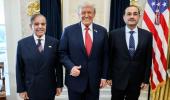
Right now he has extended his term to 2030. The government of Pakistan led by Prime Minister Shehbaz Sharif is at the mercy of the Pakistan army.
His brother, former Pakistan prime minister Nawaz Sharif, lost the elections from both the seats he contested, but the Pakistan army ensured that he wins at least from one seat.
So, the civilian set up lacks legitimacy. Besides, the civilian side has very small elbow room to manoeuvre in Pakistan.
So, I don't think any rationality donning on either side for a permanent cease-fire.
Feature Presentation: Aslam Hunani/Rediff




 © 2026