

Where Dhurandhar leaned into aggressive bloodlust through its acerbic storytelling, Ikkis moves in the opposite direction, asking us to see people beyond uniforms, slogans, or sides, observes Mayur Sanap.

When a soldier dies in a war, they often get reduced to a number on a casualty list. We may not remember their face or their name, only that they were part of the fight.
Films have always been interested in presenting the heroic lore on screen and that has paved a genre of its own.
In that sense, a biopic about a war hero might sound like familiar territory, or even predictable (Case in point, the recent 120 Bahadur).
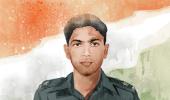
Director Sriram Raghavan moves away from his usual thrillers and presents a tale of heroism in Ikkis that honours Second Lieutenant Arun Khetarpal, the youngest recepient of the Param Vir Chakra, India's highest award for gallantry in war.
Raghavan, along with his long-time collaborators writers Arijit Biswas and Pooja Ladha Surti (Badlapur, Andhadhun, Merry Christmas), presents a stirring biopic but it is't just about grand heroics.
This is a respectful biopic to Khetarpal, whose courage and tragedy at a tender age is reflected in the film’s powerful title.
Ikkis rises above expectations as we see the templated material of a war hero biopic tell an important film of our times.
The film keeps the focus on the human cost of war and what is lost every time violence is normalised.
This sensitive take stands opposite to the tone Aditya Dhar's Dhurandhar set earlier.
Where Dhurandhar leaned into aggressive bloodlust through its acerbic storytelling, Ikkis moves in the opposite direction, asking us to see people beyond uniforms, slogans, or sides.
The film handles the nationalism with restraint, and without unjustly vilifying the opposite side in its firmly pro-humanity stand. It refuses to depict Pakistan and its people as this irrecoverable monster, much like Meghna Gulzar's Raazi.
The point Ikkis makes is honest and direct: War takes more than it gives.
The emotional impact of the film deepens once you realise this isn't a writer's invention. It's a true story, shaped by real people who actually lived through this history.
The film places Dharmendra at the centre of its core message, and for a film about lost hero, the final performance of the Bollywood legend enhances the emotional weight of the film.
He plays Arun's father Brigadier M L Khetarpal.
The year is 2001.
Brigadier Khetarpal travels to Pakistan for a three-day visit to relive old memories of his lost home and people, which he had been separated from after migrating to India during Partition.
He is hosted by Brigadier Khwaja Mohammed Naseer (Jaideep Ahlawat), an officer in the Pakistan army.
In one of the film's most striking moments, Naseer speaks with genuine sorrow and respect for Arun Khetarpal's bravery.
He admits that he was the one who killed him in the 1971 India-Pakistan war.
What could have been a moment of bitterness turns into a rare human connection that rises above the idea of enemies.
The word 'enemy' is also used with quiet impact in the film.
Naseer tells Brigadier Khetarpal, 'Arun dushman ko harana chahta tha.'
Brigadier Khetarpal asks, 'Kaun dushman?'
This one line reframes everything.
He is away from his homeland on the opposite side of the border, where he finds warmth, generosity, and shared memories in the neighbouring country. The film pushes to tap into our sensitive side as it gently asks us: Are we really that different from each other at all?
What's also interesting is that Raghavan doesn't miss his usual little film-nerd touches, along with his familiar love for the Pune city, where Arun Khetarpal spent his time as a cadet at the National Defence Academy.
These details come in the tender moments between Arun and Kiran, played beautifully by a luminous Simar Bhatia, who sets herself as a talent to watch out for.
From wandering through old cafes to catching Rajesh Khanna's Aradhana at a single-screen theatre, surrounded by hand-painted film posters, the film lets you soak in the nostalgic vibe of the bygone era.
The only hiccup comes with the generic songs and their odd placement in the narrative that frequently breaks the momentum.
The film gathers in intensity and force in the brutal war moments as the Indian Army lurches into Pakistan with their tanks.
Raghavan shows his calibre for directing warfare without going overboard in its depiction of violence.
It also helps that the film is technically sound.
Agastya Nanda's naturally innocent eyes capture Arun's eagerness and excitement about joining the army.
Those same eyes are equally powerful as they emanate fury as the film traces his journey from a young cadet to a hardened soldier.
These action scenes are certainly exciting, but it is the quieter moments where Ikkis makes the point that war-is-hell no matter what side you are on.
The film can also be seen as a companion piece to Maddock's earlier military drama Sky Force.
In Sky Force, Akshay Kumar's character travels to Pakistan to uncover the truth about a fellow officer, a fictionalised take on Maha Vir Chakra hero Ajjamada Boppayya Devayya.
Seen side by side, the two films share the same premise, told from different perspectives.
War is hell may not be a new message, but it is one worth repeating and Raghavan states it powerfully here.
This could easily have stood out as one of the year's better films had it released on its originally planned Christmas date. Still, Ikkis starts the 2026 movie calendar on a positive note.
Ikkis Review Rediff Rating:









 © 2026