

120 Bahadur is underwhelming, adding little fresh perspective and feeling like a standard war drama we have seen umpteen times before, notes Mayur Sanap.

We already know war is hell. Is there anything new left to say about its futility?
So many Bollywood films have reinforced this thought over the years with masala-laden storytelling. Perhaps it's the built-in appeal of such stories that continues to draw filmmakers to the genre.
120 Bahadur tells the tale of soldiers fighting bravely until their last breath. The story is reminiscent of Akshay Kumar's Kesari, and even J P Dutta's Paltan.
Here, the narrative is built around the Battle of Rezang La, a significant chapter in the India-China War of 1962.
This is an inherently strong story, and much of its appeal comes from the deeply moving human element at the core of it. But despite its sincerity and good intentions, the familiar treatment prevents 120 Bahadur from offering much in the way of surprise or wonder.
The film focuses on Major Shaitan Singh, a recipient of the Param Vir Chakra, who led 120 soldiers of the Indian Army's Charlie Company as they defended a strategic mountain pass in Ladakh against a much larger Chinese force.
120 Bahadur opens with Chinese troops steadily pushing into Indian territory, an act which Amitabh Bachchan's resonant voiceover describes as 'vishwasghat' to the India-China dynamics of the 1960s.
For a change, the opposing side isn't the khol-eyed, janaab-uttering adversaries, offering a more intense showdown.
As tensions in the valley rise, Major Shaitan Singh realises his men are vastly outnumbered by the Chinese troops.
He leads his 120 brave soldiers into the freezing Himalayan heights, ready to face an intense battle.
Despite the strong emotional pull of the story and earnest performances at its centre, there's something a bit too obvious and ultimately underwhelming about 120 Bahadur.
The entire first half is spent on the introduction of characters and build-up to the big battle. You already know the whys and hows, so the interest lies more in the way the events play out rather than the events themselves.
This is where the film starts to lean too heavily on all-too-familiar beats.
A significant portion of Farhan's character development is conveyed through his life back home in Rajasthan with intermittent flashbacks.
It shows his relationship with his loving wife, Shagun (Raashii Khanna), who understands that, for her husband, the nation always comes first. At one point, she even states firmly, 'Woh desh ke sipahi pehle hain.'
To establish their bond, the film also includes the customary romantic song, which resembles an extended tourism montage for Rajasthan.
Raashii does her best to bring nuance to her restrained role, but there is only so much she can do within the limited space of what is credited as a 'special appearance'.
The other soldier characters receive minimal backstory, and the little that is included leans more on cliched doses of sentimentality than any genuine depth.
However, some of these scenes still work.
One of the most affecting sequences shows the soldiers breaking into the song Yaad Aate Hain as they reminisce about their families and their longing for home. It's a tender stretch that adds emotional warmth to their characters.
Another standout moment involves debutant Sparsh Walia, who plays a young soldier fearful of war. He gets a strong redemption arc in the climax, where he finally finds his courage in a well-crafted moment. The newbie makes his mark, proving he is someone to look out for in the future.
Director Razneesh Ghai repeats the action strengths of his earlier film Dhaakad, keeping the film brisk and visually sharp.
120 Bahadur is technically impressive, with long one-shot sequences and hand-to-hand combat that capture the gritty realism of the battlefield.
It's also good to see the director avoiding excessive gore, despite the film dealing with a violent subject.
The biggest gripe about 120 Bahadur is, unexpectedly, Farhan Akhtar.
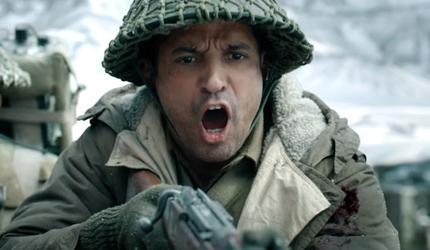
Despite being a consistently reliable performer, he feels unusually stiff in the role of a soldier. He gets the physicality and attitude right, but never fully inhabits the character.
His first appearance is striking: A dead-eyed stare at the enemy, a bullet grazing his ear, and yet he remains unflinching.
'Shaitan naam aisa hi thodi hain,' a fellow soldier remarks in admiration.
It's a strong introduction, but as the film unfolds, it becomes clear that Farhan is more effective in silent expressions than in delivering dialogue. It ends up feeling more like a big acting showcase than a performance with a real visceral impact.
In one light-hearted moment, his name, Shaitan, draws good-natured jokes from his soldiers, who guess if he was a mischievous child or if a teacher gave him the nickname. The Major just smiles at their guesses.
The name takes on new meaning in the climactic battle, where even the enemy senses the ferocity of the Indian soldiers, proclaiming that they seem 'possessed by the devil'.
By the time we reach the climax, there's a poignant moment where the soldiers look straight at the camera with gentle smiles, as if watching from above.
The plaintive music adds to the sombre mood and heightens the emotion.
It's touching, and in this short silent moment the film finally lands emotionally.
For the most part, though, 120 Bahadur is underwhelming, adding little fresh perspective and generally feeling like a standard war drama we have seen umpteen times before.
120 Bahadur Review Rediff Rating:





 © 2026