

'We are targeting a 2.5x to 3x increase in valuation by FY31.'

Key Points
- 'My first focus as I take over is to ensure that our existing businesses are brought closer to their full potential.'
- 'The primary focus over the next few years will be on building scale and capability within our existing businesses rather than launching too many new ones.'
- 'What we don't lack is opportunity, because sectors which we are operating in -- FMCG, real estate, and financial services -- are all massive sectors with tremendous headroom for growth.'
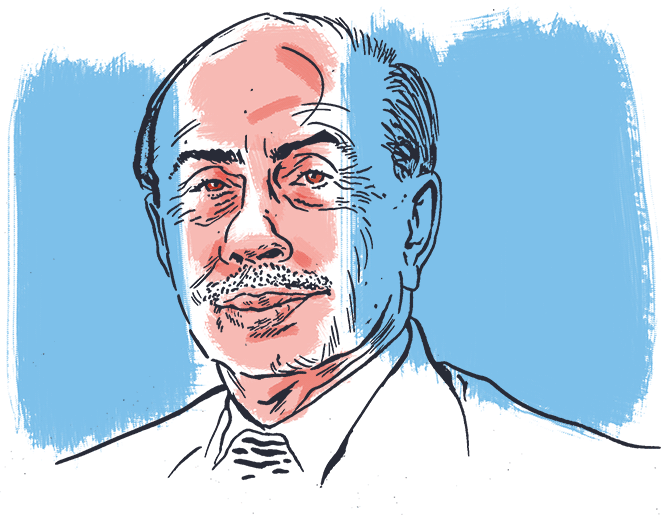
Pirojsha Godrej will take over as chairman of the Godrej Industries group in August following his uncle Nadir Godrej's retirement .
In an exclusive interview with Vishal Chhabria and Sharleen D'Souza/Business Standard, Pirojsha Godrej discusses his vision for the group.
What will be your first priority, and how do you plan to steer the group into new-age sectors -- where it is widely seen as having limited presence -- while staying true to its identity?
My first focus as I take over is to ensure that our existing businesses are brought closer to their full potential.
I don't want to open up too many new fronts until we are confident that the current businesses are reaching that potential.
We've seen a lot of progress in recent years. For example, the business I've been most closely associated with throughout my career has been Godrej Properties.
Over the past three years, it has consistently been the country's number one developer by residential sales and has also diversified significantly geographically.
It is now the number one or number two player in each of the top five markets.
I believe this same focus on growth and ambition across all our group companies is one of our key aspirations.
We have also entered new sectors, such as financial services, where we are doing extensive work, particularly on the technology side, to build a digital- and AI-first business.
In that venture, I think we are seeing strong success. For instance, we became the fastest financial services company to reach Rs 25,000 crore in AUM, achieving this within about four -and-a-half years of launching the business.
Our goal now is to reach about Rs 100,000 crore in AUM over the next five years.
We already have bold and ambitious plans across the portfolio. Frankly, what we don't lack is opportunity, because sectors which we are operating in -- FMCG, real estate, and financial services -- are all massive sectors with tremendous headroom for growth.
Financial services, in particular, also offers opportunities to expand into additional verticals beyond the lending business we are currently focused on.
So the focus will be on strengthening these businesses and exploring adjacencies that make strategic sense, as we have done in recent years.
Our company, Godrej Ventures, is entering two new business lines: Film studios and managed office spaces. These are new ventures for the group, and some are still relatively new to the country.
However, to be perfectly frank, the primary focus over the next few years will be on building scale and capability within our existing businesses rather than launching too many new ones.
Have you mapped out a five-year plan for the group, and are any future listings on the horizon?
On the financial side, we have a stated ambition to become Rs 5 trillion market-cap group. Today, the group has three publicly listed businesses and three private ones.
The listed companies are Godrej Consumer Products, Godrej Properties and Godrej Agrovet, while the unlisted businesses are Godrej Capital, Godrej Chemicals and Godrej Ventures.
Of course, there are other companies within the group, but they are subsidiaries of these six core businesses.
For example, the small listed company Astec LifeSciences is a subsidiary of Godrej Agrovet.
As of March 31, the combined market capitalisation of the listed businesses was around Rs 170,000 crore.
Reaching the target would require a roughly 2.5x to 3x increase in valuation. The unlisted businesses would also add a small value.
Overall, we are targeting a 2.5x to 3x increase in valuation by FY31.
There is nothing we can announce with clarity right now. However, we are open to exploring the structure that makes the most sense.
Over the medium term, our goal is to list all large operating businesses. At the same time, we would prefer not to have subscale listed entities such as Astec.
That could lead to some restructuring, but nothing has been finalised yet. One of our goals over the next five years is to expand from three listed platforms to five, one of which I expect will be in financial services.
Before the past five years, the group's companies delivered strong compound annual growth rate (CAGR) and stock market returns. But growth has slowed in the past five years, and most group stocks have underperformed their benchmarks.
How do you plan to turn that around?
That's not correct -- the operational growth has not slowed down. In fact, it has accelerated significantly over the past five years.
Across these six (core) businesses combined, sales have grown at a CAGR of 20 per cent, while net profit has also grown at a CAGR of 20 per cent.
Much of that growth has been driven by Godrej Properties on one hand and Godrej Capital on the other.
As you rightly pointed out, however, we have seen significant stock market disruption over the last couple of years, especially in the past couple months due to the global situation.
The stock price performance has been weak, but we do not believe there is any operational reason for that.
In fact, we bought back 5 per cent of the company in Godrej Properties from the market, largely in the last quarter, reflecting our confidence that this will turn around.
Since its initial public offering in 2010, Godrej Properties has seen five instances where the stock price corrected by 45 per cent or more.
The average one-year return following those lows has been over 100 per cent, while the average three-year return has exceeded 200 per cent.
So we are confident that the stock price will eventually reflect the company's strong operational performance.
The business's operations -- whether in sales, profits, or cash flows -- have all compounded at between 30 per cent and 40 per cent over the past several years.
While we believe the stock price may have been somewhat inflated a few years ago, we now see deep value that we expect will be reflected in the near future.
We also want to ensure that the future is even brighter than where we are today.
As part of this effort, we have laid out a five-year ambition for ourselves, covering financial metrics as well as other parameters.

'No major change in terms of family allocation'
How will the work be divided between you and your siblings?
There'll be no major change. I already directly chair three of the six businesses -- Godrej Properties, Godrej Capital and Godrej Ventures.
My sister Nisaba has been involved throughout her career with Godrej Consumer Products. She has done a fantastic job in bringing it to its current position of strength and has been closely involved in key innovations, R&D, and initiatives launched over the years.
She will continue to chair that business. I sit on the board and remain involved in key strategic decision, but she will clearly continue to oversee it.
Godrej Agrovet has been chaired by my uncle Nadir. His son Burjis, who has been in the group for five-seven years, was trained at Harvard Business School, and has also gained experience as CEO of Astec Lifesciences, one of the businesses under Godrej Agrovet.
He took over a company that was in a difficult, loss-making situation and has been able to bring it to near break-even.
He understands the agri business well. He will now be taking over as chair of that business, and I will support him in any way I can.
The only other change is in our chemicals business, which was also reporting to my uncle Nadir, and will now be reporting to me.
So there is no major change in terms of family allocation. My uncle was overseeing two businesses, and I will now oversee one of those in addition to my existing responsibilities.
When the split happened, there was no acrimony among family members. Many families go through similar transitions. What advice would you give them to ensure a smooth transition?
We were very grateful and proud that we were able to do it in the right spirit and in keeping with the Godrej values that were instilled in us from a very young age.
It was an emotional experience, both personally and professionally.
Families have to keep the interests of the business front and centre and try to be as fair as possible.
If you are in a 50-50 situation but try to keep 70 per cent for yourself, you will probably neither get that 70 per cent nor have a happy family.
I think we were able to approach it through a lens of fairness and equality, and we genuinely felt that this was best for both the business and the family.
So far, I think that has proven true. At the family level, relationships remain strong.
I have even been on holiday with some of my cousins from the other side since then.
Any minor irritation that may have existed around business matters has faded because everyone is now focused on their own thing.
On the business side, I think it has created much greater agility and reduced the need for internal alignment.
So I would say the key is to approach such situations with a spirit of fairness, be reasonable, and neither let yourself be run over nor try to run over anyone else.
We are dealing with the West Asia crisis and there are headwinds in terms of input costs -- along with indirect pressures on Indian businesses. How do you plan to steer the group through this period?
This is obviously a very serious situation. Our base case is still that the peace talks succeed over the next few weeks, allowing the crisis to gradually subside and conditions to return to normal.
If that happens, as we expect, we do not foresee any major impact. For example, we have not made any changes to the businesses' annual operating plans, on the assumption that this is a situation we can absorb if it is resolved within the next few weeks.
Of course, if we are wrong and the situation persists for six months, 12 months, or longer, oil prices could rise significantly.
There are forecasts suggesting levels of $150 or even $200 per barrel, though we believe those projections are probably overdone.
If you look at previous shocks, such as the Russian-Ukraine war, oil prices did spike sharply but eventually adjusted and came down considerably.
Even in a prolonged scenario, we believe some of these extreme forecasts are unlikely because higher prices would bring additional supply online from sources that were not viable at $50-$60 per barrel but become viable at $80-$90 per barrel.
That said, if such extreme scenarios do materialise, they would clearly have a serious impact across businesses. At present, some businesses are seeing temporary tailwinds.
For example, oil palm, which is a bio-substitute for oil and gas, has benefited from the situation, and some of our chemicals businesses have also seen product prices increase.
At the same time, input costs have risen in areas such as construction and FMCG. So it is still a little early to draw definitive conclusions.
Broadly speaking, if the situation is resolved within the next couple of weeks, we expect only a minor, temporary impact with no meaningful effect on annual plans.
If it continues, worsens, or becomes more prolonged, we will, of course, have to reassess.
'NRI sales are part of our overall business'
Do you see any specific impact on the properties business, given the sharp hit to NRI wealth right now?
It's interesting. There are two arguments. It's too soon to tell the first answer, but there are two arguments on this.
One is what you just said, which is that it's a disruption -- people may have insecurities about their jobs and may therefore be more cautious.
The flip side is whether the West Asia just looks less attractive to Indians as a destination, and whether people may want to come back to India and therefore need to buy homes here and have the ability to afford them.
So how those two factors play out and which one is the bigger driver, I think it is too soon to tell.
NRI sales are a meaningful part of our overall business, but at the same time not a very large share.
Typically, NRI sales contribute between 10 per cent and 15 per cent of our total sales.
Maybe half of that is linked to the Middle East and half to other geographies, so overall it could be a 5 per cent to 7 per cent exposure.
First of all, that will not all go away, and we also do not know whether demand from people choosing to be in India might actually create some upside.
I think it remains to be seen. What we have seen so far is that in the first half of March, we saw no impact on sales at all.
In the last 10 days or so, when it did not resolve as quickly as people had expected, there has been a bit of a wait-and-watch attitude developing.
We do think the last week of March would probably have seen another Rs 1,000 crore in sales had this disruption not happened.
That said, last quarter was still our best-ever sales quarter. We have strong plans for this year. So I think it goes back to my earlier comment: If this ends now, I do not think there will be any impact on demand.
If it continues and you see interest rates going up, oil prices remaining elevated, and some insecurity around jobs, then of course it could have an impact.
Feature Presentation: Aslam Hunani/Rediff



