
The Allahabad High Court has rejected an application to implead goddess Radha Rani as a party in the Mathura Krishna Janmabhoomi-Shahi Idgah title dispute. The court ruled that puranic illustrations are considered hearsay evidence and the applicant failed to provide concrete evidence supporting the claim of joint ownership.
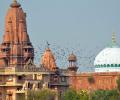
The Supreme Court on Friday rejected a plea challenging an Allahabad high court order dismissing a PIL seeking a direction to the Uttar Pradesh government to acquire the Krishna Janmabhoomi Janmasthan at Mathura and hand it over to the Hindus for worshipping Lord Krishna.
The Supreme Court refused to stay Allahabad high court's December 14 order which allowed the primary survey of the Shahi Idgah complex adjacent to the Shri Krishna Janmabhoomi Temple in Uttar Pradesh's Mathura by a court-monitored three-member team of advocate commissioners.

The Supreme Court on Friday refused to stay the proceedings before the Allahabad high court on suits related to the Sri Krishna Janambhoomi-Shahi Idgah dispute, saying it will not be fair to interfere with the high court order without hearing both the sides.
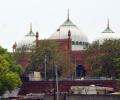
The court said the modalities of the survey will be discussed at the next hearing on December 18.

During the hearing on Tuesday, the bench said it has not received the information from the high court yet.

A bench of Justices Sanjiv Khanna and Dipankar Datta stayed the implementation of the December 14, 2023, order by which it had agreed to the appointment of a court commissioner to oversee the survey of the mosque premises which, the Hindu side claims, hold signs suggesting that it was a temple once. However, the apex court made it clear that proceedings before the high court in the dispute including the maintainability of the suit under Order 7 Rule 11 of the Civil Procedure Code (CPC) will continue.

Both green and golden coloured dresses were prepared for Ram Lalla.
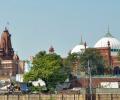
The Allahabad high court Thursday directed the lower court concerned to decide within four months the temporary injunction application as well as a plea for bunching together the trial in all pending cases related to the Shri Krishna Janmabhoomi-Shahi Idgah mosque dispute.
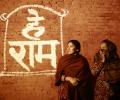
The senior advocate had on Tuesday told the court that the birth place of Lord Ram is also a deity and Muslims cannot claim right over the 2.77-acre disputed land in Ayodhya as any division of the property would amount to "destruction" and "mutilation" of the deity itself.
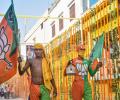
Prior to the function, the prime minister will take part in 'pooja' and 'darshan' at Hanumangarhi, a statement by the PMO said on Tuesday.
'People should see it as a victory for India.'
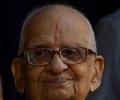
The government on Wednesday named nine out of 15 members of the 'Shri Ram Janambhoomi Teertha Kshetra' trust constituted for the construction of Ram temple in Ayodhya as mandated by the Supreme Court. Here's all you need to know about the members of the trust who have been named so far.
The plaintiffs had filed a suit in the lower court which had observed that they didn't have the right to sue.
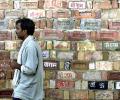
These images of deities on pillars of the structure are not found in mosques and found in temples, the counsel for the deity told SC.
The Akhil Bharatiya Tirath Purohit Mahasabha and the Mathur Chaturved Parishad pleaded to be made respondents in the case. They said the suit for the removal of the mosque should not be allowed as it is detrimental to communal harmony in the country, according to their counsels.

The senior advocate had represented the Muslim parties, including the Uttar Pradesh Sunni Central Waqf Board, in the case in trial court, Allahabad High Court and the Supreme Court.

They might have been fighting in the courts for ages to stake their respective claims over the much-debated Ram Janmbhoomi-Babri Masjid site in Ayodhya, but the rivals have heartily welcomed the view taken by the apex court on the issue.
The Supreme Court's order deferring the Ayodhya verdict title suit by the Allahabad High Court to September 28 has evoked mixed reaction from the litigants of the 60-year-old dispute.
A petition seeking review of one of the judgments in the Ram Janambhoomi-Babri Masjid title suits was on Tuesday filed before the Lucknow bench of the Allahabad high court.
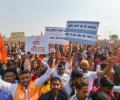
The bench on October 16 had reserved the judgment after marathon hearing of 40 days.

Here is a timeline of the second-lengthiest case in the apex court history:
A five-judge Constitution bench headed by Chief Justice of India Ranjan Gogoi, which started the day-to-day proceedings on August 6 after mediation proceedings failed to find an amicable solution to the vexatious dispute, has revised the deadline for wrapping up the proceedings and has fixed it on October 17.
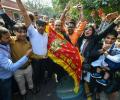
During the hearing, the 92-year-old senior lawyer had told the apex court that it must do 'full and complete justice' in all matters before it and that his last wish before he died was to finish the case.
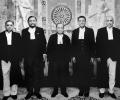
The apex court, which delivered a historic unanimous judgment putting the curtains down on the vexatious legal battle that has torn the social fabric of the nation, said citizens of all faiths, beliefs and creeds 'seeking divine provenance' are both subject to law and equal before law under the Indian Constitution.

The Allahabad high court, in its judgment of 2010 on four civil lawsuits, had partitioned the 2.77-acre disputed land in Ayodhya equally among the three parties -- the Sunni Waqf Board, the Nirmohi Akhara and Ram Lalla.
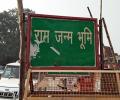
The Law of Limitation provides for mandatory filing of a lawsuit within a fixed statutory time period after the cause of action arises in favour of an aggrieved person.

The bench, which was hearing the politically sensitive case on 34th day, asked Parasaran as to whether 'it has been held that any Hindu temple, including the land has been accorded the juristic personality'.
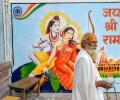
The apex court, which delivered a historic verdict and put the curtains down on the vexatious legal battle that had torn the social fabric of the nation, said that dividing the land would not subserve the interest of either of the parties or secure a lasting sense of peace and tranquillity.
The litigants and their counsels -- altogether over 50 people -- met the three-member mediation panel on the Avadh University premises in Faizabad.
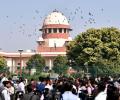
highlights of the Supreme Court judgment in which it unanimously granted the entire 2.77 acre of the disputed Ram Janambhoomi-Babri masjid land in Ayodhya to deity Ram Lalla.
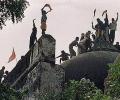
The bench took serious note of the submission of senior advocate Kapil Sibal, appearing for one of the parties, that the appeals be heard in July 2019 after completion of the next Lok Sabha polls as the atmosphere at present was not conducive.

The court then asked Prasaran if question of this nature about birth of a religious figure has ever arisen in any court.
A 5-judge Constitution Bench headed by Chief Justice Ranjan Gogoi, in its historic verdict delivered on a court holiday, held that the lawsuit of the deity was "within the period of limitation" and granted the title decree in its favour.
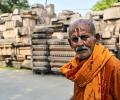
'Gods of different religions haven't warred, so we shouldn't either.'
The bench said after perusing the report, if it came to a conclusion that an amicable solution through mediation was not possible, then the apex court would commence day-to-day hearing in the matter from July 25.

'The locals want a permanent solution to the perennial Mandir-Masjid issue. They have realised political parties will lose relevance if a temple is built.'
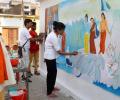
The submissions were made during the eighth day hearing in the case before a bench headed by Chief Justice Ranjan Gogoi.
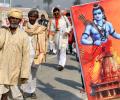
The bench questioned as to how the belief of Hindu worshippers can be challenged with regard to existence of 'janmasthan' and said the "sanctity of belief" that Lord Ram took birth there and whether it was genuine or "frivolous" can only be tested under Hinduism.
'Akahara' apprised a 5-judge Constitution bench, headed by Chief Justice Ranjan Gogoi, of its stand following a direction whether it opposes the plea of the deity in view of the fact that its right as 'shebait' (devotee) over the property can only stand if the lawsuit of 'Ram Lalla Virajman' is allowed.
 © 2026 Rediff.com - Advertise with us - Disclaimer - Privacy Policy - Sitemap - Feedback - About us - Terms of use - Grievances