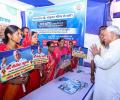
For nearly two decades, Nitish Kumar has cultivated women as a distinct constituency. 'To create a broader vote base, he thought it would be better to bring women to electoral politics.'

The Central Board of Secondary Education (CBSE) has directed schools to establish 'oil boards' to educate students and staff about the dangers of consuming high-fat foods and oils, serving as daily reminders to promote healthier eating habits.
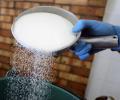
The Union health ministry is urging all ministries and departments to display 'oil and sugar boards' in common areas to raise awareness about hidden fats and sugars in everyday foods and promote healthier lifestyles.

Food budgets in urban areas spent less on protein as compared to beverages and processed foods, reveals the Household Consumption Expenditure survey data for 2023-24.

'Women' as a political constituency appears to be an idea that has come of age. It is changing India in ways that we only dimly understand, asserts Aditi Phadnis.
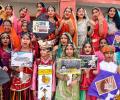
The Bihar government has formed a state-level task force to monitor actions taken by authorities to prevent and eradicate child marriages in the state. Bihar has the second-highest rate of child marriage in India, with 40.8% of women getting married before turning 18. The government is implementing a multipronged strategy to combat child marriage, including stricter enforcement of the law, empowering girls through education, and raising awareness.

The decline in life expectancy was higher among young individuals and those aged 50 to 60.

In India, 11.9 lakh excess deaths occurred in 2020 during the COVID-19 pandemic, 17 per cent higher compared to 2019, an international study has found.

Experts recommend awaiting the findings of the 2021 Census, which is yet to be conducted, before introducing population control policies.
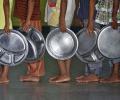
The Global Hunger Index exaggerates the measure of hunger, lacks statistical vigour and has problems on multiple counts, Union Health Ministry sources said.

In the Interim Budget, Finance Minister Nirmala Sitharaman announced that a high power committee would be set up to consider the challenges arising from 'fast population grown and demographic changes.' 'But who wants data? It pays to feed people's fears, insecurities and apprehensions. If such fears don't exist, they must be created,' her husband Parakala Prabhakar says in this fascinating excerpt from his book, The Crooked Timber of New India: Essays on a Republic in Crisis.

'The response from the government using words like malicious, deliberate, etc is diverting from the real issue.' 'The indicators related to young children such as stunting or child mortality are a reflection of the social development in the country.' 'That's how we have to look at it and not ignore the issue by denying the data.'

Using the same methodology as the EAC-PM study, the fastest-growing religious population is, in fact, the Buddhists. The Buddhist population increased by over 1,600 per cent between 1950 and 2015.
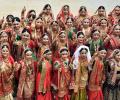
But the report also said that early marriage has been declining over time.

On the heels of the National Family Health Survey-5 (NFHS-5), which revealed new demographic trajectories including the replacement level of fertility, the government will, on Monday, unveil extensive economic data related to health and the broader economy. New data will relate to per capita spending on health and proportions of the GDP to health spending. Health ministry sources said the NFHS-5 marked some areas for celebration but also some markers that should cause concern.

Bihar has fertile grounds for caste to emerge as an electoral issue.

India remains a young nation, but it will not get younger in future. India has not managed to noticeably improve education. Nor has it managed to create employment opportunities, observes Devangshu Datta.

As per the fifth round of the NFHS, there are 1,020 women for every 1,000 men.

'Our study finds that only about 20% of Indians are vegetarians and the rest of the 80% are non-vegetarians or meat-eaters.'

Kerala is likely to witness all-time high liquor sales this Onam, the harvest festival, with the season already reporting a 30 per cent hike. According to the Kerala State Beverages Corporation (BevCo), the first few days of this Onam season have set the tone for record sales. "During last year's Onam season, our sales were around Rs 561 crore. This year, we expect it to be over Rs 700 crore," said Yogesh Gupta, chairman and managing director, BevCo.

A timely phone call to Childline by a 15-year-old girl from a remote village in West Bengal's Purulia district helped the teenager prevent her marriage.

Efforts of the government have been successful in reining in the growth of population, she said in a written reply.

The most common abuse happens in marriages in the confines of one's own home. Be it raising a hand on one's spouse without the slightest provocation, or abusing them without their consent, notes Aarti David.

The opposition has criticised the manner in which the drive against child marriage was being carried out, equating the police action with "terrorising people".

Amid protests in Barak Valley, Morigaon and Dhubri, the crackdown on child marriage in Assam entered the fourth day on Monday, with the number of arrests rising to 2,441.
Experts, however, have raised concern over the decision, saying the move is akin to treating symptoms instead of the underlying causes.

A birthing centre in Bengaluru is helping women make informed decisions about their pregnancy, right down to choosing how they have their baby.

At some stage this fall in the quality of life will begin to hurt anybody's popularity, observes Shekhar Gupta.
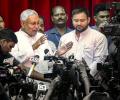
Various indicators make it amply clear that there are grave challenges facing the new government of Chief Minister Nitish Kumar, reports Indivjal Dhasmana.
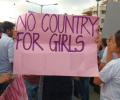
According to NHFS-5, over 75 per cent women justified men beating their wives in three states -- Telangana (84 per cent), Andhra Pradesh (84 per cent) and Karnataka (77 per cent).

Bihar, Jharkhand and Uttar Pradesh have emerged as the poorest states in India, according to Niti Aayog's first Multidimensional Poverty Index (MPI) report. As per the index, 51.91 per cent population of Bihar is poor, followed 42.16 per cent in Jharkhand, 37.79 per cent in Uttar Pradesh. While Madhya Pradesh (36.65 per cent) has been placed fourth in the index, Meghalaya (32.67 per cent) is at the fifth spot. Kerala (0.71 per cent), Goa (3.76 per cent), Sikkim (3.82 per cent), Tamil Nadu (4.89 per cent) and Punjab (5.59 per cent) have registered the lowest poverty across India and are at the bottom of the index.

Uttar Pradesh still remains far behind the Indian average on most health indicators, says Dipa Sinha.

11 states were assessed for access to clean water, energy and sanitation and use of iodised salt.

India has entered a 'demographic sweet spot' with half of its population being under the age of 29. This 'demographic dividend' is likely to last for 2-3 decades and provides the government a unique opportunity to harness the vast potential of India's youth, points out Raj Kishore Mishra, the former civil servant turned development professional.

The supplementary nutrition programme and the Poshan Abhiyaan under the Women and Child Development Ministry has been merged to launch Mission Poshan 2.0 to strengthen nutritional content, delivery, outreach, and outcome, according to the Union Budget announced on Monday.

About 63 per cent women and 82 per cent men said that HIV/AIDS should be taught to both the sexes. Though, 42 per cent women feel the right age should be 16 years, majority of men think the perfect age is 13 to 15 years.
Women from Mumbai top the list of divorcees across the country in 15-49 age group, says a new government survey. "In Mumbai, 0.4 per cent women in 2005-06 have opted for divorce while in Delhi, it is 0.2. Kolkata and Chennai follows with 0.1 and 0.2 per cent respectively," Women and Child development Minister Renuka Chowdhary told Rajya Sabha, citing the National Family Health Survey (NFHS).
The final report of NFHS-III report released on Thursday said married women with no education were 46 per cent more likely to suffer from spousal violence than those having some education.

With India set to be the world's most populous country by 2030, there is a growing need to control population through better use of contraceptives, says Abhishek Waghmare.
The survey of women aged between 20 and 24 years showed that the worst situation is in Jharkhand and Bihar.
 © 2026 Rediff.com - Investor Information - Advertise with us - Disclaimer - Privacy Policy - Sitemap - Feedback - About us - Terms of use - Grievances