
The 4,700 kg GSAT-N2 High-throughput (HTS) satellite has been injected into the desired orbit, NewSpace India Limited (NSIL) said in a series of posts on microblogging site 'X.

The 3,357-kg satellite, which was deployed from the lower passenger position of Ariane-5 launch vehicle (VA 251) into the geostationary transfer orbit, is configured on ISRO's enhanced I-3K Bus structure to provide communication services from Geostationary orbit in C and Ku bands.

INSAT-4A, India's most advanced and powerful communication satellite, has been successfully placed in near geo-synchronous orbit and its solar panels and two antennae have been deployed.
The most advanced and powerful fourth generation communication satellite INSAT 4A was now closer to its space home in geostationary orbit.
All systems on board the satellite were functioning normally.
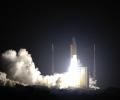
Indian space scientists have received signals of Indian National Satellite-4A.

India's advanced multi-band communication satellite GSAT-7, launched from French Guiana by European space consortium Arianespace's Ariane 5 rocket on August 30, has been successfully placed in the geosynchronous orbit with an altitude of about 36,000 km above earth's surface.
India has nine operational satellites in the high earth orbit geostationary region.
The apogee [farthest point] is 36,000km and the inclination of the orbit with respect to the equatorial plane has been reduced from 7.37 degrees to the present 0.32 degrees,
It will manage the increasing number of satellites ISRO plans to put in the geo-stationary orbit in the next two-three years.

"First orbit raising operation of GSAT-6 was successfully completed by firing the Apogee Motor for 3385 seconds at 8:35 pm IST on August 28," the ISRO said.

The GSAT-31 is a 'high power' communication satellite going to serve and replace some of the satellites that are going to expire soon.

ISRO Chairman K Sivan described the GSAT-11 as the "richest space asset" for India.

It also carries equipment for meteorological data relay and satellite based search and rescue services being provided by earlier INSAT satellites.

In a textbook mission, ISRO's PSLV-C32 lifted off from Sriharikota and later injected the IRNSS-IF in sub-Geosynchronous Transfer Orbit.

The rocket is almost 49 meters high -- as much as a 17-floor building. It weighs 415 tons -- as much as the combined weight of 80 full grown elephants.

A high power satellite, GSAT-15 is being inducted into the INSAT/GSAT system. GSAT-15 carries a total of 24 communication transponders in Ku-band as well as a GPS-Aided GEO Augmented Navigation (GAGAN) payload operating in L1 and L5 bands.
The feat is the second one for the Indian Space Research Organisation scientists in using the indigenously made cryogenic stage after the January 5, 2014 launch of GSLV-D5.

GSAT-18, which aims at providing telecommunications services for the country by strengthening ISRO's current fleet of 14 operational telecom satellites, was launched into a Geosynchronous Transfer Orbit about 32 minutes after the lift-off.

The Indian Space Research Organisation successfully launched India's fifth navigation satellite IRNSS-1E from Sriharikota.

Boosting India's communication services, its latest satellite GSAT-16 was successfully launched on board Arianespace rocket from the spaceport of Kourou in French Guiana in the early hours of Sunday, after a delay of two days due to bad weather.
 © 2026 Rediff.com - Investor Information - Advertise with us - Disclaimer - Privacy Policy - Sitemap - Feedback - About us - Terms of use - Grievances