
BJP MLA Dhirendra Singh has urged the Uttar Pradesh government to formulate a comprehensive policy covering education, healthcare, housing and social security for labourers.

It seems odd to criticise a country for delivering growth rates in standards of living and consumption that have been perhaps the fastest, longest, and most broad-based (affecting hundreds of millions of people) in history, points out Arvind Subramanian.

'Workers are the people who create all the wealth in this country. How can you call them anti-national?'
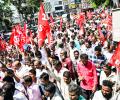
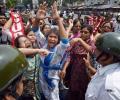
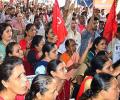
A nationwide strike called by trade unions to protest against the central government's labor policies had a mixed impact across India. While normal life remained largely unaffected in most parts of the country, some sectors like banking, transport, and insurance experienced disruptions. Sporadic incidents of violence were reported in West Bengal.

There is a Trade Union Act and the Industrial Disputes Act but they are not being used in the interest of the workers.
Leaders of major central trade unions on Wednesday made a strong demand before Prime Minister Manmohan Singh for restoring the interest rate on Employees Provident Fund to 12 per cent
No successive government thought of reviving the idea of an exit policy.

We have the workforce, now we need to ensure that we take full advantage of game-changing technologies and geopolitical openings, suggests Jayant Sinha, chairman, Parliament's Standing Committee on Finance.

Militant labour policies compounded a poor security environment for capital in West Bengal and encouraged the business community to relocate. constraining the private sector's right to hire freely could well be the coup de grace. As with Calcutta/Kolkata, it will probably take a decade for Gurgaon/Gurugram to feel the difference, says Kanika Datta.

A joint forum of central trade unions has given a call for a nationwide strike on March 28 and 29, to protest against government policies affecting workers, farmers, and people. The Joint Platform of central trade unions held a meeting in Delhi on March 22, 2022, to take stock of the preparations in various states and sectors for the proposed two-day all India strike on 28-29 March 2022 against "the anti-worker, anti-farmer, anti-people and anti-national policies" of the central government, a statement said. The statement said that roadways, transport workers and electricity workers have decided to join the strike in spite of the impending threat of ESMA (Haryana and Chandigarh, respectively). Financial sectors, including banking and insurance, are joining the strike, it stated.
None of the issues which have been continuously raised by the central trade unions, including unemployment, minimum wages, social security and 14-point charter of demands, were addressed by the minister.

Buses kept off the roads and shops were closed in the state.
Senior Member of Parliament from the Communist Party of India-Marxist Vrinda Karat said workers in the country are at receiving end of Centre's anti-labour policies and promotion of multinational firms.

The four are said to be belonging to the ruling Communist Party of India-Marxist's union outfit -- CITU, one of the 10 trade unions, which were on strike on Wednesday.
The 48-hour nationwide strike called by central trade unions hit normal life across Kerala on Wednesday with workers from varied sectors, including transport and banking, staying away from work to protest the UPA government's economic and labour policies.

"The Embassy urges the Indian expatriate community not to panic based on inaccurate reports published by some sections of the media," an embassy statement said.

The government may have to resort, eventually and however unwillingly, to printing money, abandoned as policy and practice in the 1990, predicts T N Ninan.

These are early reports and situation can change later in the day.
The West Bengal government is mulling amendment of labour laws to prevent strikes on "trivial issues", while also checking unfair labour practices.
Most of the buses run by Telangana State Road Transport Organisation are also off the roads

Liquidity issues post the crisis at DHFL, progress of monsoon, rupee trajectory at the domestic level and oil prices are some factors that will keep markets choppy, analysts say.
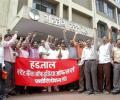
In all, 14 unions representing bank employees and officers will be supporting the day-long stir.
Accusing the labour ministry of "playing hide and seek" with their demands, the bank unions on Tuesday threatened to go on an indefinite strike.\n\n\n\n
About 196 Regional Rural Banks will participate in the nationwide strike called by central trade unions and federation of bank employees on May 21, in protest against the 'anti-labour' policies of government.
Banking operations will be hit for the second time this month on May 21 with employees owing allegiance to various unions going on strike to protest Centre's "anti-labour" policies.
The anti-labour policies of the government will leave the employees in the lurch and take away all their safeguards, says V K Gupta, Delhi convenor of United Forum of Bank Unions.

10 central trade unions have called a nationwide shutdown against 'anti-worker policies' of the central government. Apart from being successful in Bengal, Kerala and NE states, the bandh has also got support from Cong leader Rahul Gandhi and Shiv Sena in Maharashtra.

This whirlwind of activity only confirms that rushing around creating an impression of pompous busy-ness is not the same thing as solving problems, argues Mitali Saran.

A new study shows that the bottom half of the population enjoyed only 15 per cent of national income in 2013-14, down sharply from 24 per cent in the early 1980s.

A more effective promotion of domestic manufacturing and mining could significantly reduce the trade deficit in key sectors, says T N Ninan.

After assuming power in 2014 with a full majority of its own, the BJP-led NDA government started an ambitious process of reforming labour laws in the form of codes aimed at making the framework less cumbersome with a variety of alterations. It had planned four codes each for industrial relations, wages, social security and welfare, and occupational safety, health and working conditions. To this end, 35 central labour laws were to be converted into four codes that would have had the virtue of streamlining labour relations. But none of the proposed code Bills could be converted into a law principally because neither trade unions nor industry representatives came on board. They hold the key to India's low-growth-high unemployment paradigm but the government may struggle to push them through this time as well. Somesh Jha explains why

'The government is sincerely working on employment generation. Unfortunately, they are depending on these people from Harvard. Their wrong policies are killing jobs. The government has to come out of the Western framework on which they depend upon a lot.'

How soon can India reach a point when there is no hidden underemployment and all who want work can find it at a fair wage and decent work conditions, asks Nitin Desai.

Now mergers, acquisitions, sale of assets, fundraising, strategic intent and competitive position in the market are part of business life everywhere.

'With this amendment, permanent employees will cease to exist.' 'The government should give a human touch and human face to labour reforms.' 'Ideas like survival of the fittest, might is right, etc, are rules of the jungle.' 'They cannot give new terms like hire and fire to jungle law.'
The next general election is more than three years away. Yet, the Centre appears to be reluctant to take any bold move that might annoy influential sections of the electorate.

Trade union leaders claimed that the strike would be even bigger than the one last year as the number of striking workers is expected to swell to 18 crore
Ten trade unions with a combined membership of 15 crore workers in public and private sector, including banks and insurance companies, are on a nationwide strike to protest against changes in the labour laws.

'You cannot treat workers like beggars.'
 © 2026 Rediff.com - Advertise with us - Disclaimer - Privacy Policy - Sitemap - Feedback - About us - Terms of use - Grievances