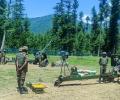
India fully utilised its military modernisation budget in 2024-2025 -- the first time in five years -- and signed a record Rs 2 trillion defence contracts.

The third and final test in the series of landing experiment (LEX-03) was conducted at 07:10 1ST at the Aeronautical Test Range in Chitradurga, Karnataka.

The space agency said the Mission Operations Complex (MOX), located at the ISRO Telemetry, Tracking and Command Network (ISTRAC) in Bengaluru, is buzzing with energy and excitement.

Prime Minister Narendra Modi was accorded a warm reception as he arrived at the Indian Space Research Organisation headquarters in Bengaluru on Saturday morning.

A visibly emotional Modi addressed scientists at the Indian Space Research organisation's command centre in Bengaluru, who were involved in the Chandrayaan-3 mission and lauded them for their efforts.

ISRO on Monday said a two-way communication between the Chandrayaan-2 orbiter and Chandrayaan-3's Lunar Module has been established.

Indian Space Research Oganisation (ISRO) on Sunday said it has successfully performed the first earth-bound manoeuvre of the country's maiden solar mission, Aditya L1, from ISRO Telemetry, Tracking and Command Network (ISTRAC) in Bengaluru.

The next operation - reduction of orbit- will be done at 11 PM on Sunday, ISRO added.

Chandrayaan-3 mission's lander 'Vikram' chose a relatively flat region on the lunar surface to touch down, images captured by its camera showed.
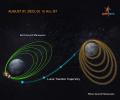
The ISRO had said it would attempt softlanding on the lunar surface on August 23.

Shifting the focus to its next space odyssey after successfully placing a lander on the moon's uncharted South Pole region, the Indian Space Research Organisation (ISRO) chief S Somanath on Saturday said that the country's maiden solar mission Aditya-L1 is ready and will be launched in the first week of September.

About 80 per cent of Indians have a favourable view of Prime Minister Narendra Modi and around seven in 10 Indians believe their country has recently become more influential, according to a survey by the PEW Research Center.

Aditya-L1 is the first Indian space-based observatory that will study the Sun from a halo orbit around the first Sun-Earth Lagrangian point (L1), which is located roughly 1.5 million km from the Earth.

Aditya L1, the first space based Indian mission to study the Sun underwent the second earth-bound manoeuvre successfully, during the early hours on Tuesday, Indian Space Research Organisation (ISRO) said.

'Today onwards, the onboard thrusters will be fired and Chandryaan-3 will be taken away from Earth for an eventful landing on Moon's surface on August 23'

India is now on the Moon and the success of the lunar mission has sounded the bugle for the emergence of a developed nation, Prime Minister Narendra Modi said on Wednesday as Chandrayaan-3 landed successfully on the lunar surface.

August 23, the day the Chandrayaan-3 lander touched down on the lunar surface, would be celebrated as 'National Space Day'.
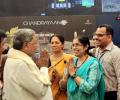
Even as the scientists and staff at Mission Operations Complex broke into applause, the core team members thanked all those who had worked on the mission. Quietly and without jingoistic boasting of their stupendous achievement. And that is the most remarkable aspect of ISRO -- they let their work do the talking, notes Minnie Vaid, author of Those Magnificent Women And Their Flying Machines, ISRO's Mission to Mars.
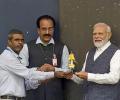
'Perhaps the government should explain how the same scientific temper, which authored a precise landing for Chandrayaan-3, finds the periodic table and the theory of evolution not good enough for inclusion in the educational curriculum,' asserts Shyam G Menon.
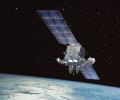
The Indian Space Research Organisation said it successfully carried out an "extremely challenging" controlled re-entry experiment of the decommissioned orbiting Megha-Tropiques-1 (MT-1) satellite.

Skyroot Aerospace has become the first private company in India to give wings to the Indian space programme, after the sector was opened to private players by the Centre in 2020.

'I am extremely excited to be at the ISRO Centre in Bengaluru to witness the extraordinary moment in the history of India's space programme,' Modi tweeted earlier in the day.

Two de-orbit manoeuvres of Vikram Lander, to bring it further down, have been planned to prepare for its landing in the south polar region of the moon.
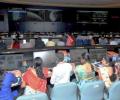
"Progressively, you can imagine that it becomes that much more difficult, with each passing hour, the available power on the battery gets drained out, and there won't be anything left for it to power and operate", an ISRO official said.

An ISRO official said: "Unless and until everything is intact (lander), it's very difficult (to re-establish contact). Chances are less. Only if it had soft-landing, and if all systems functioned, then only communication can be restored. Things are bleak as of now."

The Vikram Moon Lander, named after the father of India's space mission Vikram Sarabhai on his birth centenary year, is scheduled to touch the lunar surface near its south pole on September 7 about 1.55 am.

All spacecraft parameters are normal, the Bengaluru headquartered space agency said after the maneuver on the spacecraft.
There will be two more orbit manoeuvres to make the spacecraft enter into its final orbit passing over the lunar poles at a distance of about 100 km from the Moon's surface.

All spacecraft parameters are normal, the Bengaluru headquartered space agency said after the maneuver.

The Indian Space Research Organisation is gearing up to turn on several probes, a day after the box carrying the Moon Impact Probe, armed with the tricolour, crash-landed on the lunar surface to mark India's presence on the moon.Scientists at ISRO told rediff.com that the groundwork to detach eight other payloads from Chandrayaan-1, in order to conduct further studies on the moon, was underway.

Vikram (with rover 'Pragyan' housed inside) is expected to touch down on the lunar surface on September 7, between 1.30 am and 2.30 am.

Indian Space Research Organisation's plan to soft land Chandrayaan-2's Vikram module on the Lunar surface did not go as per script in the early hours of Saturday, with the lander losing communication with ground stations during its final descent.

The New York Times, The Washington Post, The BBC and The Guardian, among many other leading foreign media outlets, all carried stories on Chandrayaan-2, India's landmark moon mission.

Hours before Chandrayaan-2's 'Vikram' module's proposed soft landing on the Lunar surface, Indian Space Research Organisation chairman K Sivan said on Friday things are progressing as per plan for the much-awaited event.
The Chandrayaan-2 spacecraft is expected to reach the moon's orbit on August 20 and land on lunar surface on September 7.
'We hope one of these days we will get a message that can make us feel very relieved,' Krishna said.
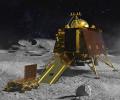
ISRO chairman K Sivan said the proposed soft-landing was going to be a 'terrifying' moment.
.jpg)
India's maiden mission to Mars has traversed beyond the sphere of influence of Earth extending about 9,25,000 km in its 10-month long voyage to the red planet.
Nirmala Sitharaman, Amit Shah, Arvind Kejriwal and Rahul Gandhi also expressed solidarity with ISRO.

Indian Space Research Organisation's Mars Orbiter, which was placed in inter-Mars trajectory in the early hours on Sunday, has crossed Moon's orbit and is travelling beyond Earth's natural satellite.
 © 2026 Rediff.com - Advertise with us - Disclaimer - Privacy Policy - Sitemap - Feedback - About us - Terms of use - Grievances