
The Appointments Committee of Cabinet headed by Prime Minister Manmohan Singh approved Joshi's appointment as Secretary (RAW) for a period of two years or until further orders, whichever is earlier, the order said. Joshi will succeed Sanjeev Tripathi whose tenure ends on December 29.
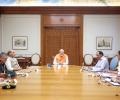
The NSAB is an advisory body that provides inputs to the National Security Council Secretariat.
Senior Indian Police Service officer Alok Joshi will be the new chief of the Research and Analysis Wing and Syed Asif Ibrahim will be the next Director of Intelligence Bureau, the first Muslim to head it with four officers senior to him having been shifted out.

The Supreme Court of India will hear a batch of pleas seeking a probe into the alleged unauthorised use of Pegasus spyware for the surveillance of journalists and others next week. The court had previously ordered a technical panel to investigate the matter but received no reports. Senior advocate Shyam Divan, appearing for some petitioners, urged the court to pass directions as the reports were not shared. The court has now listed the matter for hearing on April 29.
The Supreme Court of India on Tuesday questioned the issue of using "spyware against terrorists" and stated that any report touching upon the country's "security and sovereignty" won't be made public. The court indicated it might address individual concerns regarding privacy breaches, but the report of the technical committee would not be a document for public discussion. The court will examine the extent to which the report can be shared publicly. The court's statement came during a hearing on a petition related to the alleged use of Pegasus spyware for surveillance. The court also emphasized that "having spyware is not wrong, against whom you are using is the question" and that the security of the nation cannot be compromised. The hearing has been adjourned to July 30.

A bench comprising Chief Justice N V Ramana and Justices Surya Kant and Hima Kohli has listed as many as 12 PILs, including the ones filed by Editors Guild of India and veteran journalists N Ram and Sashi Kumar, for hearing on February 23.

The SC, in October last year, had ordered a probe into the alleged use of the spyware.

The Supreme Court-appointed panels probing the unauthorised use of Pegasus found some kind of malware in five mobile phones out of the 29 examined but it could not be concluded that it was due to the Israeli spyware.

The Supreme Court-appointed committees, entrusted with the probe of unauthorised use of Pegasus, have given a slew of recommendations including amending laws to protect citizens' right to privacy and ensure the nation's cyber security.

The media report claiming India bought Pegasus spyware as part of a $2 billion defence deal with Israel in 2017 has triggered a major controversy with the Opposition alleging that the government indulged in illegal snooping that amounted to 'treason'.

Citing national security, the Centre had refused to file a detailed affidavit in the matter.

The committee has shared an online form consisting of 11 questions seeking comments of lay persons until March 31.

The Supreme Court agreed to hear on Friday, instead of Wednesday, a batch of pleas alleging the use of Israeli spyware for surveillance of certain people in India, after taking note of the submissions of the solicitor-general that he would be busy arguing a money-laundering case in another court.
Ten Central Industrial Security Force personnel, including an assistant commandant, were booked on Friday for allegedly thrashing four policemen and kidnapping them in south Mumbai, the police said.
Three experts on cyber security, digital forensics, networks and hardware were roped in by the Supreme Court on Wednesday to "enquire, investigate and determine" whether Pegasus spyware was used for snooping on citizens and their probe would be monitored by former apex court judge R V Raveendran.

The National Security Advisor and Intelligence Bureau chief worked their sources in Saudi Arabia and Syria to persuade the ISIS terrorists to talk to the Indian government.

Ajit Doval is now India's all-powerful security boss. This concentration of power disrupts our layered security system. Will it not weaken whatever remains of the power and authority of the home, defence and finance ministers? asks Shekhar Gupta.
 © 2026 Rediff.com - Advertise with us - Disclaimer - Privacy Policy - Sitemap - Feedback - About us - Terms of use - Grievances