
He's one of the world's top cardiac surgeons and chairman of the Asian Heart Institute, Mumbai.
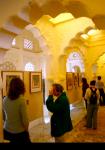
And he is currently sharing one of his passions at an exhibition at Bikaner House in New Delhi.
Dr Ramakanta Panda's unique exhibition, Heartbeats -- Wildlife, Our Shared Future, features a compelling collection of over 200 photographs centred around the theme of wildlife conservation.
Dr Panda hopes these images will shed light on the urgent need for wildlife preservation.
'For me, each photograph is a poignant reminder of the delicate balance between humans and the animal kingdom, highlighting the responsibility we bear for the planet's future. The proceeds from the sale of photographs at the exhibition will go towards wildlife conservation efforts,' said Dr Panda.
The exhibition is open to the public till the evening of September 30.
Dr Panda shares a few images and explains their significance.

'This is a hidden photo. I had to sit all night to take this photo.
'Animals have a very heightened sense of fear at night so they are very careful when they approach a water role.
'Cheetahs, in particular, are vulnerable to attacks from lions, leopards and hyenas.
'You can see the caution and fear on the face of the cheetah.
This picture is especially significant to me because it is extremely rare to see a cheetah come to a waterhole at night.'
Taken at the Ndoto House, Kenya.

'This is a bull elephant in musth; at this time, due to a sharp increase in reproductive hormones and heightened sexuality; they are aggressive and irritable.'
Taken at the Amboseli National Park, Kenya, which is famous for super tuskers.

'A leopard cub trains with its mother.
'The role of a leopard mother in raising her cub is vital and deeply demanding. She is solely responsible for their survival, protection and education in the wild.
'This unusual pose has a special significance. The cub is learning how to kill prey by biting its throat. She's practising the move on her mother.
'I had to wait an entire morning for about five hours before I got this image as the mother and cub were on a tree for a long time.'
Taken at the Naboisho Conservancy, Kenya.

'This cheetah -- her name is Nagol -- had six cubs and lost five of them within a month.
'Cheetah cubs have a very high mortality rate; 90 per cent of the cubs that are born don&'t reach adulthood.
'The Asian Wildlife Trust is supporting the team at th Maasai Mara National Reserve to help protect the cheetahs.'
Taken at the Maasai Mara National Reserve, Kenya.

'Male lions walk at sunrise to patrol their territory and scent-mark boundaries.
'The cooler temperatures make the long walks easier and it's their prime time to detect intruders or threats.
'I love the interplay of golden light and shadow on his face and eyes.'
Taken at the Naboisho Conservancy, Kenya.

'Lionesses from the Rongai pride move their newborn cubs to a different hiding location early in the morning.
'Lion cubs are very vulnerable to being killed by other predators and lionesses frequently change their hiding location.
'It took me one and a half days to get this picture.
'On the first day, the cubs remained in hiding in a bush.
'On the second day, I was lucky to see their mothers taking them on a safari road to a new location.'
Taken at the Maasai Mara National Reserve, Kenya.

'This very low angle, close-up picture of a rhinocerous with two subadult cubs took me two days to capture.'
Taken at the Solio Game Reserve, Kenya.

'Another picture that took me two days to get.
'I was looking for silhouette images of the rhinos in a band of golden sunlight with the interplay of the light at sunset and the clouds above.'
Taken at the Solio Game Reserve, Kenya.

'A night time image of a herd of zebras drinking at a waterhole.
'All herbivores, including zebras, have poor night vision as compared to cats and are more vulnerable. They seek protection in a group.
'I sat for two nights in a hide to get this picture of 11 zebras in perfect symmetry.'
Taken at the Ndoto House, Kenya.

'The white male Asian Paradise Flycatcher brings small insects to his hungry chicks, feeding them gently and carefully.
'He works hard, flying back and forth to find food, helping the female care for the babies.
'The chicks grow quickly and leave the nest in about 12 to 14 days.
'Even after they fly out, the parents still look after them for a few more days, helping them learn to fly and find food on their own.
'It took two years and multiple trips before I got this image of a male with an extra-long tail feeding his babies.'
Taken at Purbasthali, West Bengal.

'The Black-Backed Dwarf Kingfisher, also known as the Oriental Dwarf Kingfisher, is called the jewel of the forest because of its tiny size, brilliant rainbow-like plumage and its secretive presence.
'It prefers to remain deep inside dense forests.
'This image shows it catching a frog to feed its chicks.
]The Black-Backed Dwarf Kingfisher doesn't make nests to lay eggs. Instead, they excavate a long horizontal tunnel -- sometimes up to a meter deep -- in the banks of streams, forest paths or even mud walls.
'At the end of this tunnel lies a small chamber where the female lays three to seven glossy white eggs.
'Both parents share the duties of incubation and later tirelessly bring food to the chicks until they are ready to fly out.
'I am actively involved in helping the local population protecting these nests. In the last five years, we've seen the population of the Black-Backed Dwarf Kingfisher increase.'
Taken at Karnala, Maharashtra.

'After regular visits every morning for a few days, I got this picture of a Black Naped Monarch feeding its chick.
'After hatching, the chicks remain in the nest for about 12 to 14 days. They are fed by the parents until they take their first flight.'
Taken at Karnala, Maharashtra.

'A tigress plays with her cubs, teaching them essential skills.
'Tigers have a special love for water.
'In the heat of the day, they often cool off by lounging in ponds, rivers or forest pools, sometimes spending hours half-submerged.
'Strong swimmers, they can cross wide rivers with ease and even carry prey through water.
'This unique bond with water makes the tiger a powerful hunter on land and a graceful presence in the streams of its jungle home.
'The Umred-Gothangaon Sanctuary has been a stupendous success story; cooperative locals and the forest department have created corridors for free movement of tigers between sanctuaries. This has also helped the local people earn a livelihood though tourism.'
Taken at the Umred-Gothangaon Sanctuary, Maharashtra.

'This is the kind of proud success story that we get to see when the local population is involved in wildlife conservation.
'It is extremely rare for a tigress to give birth to five cubs and even more rare for all of them to survive.'
Taken at the Umred-Gothangaon Sanctuary, Maharashtra.

'The tigress is teaching her cubs to mark their territory.'
Taken at the Umred-Gothangaon Sanctuary, Maharashtra.
Photographs curated by Manisha Kotian/Rediff








 © 2025