
The autonomous satellite swarm is being designed for the Defence Space Agency.
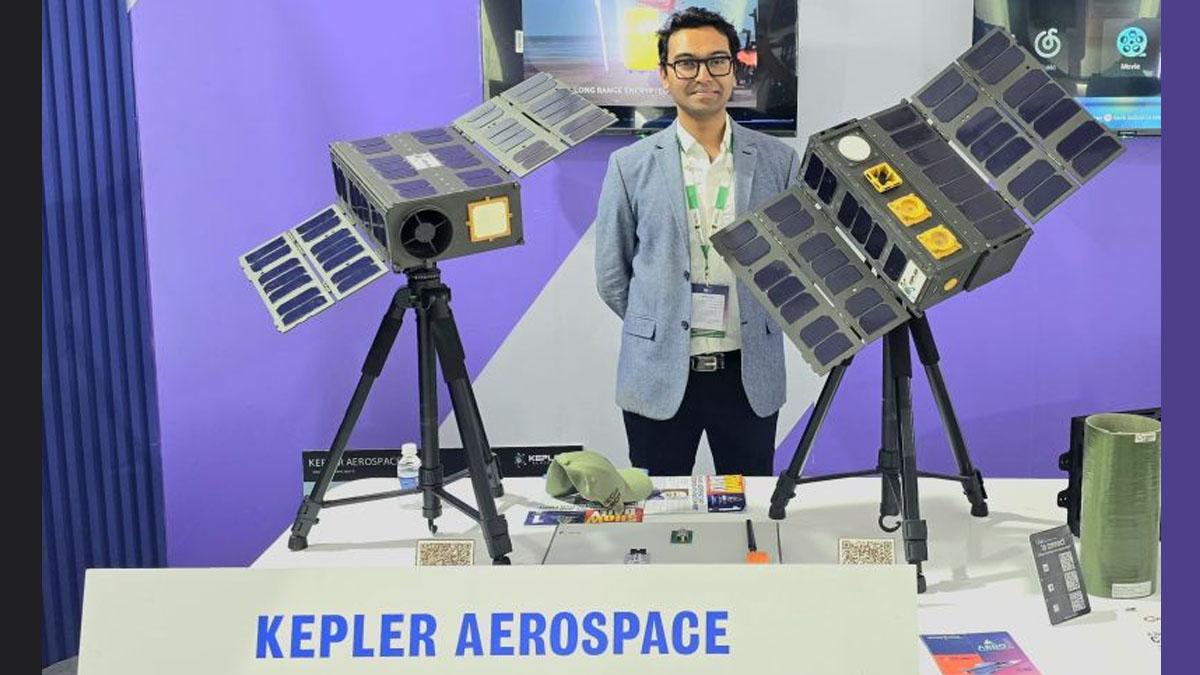
Kepler Aerospace, an Indian space-tech startup, has secured a landmark defence contract to develop the world's first autonomous swarming satellite constellation for intelligence, surveillance, and reconnaissance (ISR).
The project falls under the defence ministry's iDEX (Innovations for Defence Excellence) initiative.
This contract marks a significant leap for the bootstrapped startup, which is now seeking to raise $10 million in venture capital to support the project and fuel its future roadmap.
Under the iDEX agreement, Kepler Aerospace will receive $4 million in government funding and access to launch infrastructure.
The autonomous satellite swarm is being designed for the Defence Space Agency with a targeted launch window in 2027.
"This isn't just satellite development -- it's about redefining India's approach to space-based defence," said Navneet Singh, CEO, Kepler Aerospace.
"We're building an autonomous intelligence system that will transform national security in orbit."
A Breakthrough in Space-Based ISR
Kepler's ISR satellite constellation will feature a novel swarming architecture -- a network of satellites operating autonomously as a coordinated collective. Key innovations include:
Man-independent self-tasking, removing the need for constant human oversight;
AI/ML-based target detection, for faster and smarter threat identification;
Multi-sensor data fusion, spanning the full electromagnetic spectrum;
Real-time swarm coordination, enabling satellites to react instantly to emerging threats.
These satellites will make independent decisions, adapt in real time, and gather multi-domain intelligence -- all without pre-programmed instructions or continuous ground control.
According to Singh, this architecture will serve as the base for two major future capabilities:
Intelligence-as-a-Service (IaaS) platform for commercial geospatial and ISR use.
India's Advanced Distributed Warfighter Data (ADWD) network for next-gen battlefield awareness.
With built-in resilience against Rendezvous Proximity Operations (RPO) and autonomous threat mitigation, the constellation will play a crucial role in enhancing India's space-based defence and strategic intelligence infrastructure.
Advancing India's Space Autonomy
In addition to the defence project, Kepler recently delivered flight-qualified telemetry and telecommand (TMTC) transceivers and GNSS antennas to an Indian satellite customer -- components traditionally sourced from foreign vendors.
"This achievement validates both our technology and the strength of India's emerging space supply chain," said Singh.
The Rs.7.3 crore revenue Kepler Aerospace has also made and sold 50 units of its ultra-light, 10-gram GPS module -- claimed to be the smallest of its kind globally -- and supplies components to satellite operators across the Global South.
Having been bootstrapped to date, Kepler Aerospace is now in early-stage discussions with venture capital firms to raise $10 million.
The funding will help drive the iDEX contract and expand the company's product portfolio.
Singh did not disclose the valuation or equity offered.
Looking ahead, Kepler Aerospace plans to evolve into a vertically integrated space-tech enterprise.
"We're starting with a cubesat, and will move on to larger platforms," Singh said.
With the ISR constellation in development and rising demand for indigenous space solutions, Kepler Aerospace aims to be a key player in shaping India's next wave of space innovation -- where autonomy, intelligence, and defence converge.
Venkatachari Jagannathan can be reached at venkatacharijagannathan@gmail.com
Feature Presentation: Ashish Narsale/Rediff









 © 2025