
Rajinikanth may have made his last Hindi film two decades ago but he can still set the screen alight, blazing away with a gun that has dozens of barrels.
As Thalaiva turns 75 on December 12, Dinesh Raheja looks back at his 17 year journey in Hindi cinema.

At 75, Rajinikanth stands out as a unique cultural phenomenon. Though he has scored his biggest successes in Tamil films, his fame is pan-India.
How many actors can lay claim to a flex like this?
Even Shah Rukh Khan, Deepika Padukone and Yo Yo Honey Singh declared themselves 'Rajini fans' in the Chennai Express (2013) dancefloor smash Lungi Dance which begins with the line: 'This is a tribute to Thalaivar from King Khan.'
On television, a witty play on the megastar's household name was made with the show Bahu Hamari Rajani Kant, which was about a humanoid trying to fit into a joint family. Our ever-inventive colloquial vocabulary has included Rajinikanth as an autonomous title, to be conferred on anyone particularly strong and powerful.
The famous string of Rajinikanth jokes riff on this same legendary prowess.
Popular for over a decades now, these one-liners don't target the star as is the norm but are extremely laudatory instead.
Case in point: 'When Rajinikanth does push-ups, he isn't lifting himself up. He is pushing the earth down.'
Here's another joke: 'Rajinikanth gave Mona Lisa that smile.'
The all-pervasiveness of Rajinikanth's iconic status stems from several factors. As recently as in 2023, he was widely reported to be India's highest paid actor. Not to forget, the Hindi versions of his modern hits like Robot and its sequel 2.0 have also found a ready audience.
Perhaps most significantly, his long (albeit only partly successful) journey in Bollywood films of the '80s and '90s laid the groundwork -- his Hindi films made him a familiar well-liked face all over the country.
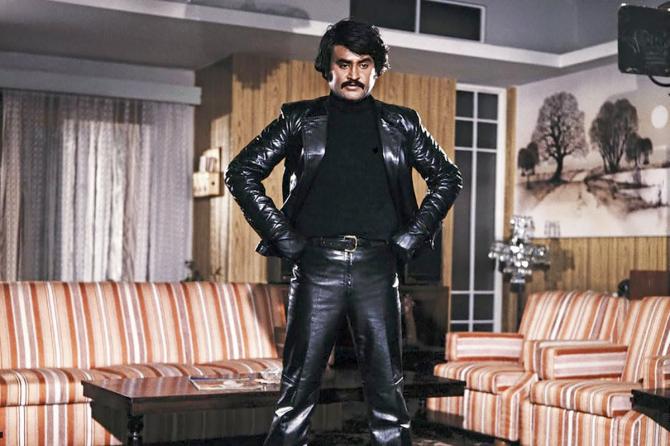
Rajinikanth was 32 and already a major star in South Indian cinema when he made his Hindi film debut with the smash hit Andhaa Kaanoon (1983). Born into a Marathi-speaking family as Shivaji Rao Gaikwad, the actor had clawed his way up the ladder of success, going from bus conductor to saleable star through sheer grit. Rajinikanth applied the same template to Hindi films as well.
Andhaa Kaanoon featured peak-era Amitabh Bachchan in an extended special appearance -- and the senior star cornered a chunk of the glory for the film's success -- but Rajini too found new fans with his highly stylised performance.
He employed every audacious gimmick that had scored him thunderous applause in the south, and which now dazzled Hindi audiences too.
Rajinikanth performed his famous 'flipping the cigarette with his hands and catching it with his teeth' manoeuvre in his very first action scene, 10 minutes into Andhaa Kanoon. The lit cigarette remained in his mouth while he tackled half-a-dozen baddies. He then took a few showy puffs mid-fight before stubbing it out on a vanquished henchman.
Sure enough, Rajini also enacted his well-known sunglasses trick before long, twirling the glares twice before landing them perfectly on his nose in an intriguing display of sleight of hand.
Andhaa Kaanoon pitted Rajinikanth against his police inspector sister (Hema Malini). Flouting her law-abiding diktats, he avenged his father's murder; and each time he eliminated one of the villains (Pran, Danny, Prem Chopra), he signed off with his signature sunglasses twirl.
In another scene, Amitabh looked on bemusedly as Rajini lights his cigarette by forcefully striking the matchbox against the matchstick, instead of the other way around. One can discern how such sequences laid the bedrock for the Rajini jokes to come.
A new mass hero was born with Andhaa Kaanoon.
Rajinikanth could romance and groove at the disco with the heroine, Reena Roy, mouth bombastic dialogue and he could also fire up myriad intense expressions to convey angst.
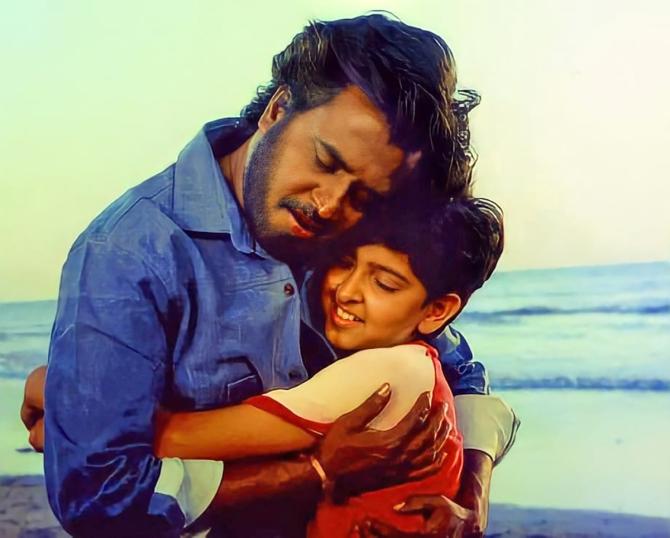
Rajinikanth and Kamal Haasan (who had already broken the bank two years earlier with Ek Duuje Ke Liye, 1981) became the new trailblazers from the South. Many in the Hindi film industry of the 1980s had laid bets that the two stars would finally break the hegemony of the northern heroes and succeed in carving out a place for South Indian actors.
Kamal Haasan, however, soon gave up on the Hindi film world after Saagar (1985), but Rajinikanth soldiered on.
He added another success to his roster the next year with a triple role in John Jani Janardhan (1984) alongside Rati Agnihotri and Poonam Dhillon. This result was in marked contrast to Mahaan (1983) in which even Amitabh Bachchan had not succeeded in wooing the audience with a triple role.
For the next decade, Rajinikanth was a dependable box office star. His films like Bhagwan Dada (1986) fetched a good initial draw, no matter what their final result.
Action-packed multi-starrers such as Dosti Dushmani (1986, with Jeetendra and Rishi Kapoor), Asli Naqli (1986, with Shatrughan Sinha) and Insaaf Kaun Karega (1987, with Dharmendra) kept him in the news.
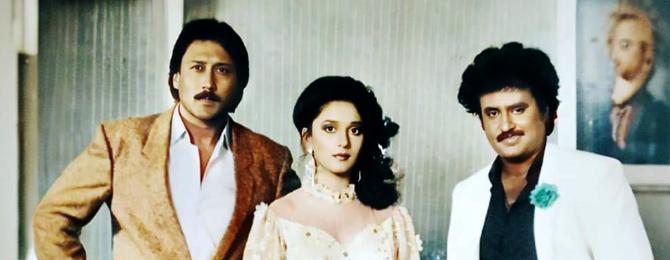
As was characteristic of most cinema in the 1980s, Rajini's films were largely unapologetic potboilers. He played to his strengths. In Mahaguru (1985) too, he impresses Meenakshi Seshadri with his sunglasses twirl trick.
In Geraftaar (1985), he stars alongside Amitabh Bachchan and Kamal Haasan and replays his cigarette-somersault trick, adding another success to his tally.
Rajinikanth romanced reigning queen Sridevi in Chaalbaaz (1989) but the actress, in a double role, walked away with most of the attention.
He was paired with newbie Madhuri Dixit in Uttar Dakshin (1987) but the film didn't do well despite being produced by Subhash Ghai.
A cameo in Ramesh Sippy's Bhrastachar (1989) followed.
Producers often rushed to cast Rajini in special appearances -- Gair Kanooni, Daku Haseena -- to add to their movies' commercial appeal but it didn't benefit the actor's plateauing Bollywood career.
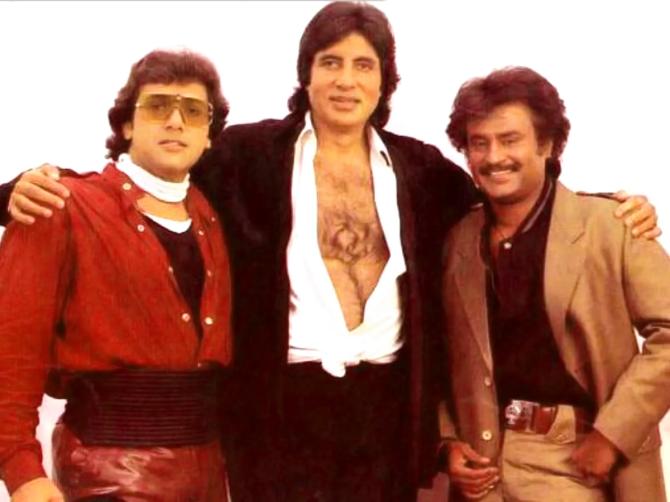
Rajinikanth hit his form once again with four major Hindi language releases in 1991. In the high-grossing Hum, Rajini's role had unusual emotional depth as the policeman who falls out with his elder brother (Amitabh Bachchan) after his wife and child are kidnapped.
In his second hit that year, Phool Bane Angaarey, Rajinikanth was one again a principled lawman whose death propels Rekha to turn into an avenging angel.
His other two releases that year -- Farishtay (with Dharmendra and Vinod Khanna) and Khoon Ka Karz (with Vinod Khanna and Sanjay Dutt) -- were massively scaled multi-starrers that failed.
Thereafter, Rajinikanth drastically cut down on his Hindi assignments.
After playing a gangster alongside Aamir Khan in Aatank Hi Aatank (1995), he reappeared only five years later in a cameo in the Anil Kapoor-Rekha starrer, Bulandi (2000). It was Rajinikanth's last Hindi film.
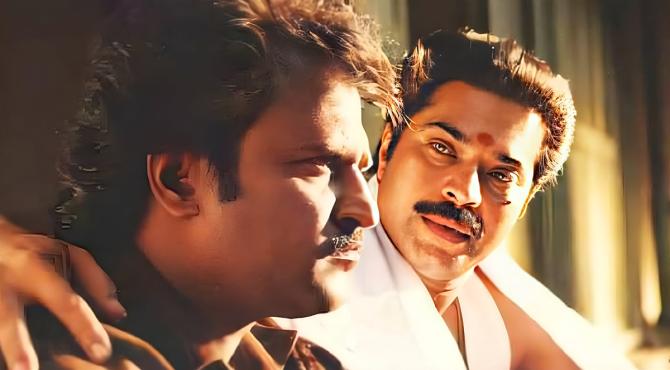
The reason why Rajinikanth slammed the brakes on his Hindi film career after 28 films and several hits is manifold.
His career in Tamil films hit an inflection point in the 1990s with the blockbusters Thalapathi (1991), Baashha (1995) and Muthu (1995) and he ascended to the next level of superstardom.
It didn't make sense for the star to be a part of ensemble Hindi films when he was being offered astronomical sums to play central author-backed roles in south films. His films were filling theatres even in Japan towards the end of the decade.
But his connection with the Hindi audience was not severed as was evidenced by the reception to the Hindi versions of Robot (2010) and in particular, its sequel 2.0 (2018).
Rajinikanth may have made his last Hindi film two decades ago but he can still set the screen alight, blazing away with a gun that has dozens of barrels.
Photographs curated by Satish Bodas/Rediff







 © 2025