
'We all make mistakes, but what is important is that you've got to get that out of your mind before the next ball commences.'
K R Nayar recalls his many encounters with Dickie Bird, the legendary cricket umpire who passed into the ages this week.

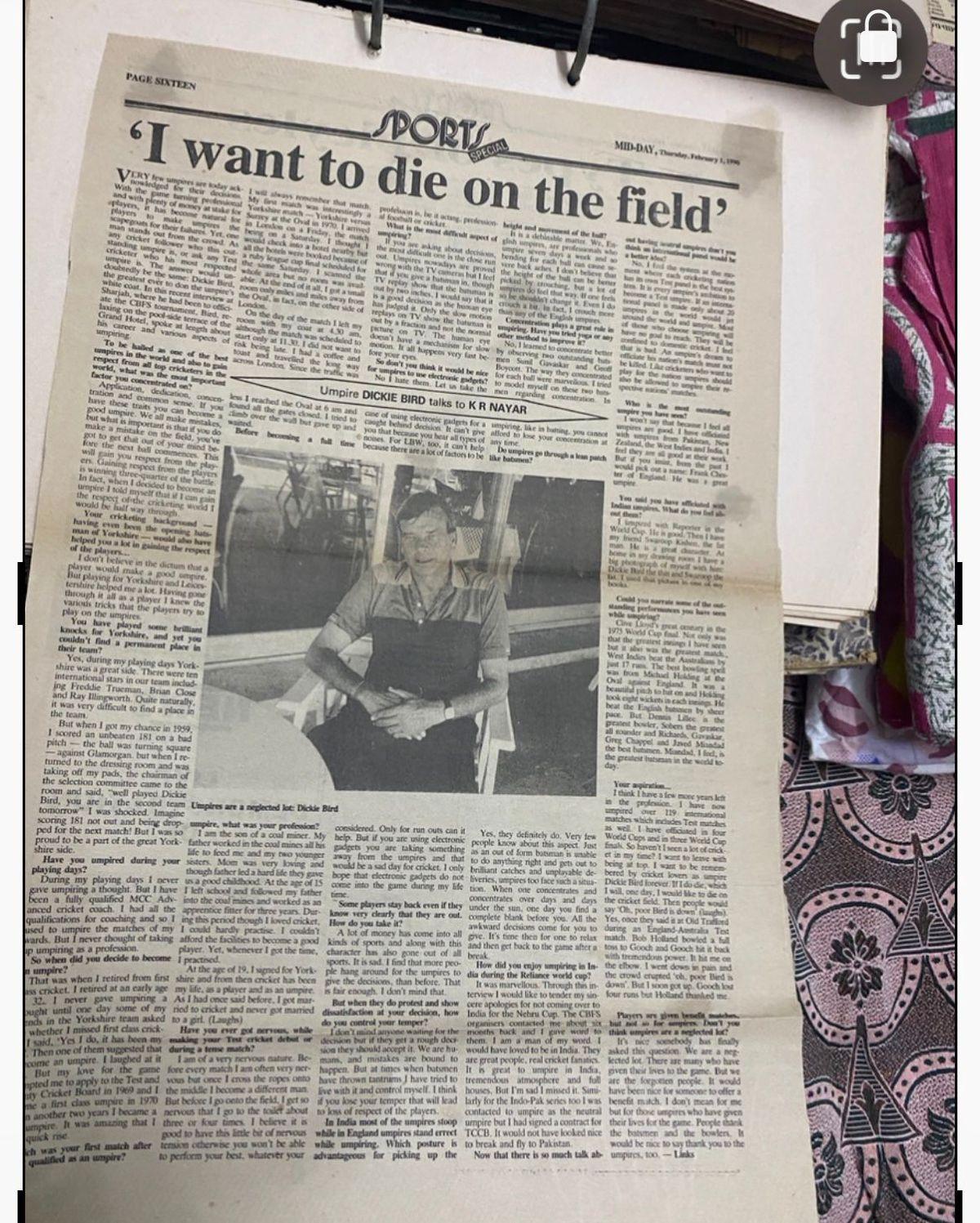
Dickie Bird, who passed away on Tuesday, September 23, 2025, had always expressed his wish to die on a cricket field.
He had mentioned this in one of my conversations with him years ago.
When the Yorkshire County Cricket Club announced that he had died peacefully at his home at the age of 92, I was reminded of that interview where he had shared this sentiment.
Such was his love for the game -- his pulse always beat for cricket.
Dickie Bird admired anyone who loved cricket as much as he did, but he was particular that it should be someone with whom he could debate about the game.
We shared a special relationship because, before my interview with him, I had introduced myself as a qualified state panel umpire who later became a journalist.
I also happened to mention that he was one of my idols in umpiring along with the late A M Mamsa, whose umpiring classes I had regularly attended in Mumbai.
During the early days of cricket in Sharjah, the press box at the stadium was very close to the umpires' room.
He was the star umpire for almost every match, and after my interview with him, he always made sure to either come over for a quick chat or wave at me before he entered their room.
We developed a close bond because as much as he was a regular at the Sharjah Cricketers Benefit Fund Series (CBFS) tournaments, so was I as a reporter for the BBC and Associated Press.
On one occasion, I requested a special interview with him for the Emirates Airlines inflight magazine. He was happy to talk to me and invited me to his hotel room.
There he showed me all the equipment he carried on to the field in his pockets -- including the six marbles with which he counted the balls, his go/no-go gauge to measure the size of the ball, and a small pair of scissors.
Bird used those scissors to trim Sunil Gavaskar's hair which had been falling into his eyes, during a 1974 England-India Test match.

That interview remains one of my most treasured experiences -- not just for his immense knowledge of cricket and umpiring, but also for the lessons he gave on how to succeed in life.
To my question on the factors that made him a successful umpire, he'd said: "Application, dedication, concentration, and common sense. Once you have these, you can become a good umpire."
He then went on to patiently explain each of these attributes with examples from his career.
Our conversation continued for nearly 40 minutes, and then he suggested continuing it by the hotel swimming pool.
Those were the days without mobile phones, unlike today when anyone can quickly take a photo.
I had a small Kodak camera with me and managed to capture a colour photograph of him.
I gave him a copy of that photograph, developed in a Mumbai studio, during another series.
I also recall the 1988 Sharjah match when he felt giddy and collapsed due to the extreme heat.
In those days, journalists could go close to the umpires' room, and when he came out a little later, he jokingly told me that "the heat had bowled him."
Conversations with him often felt like chats with a philosopher.
He once remarked: "We all make mistakes, but what is important is that you've got to get that out of your mind before the next ball commences."
Dickie Bird had been a fine cricketer, even opening the batting for Yorkshire.
In that context, when I once asked him if that was the reason behind his umpiring success, he noted: "I don't believe in the dictum that a player will make a good umpire; but having gone through it all as a player, I knew the various tricks that players try to play on the umpire."
So what were those little things that mattered for an umpire?
He explained that an umpire should stand erect, not crouch, to correctly judge the height and movement of the ball.
Umpires from England, he pointed out, officiated seven days a week in those days, and crouching for every delivery could easily lead to back problems.

One of his most memorable responses was when I'd asked him if he practised yoga to improve his concentration.
He said he didn't, but added that he sharpened his concentration by observing two outstanding batters -- Sunil Gavaskar and Geoff Boycott.
"The manner in which they concentrated for each ball was marvellous. I try to model myself on them regarding concentration. In umpiring, like in batting, you cannot allow yourself to lose focus at any time," he stressed.
His remark about wanting to die on the field had been his response to my question about his aspirations.
"I have a few more years in the profession. I want to be remembered by cricket lovers as umpire Dickie Bird forever. If I do die, which I will one day, I would like to die on the cricket field.
"Then people would say: 'Oh poor Bird is down' (laughs). Yes, once they said it at Old Trafford during an England-Australia Test match. Bob Holland bowled a full toss to (Graham) Gooch, and Gooch hit it back with tremendous power.
"It struck me on the elbow. I went down in pain, and the crowd erupted, 'Oh poor Bird is down.' But I soon got up. Gooch lost four runs, and Holland thanked me."
That incident and laughter comes back vividly to my mind as I write this piece, and it is profoundly moving to know that he is no more.
For me, Bird was not just a great umpire, but also a great human being -- one who showed me how to love the game unconditionally.
Feature Presentation: Aslam Hunani/Rediff









 © 2025