
Consumption of gold is the highest among middle-income households - those with annual income between Rs 2 lakh and Rs 10 lakh - who account for an average of 56 per cent of gold sales over the last five years, according to a nationwide survey conducted by India Gold Policy Centre (IGPC) at the Indian Institute of Management, Ahmedabad (IIM-A). "Per capita consumption is highest among the rich, but total volume still rests with the middle-income group. "With increasing income, there is an increasing propensity to consume gold, although the share of gold in the portfolio does not increase with the same proportion of income," the survey report says.

India's gold demand declined 18 per cent to 135.5 tonnes in the first three months of this year, mainly due to a sharp rise in prices, according to the World Gold Council (WGC). The demand stood at 165.8 tonnes in the first three months of 2021. In terms of value, gold demand dropped 12 per cent to Rs 61,550 crore in the January-March period. It stood at Rs 69,720 crore in the year-ago period, the 'Gold Demand Trends Q1 2022' report released by the WGC said.
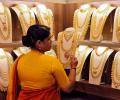
Dhanteras has cheered up jewellers as it has turned out to be the best in three years, thanks to the lower price of the yellow metal and pent-up demand. In Mumbai's Zaveri bazaar, buyers came in out force and jewellers did not have to depend on freebies to induce sales, even though all of them had announced some offers. In fact, more discounts were announced for diamond and studded jewellery.

WGC had earlier estimated around 200 tonnes of gold was brought into India through smuggling in calendar year 2013.

India's widening current account deficit (CAD), driven by the massive spike in commodity prices led by crude oil, is set to put pressure on the fragile recovery, warns a brokerage report that has revised upwards its CAD forecast to $45 billion or 1.4 per cent of GDP by March. According to a report by British brokerage Barclays, the worries arise from the fact that the trade deficit has been jumping continuously since July. From an average monthly trade deficit of $12 billion till June, it has jumped to $16.8 billion in July-October, with September showing the highest-ever trade deficit on record at $22.6 billion, the report said.
The World Gold Council initiates micro-finance scheme to promote investments by low-income groups.

Consumers during the quarter sold 37.9 tonnes of old gold, which is the highest quarterly sale after September 2016, when old gold sale, or scrap supply, was 39 tonnes.

The demand for gold has bounced back sharply in India from the lows seen in 2020 because of the outbreak of the Covid-19 pandemic, and has even beaten the pre-pandemic level. In the September quarter, the demand for gold jumped 47 per cent year-on-year (YoY) to 139.1 tonnes, as against 94.6 tonnes in the year-ago period, and higher than the 123.9 tonnes recorded in the pre-pandemic September 2019 quarter, the World Gold Council (WGC) said in its latest release. In value terms, demand surged 37 per cent year-on-year (YoY) to Rs 59,330 crore during the quarter.

Some antique jewellery is displayed in a couple of museums in the world.

A WGC survey says that there is no dearth of gold demand, but there is lack of trust among prospective gold buyers, not only in India but globally.

The Reserve Bank of India (RBI) has increased its gold purchases, as part of its foreign exchange (forex) reserves. In the first half (H1) of calendar year 2021 (CY21), the addition of gold to India's forex reserves has been the highest - on a half-yearly basis -at 29 tonnes. Now, the RBI's gold holding - as a proportion of its forex reserves - has for the first time crossed 700 tonnes.

India, China account for 54% of total gold demand in first four mnths of 2015.
In comparison to other asset classes, globally, gold rallied significantly after many years to deliver 18.4 per cent returns in 2019.
Global central banks bought 157.5 tonnes of gold in the second quarter.
Gold, which lost its sheen to some extent in the second half of 2021, is likely to regain the glitter in the New Year and cross the Rs 55,000-per-10-grams level amid pandemic woes, inflation worries and stronger US dollar. After a stellar run up in 2020 when the yellow metal touched a record high of Rs 56,200 on the MCX in August, the prices are near Rs 48,000 per 10 grams now. This is roughly 14 per cent lower from the all-time highs and 4 per cent lesser compared to January 2021 levels.
World Gold Council estimates that central banks will have purchased 500 tonnes of gold in 2012.
Gold demand fell 15 percent in 2013 as huge outflows from physically backed investment funds outweighed record consumer demand, but that heavy disinvestment is tailing off this year, pointing to a recovery, the World Gold Council said.
Gold demand fell 15 percent in 2013 as huge outflows from physically backed investment funds outweighed record consumer demand, but that heavy disinvestment is tailing off this year, pointing to a recovery, the World Gold Council said.
India's gold demand increased by 19.2 per cent to 76.1 tonne during the April-June quarter this year, largely due to low base effect, owing to the nationwide lockdown that hit economic activity last year, the World Gold Council (WGC) said in a report. The overall gold demand during the second quarter of 2020 calendar year stood at 63.8 tonnes, according to the WGC's 'Gold Demand Trends Q2 2021' report. In value terms, India's gold demand witnessed 23 per cent growth during April-June quarter at Rs 32,810 crore, compared to Rs 26,600 crore during the corresponding period of 2020.
The high import duty on gold, local taxes and restrictions on imports are leading to a rise in smuggling of the commodity into the country.
Gold demand in the country was 864 tonnes during 2012, according to data given in WGC 'Gold Demand Trends 2013' report.

India's gold demand recovered during the January-March period to witness a growth of 37 per cent at 140 tonne compared to the same quarter of 2020, due to ease of COVID-related restrictions, pent up demand and softening of prices of the yellow metal, according to the World Gold Council (WGC). The overall gold demand stood at 102 tonne during the first quarter of 2020, as per WGC data. Gold demand in value terms increased by 57 per cent during the first quarter of this calendar year to Rs 58,800 crore compared to Rs 37,580 crore in the corresponding period of 2020.
Global appetite for gold fell 21 per cent in the third quarter as outflows from physical bullion funds and the drop in buying from India offset firmer jewellery, coin and bar sales, a quarterly report from the WGC showed on Thursday.

Global gold demand hit an 11-year low in 2020 at 3,759.6 tonnes, mainly due to a weak October-December quarter and the COVID-19 related disruptions across the world driving a muted consumer sentiment throughout the year, the World Gold Council (WGC) said in a report. The overall consumer demand during 2019 was at 4,386.4 tonnes, while in 2009 the overall demand was at 3,385.8 tonnes, according the WGC's 2020 Gold Demand Trends report. Global gold demand dropped by 28 per cent year-on-year (YoY) to 783.4 tonnes in the fourth quarter compared to 1,082.9 tonnes during the October-December period of 2019, the report stated.

Those interested in investing in gold have shifted to instruments, such as sovereign gold bonds and gold ETFs. Many others are, in fact, selling gold or using it as collateral to generate short-term liquidity.
The demand for the precious metal stood at 202.1 tonnes in the same quarter last year.
The World Gold Council (WGC) said the recent fall in gold prices was driven by speculative traders in the futures markets.
Gold prices on Friday rose by Rs 210 to hit another five-week high of Rs 28,300 per 10 grams in the national capital on sustained buying by stockists amid a firming global trend.

Regaining the lost sheen, sales of gold jewellery and coins are set to touch pre-COVID levels in volume terms on the auspicious Dhanteras as easing pandemic concerns and pent up demand saw consumers flocking to stores to buy the precious metal. Increased footfall at stores and brisk sales online as well as relatively softer gold prices compared to record Rs 57,000 per 10 grams level in August spurred increased buying, especially light weight offerings, on Tuesday. Dhanteras is considered to be auspicious for buying precious metals and other valuable items.
In the first quarter of 2013, gold imports declined 5.7 per cent, as traders relied mostly in stocks to meet rising demand.

The total sales volumes of gold for 2012 stood at Rs 2.47 lakh crore (Rs 2.47 trillion) and total quantity of gold sold in the country was 864 tonnes, Vipin Sharma, Director (Jewellery) WGC told reporters in Kochi.

This year, WGC expects India's gold demand to stand at 865-965 tonnes. Last year, it was 864.2 tonnes.

In the July-September period of this year, the domestic demand improved mainly due to Diwali demand and the upcoming marriage season.
While gold consumption is expected to stabilise this year, it may be some time before it revisits record levels seen in the depths of the financial crisis.
Mandatory hallmarking of gold would be a positive in making the gold market more organised. Mandatory hallmarking would come into effect from January 15, 2020, with a one-year transition period for trade to sell existing inventories. Experts also expect more policy measures next year to bring in more transparency in terms of gold as an asset class.
The World Gold Council recently listed Suhani Pittie as one of the top ten inventive and ingenious jewellery designers in the world. Pittie who showed at the recently concluded Lakme Fashion Week talks about how she made it.
From the studios of top jewellery designer, Suhani Pittie came the Child of Eden collection which dazzled the audience on Day 2 of Lakme Fashion Week Summer/Resort 2012.
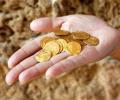
Sales of gold coins and bars should be curbed after reaching around 300 tonnes
The global official gold holdings totaled 31,694.8 tonnes as of April 2013.
India's first quarter gold demand decreased by 29 per cent in volume at 207.6 tonne, year-on-year, while it dipped by 3 per cent at Rs 56,650 crore (Rs 566.5 billion) in terms of value.
