
The combined market valuation of four of India's top-10 most valued firms, including State Bank of India, Bharti Airtel, Tata Consultancy Services, and Larsen & Toubro, eroded by Rs 1 lakh crore last week amidst a volatile and range-bound equity market.

External Affairs Minister S Jaishankar raised India's concerns with US Secretary of State Marco Rubio regarding changes to US visa and immigration policies, emphasising that legal mobility should not be negatively affected. Rubio acknowledged potential 'bumps' during the transition as the US aims to improve its immigration system.

Credit card adoption is rapidly expanding beyond India's major metropolitan areas into Tier-II and Tier-III cities, driven by increasing incomes, digital awareness, and the integration of RuPay credit cards with UPI, according to a new report by SBI Card.

The Confederation of Indian Industry (CII) has urged the Indian government to gradually restore the Rs 10-per-litre cut in special additional excise duty on petrol and diesel over six to nine months. This move aims to relieve pressure on government finances as crude oil prices stabilise, without significantly impacting consumer sentiment.

The Election Commission reports that poll-related seizures, including cash, drugs, and liquor intended to sway voters, have surpassed Rs 1000 crore in West Bengal and Tamil Nadu.
India's foreign direct investment (FDI) inflows are projected to surpass $90 billion in 2025-26 (FY26), driven by robust policy reforms, free trade agreements, and strong economic growth, according to DPIIT Secretary Amardeep Singh Bhatia.

Ludhiana Police have busted a large cyber fraud racket, arresting 132 people involved in running fake call centres that targeted foreign nationals through various online scams.

A 40-year-old school teacher was killed in a hit-and-run accident on the Mumbai-Ahmedabad highway in Palghar district, Maharashtra. Police are investigating the incident and searching for the driver.

A social media influencer was arrested for allegedly uploading a reel containing abusive language with a Russian woman at the historic Gwalior Fort in Madhya Pradesh.

A foetus was discovered in a government hospital bathroom in Nahan, Himachal Pradesh, leading to an investigation into the alleged sexual assault of a minor girl who suffered a miscarriage on the premises.

Police in Budgam, Jammu and Kashmir, have registered a case against a man for allegedly operating a fake WhatsApp account in the name of the Senior Superintendent of Police (SSP) Budgam.
Seven pilgrims were killed and others injured after being struck by a speeding truck in Gujarat's Surendranagar district. The incident occurred on the Lakhtar-Viramgam highway as the group walked to Bahucharaji as part of a religious procession.

API Holdings, the parent company of online pharmacy PharmEasy, has significantly reduced its debt from 1,800 crore to 1,050 crore and refinanced it at lower interest rates under CEO Rahul Guha, shifting its focus from 'growth at any cost' to profitability and aiming for a debt-free balance sheet before a potential stock market listing.

Delhi Police have arrested three individuals for their alleged involvement in an online investment fraud of Rs 10 lakh. The accused lured a complainant with promises of high returns on stock market investments before ceasing communication after receiving the funds.

Indian stock markets are poised for volatility this week, driven primarily by the outcomes of five state assembly elections, ongoing high crude oil prices amid West Asia tensions, and the release of Q4 corporate earnings, according to market analysts.

India's mergers and acquisitions (M&A) market is projected to maintain an annual run-rate of approximately $200 billion, evenly split between domestic, inbound, and outbound transactions, despite global geopolitical turbulence, according to Rajesh Singhi, global co-head, M&A Advisory, Standard Chartered Bank.
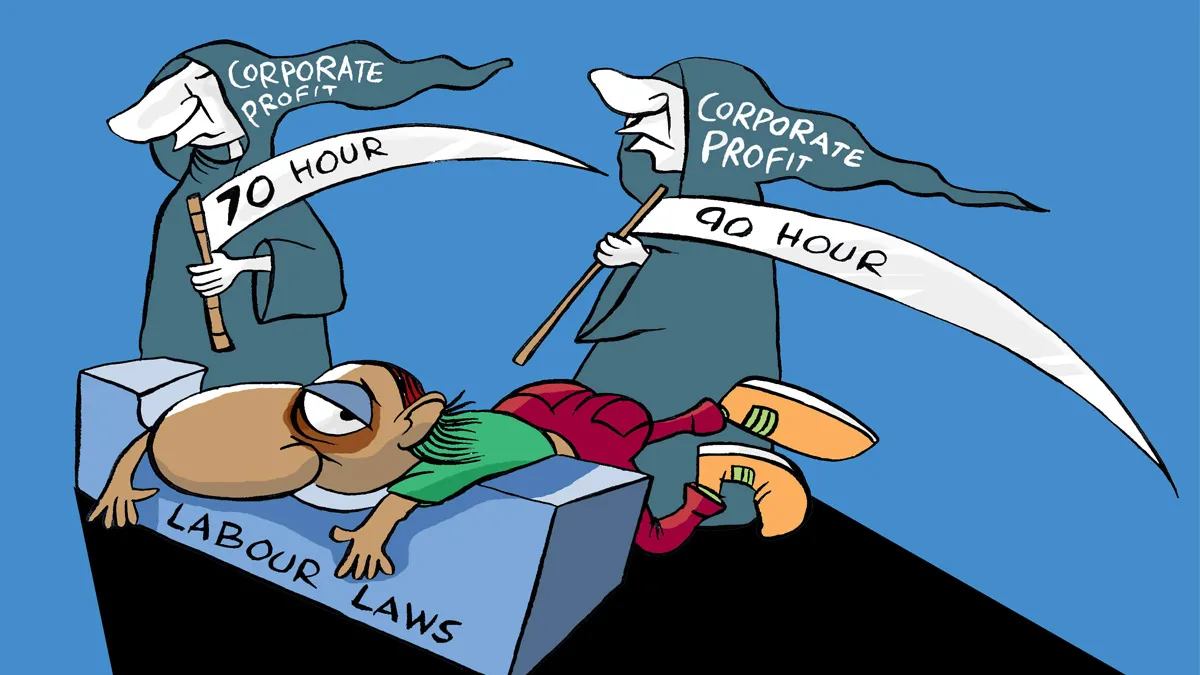
The Indian government has notified final rules under four labour codes, potentially enabling a four-day workweek in certain sectors by capping weekly working hours at 48 while allowing daily flexibility. This move also introduces significant changes to wage fixation, compliance obligations, and social security norms.

India's outward foreign direct investment (FDI) saw a significant increase of 27.5 per cent, reaching $7.06 billion in March, primarily driven by a sharp rise in guarantees for overseas units, according to the Reserve Bank of India.
Police in Amravati, Maharashtra, have arrested a second suspect in connection with the sexual exploitation and circulation of obscene videos involving minor girls, after a victim's family reported continued contact from the accused.

The National Consumer Disputes Redressal Commission dismissed a flat buyer's plea for a refund from a builder facing liquidation, highlighting the challenges faced by consumers in stalled real estate projects.

A 55-year-old man, Ganesh Kashinath Pawar, accused in a cheque bounce case, died of a heart attack at Beed district jail in Maharashtra. He was in judicial custody after failing to appear in court.

A man has been arrested in Rajasthan for his alleged involvement in an illegal Aadhaar enrolment racket, where fake Aadhaar cards were generated using manipulated biometric data.

Police are investigating the bank accounts of those arrested in connection with the sexual harassment and religious conversion case involving women employees of an IT firm in Nashik to determine if they received funds for illegal activities. A special investigation team (SIT) is handling the case.

China has emerged as India's largest trading partner in 2025-26, with bilateral trade reaching USD 151.1 billion, while India's trade deficit with Beijing widened to an all-time high of USD 112.6 billion.
Three police personnel in Pune, including a social media influencer, are accused of extorting a college principal by threatening to falsely implicate him in a sexual harassment case.

Police in Kerala have filed an extortion case against an online loan app following the death of a student who allegedly faced harassment and intimidation over loan recovery.
Four individuals, including two bank managers, have been arrested in Telangana for allegedly siphoning off Rs 2.65 crore from a state-owned bank branch in Nalgonda district.
Police in Una, Himachal Pradesh, are investigating the alleged sexual assault of a class 6 student who was reportedly abducted and held captive for several hours.

India's retail inflation marginally increased to 3.4 per cent in March, up from 3.21 per cent in February, primarily due to an uptick in certain food items and the initial impact of the West Asia crisis on fuel prices, according to government data.

Small- and midcap stocks have delivered their biggest monthly rally in 12 years, but rising oil prices and global tensions could make the road ahead volatile.

Several non-banking financial companies (NBFCs) are observing an increase in early-stage delinquencies within their micro, small and medium enterprises (MSME) loan portfolios, primarily driven by supply chain disruptions and escalating raw material costs exacerbated by the ongoing conflict in West Asia.
A man in Bengaluru was arrested for uploading a misleading video claiming a person was under the influence of a 'zombie drug,' leading to public panic and misinformation.
SIS Ltd, a security and facility management services provider, aims to cross Rs 20,000 crore in revenue by FY27, driven by strong double-digit growth, expansion of its service network, and a simplified regulatory framework under new labour codes, said its Group Managing Director Rituraj Sinha.
Hyderabad Police Commissioner V C Sajjanar convened a meeting with bankers to address the misuse of bank accounts in cyber frauds and implement preventative measures, following 'Operation Octopus' which dismantled cyber fraud networks and led to arrests of complicit bank officials.

SBI General Insurance aims to achieve a 10 per cent market share among private and standalone health insurers within approximately five years, up from its current 7.17 per cent, said Naveen Chandra Jha, managing director and chief executive officer, SBI General Insurance.

CRISIL Ratings predicts that the share of bank loans in NBFCs' overall borrowings will increase to 44-45 per cent by FY27, driven by elevated bond yields and softening bank lending rates.
A 55-year-old builder and social media influencer with a large Instagram following has been arrested in Thane, Maharashtra, for allegedly possessing a cache of illegal weapons. The arrest occurred shortly after his release on bail in a separate case, raising concerns about his activities and intentions.

New demat account additions in India reached an 11-month low in March, with only 2.15 million new accounts opened, significantly below the 12-month average. This slowdown is attributed to a sharp decline in equity markets, escalating West Asia tensions, and increased crude oil prices impacting India's economic outlook.

The Indian government has maintained the interest rates on small savings schemes, including PPF and NSC, for the eighth consecutive quarter, starting April 1, 2026.
The Indian banking system's net liquidity surplus has reached a four-year high of Rs 4.57 trillion, driven by maturing government securities, with further maturities expected to push the surplus to around 5 trillion.
