
The Reserve Bank of India's proposal to allow non-banking financial companies (NBFCs) access to the term money market is projected to significantly increase market volumes by 40-60 per cent in the first year, potentially doubling turnover within two to three years, according to treasury executives.

The Food Safety and Standards Authority of India (FSSAI) has issued notices to eight food business operators, including Emami Healthy & Tasty and Plan B, for using misleading brand names, trade names, and product claims that violate the Food Safety and Standards Act, 2006.
The Reserve Bank of India has imposed a penalty of Rs 41.8 lakh on Canara Bank for non-compliance with KYC norms and incorrect account classification, and Rs 3.1 lakh on Puran Associates Pvt Ltd for asset classification violations.
Fintech unicorn Razorpay has confidentially filed draft documents with SEBI for an Initial Public Offering, with market sources estimating the issue size between Rs 5,000-6,000 crore. This move comes as a rival firm, PhonePe, has paused its IPO plans.

Patan Police have busted a large-scale cyber fraud racket, arresting 14 individuals involved in illegal transactions worth Rs 398.43 crore through 13 'mule accounts'. The operation, dubbed "Operation Mule Hunt 2.0", uncovered a network linked to 228 inter-state cyber fraud complaints, where individuals were lured to open bank accounts used to channel proceeds of cyber crimes.

The Consumer Affairs Ministry is developing machine-readable SMART standards using AI to reduce industry compliance burden. This initiative aims to modernise India's standards ecosystem, with the Bureau of Indian Standards transitioning from a regulator to a facilitator, promoting private sector testing and faster processes.

Police in Sambhal, Uttar Pradesh, have registered a case against a postal assistant after suspicious transactions worth approximately Rs 4.5 crore were allegedly detected in his bank accounts.

A police inspector with the Telangana Cyber Security Bureau has been arrested by the Anti-Corruption Bureau (ACB) for allegedly demanding and accepting a bribe to protect the family and friends of an individual booked in a cyber fraud case.

Realty firm Unitech Ltd reported a consolidated net loss of Rs 441 crore for the quarter ended March 2026, compared to a net loss of Rs 309.95 crore in the year-ago period. The company faces a cash crunch and delays in housing projects, affecting around 22,000 customers.

The Supreme Court has granted bail to Shubham Saxena, accused of siphoning off Rs 22 crore from a real estate company, primarily due to his prolonged pre-trial detention of over four and a half years. This decision overturns a Delhi High Court ruling that had denied bail citing the gravity of the economic offence.

India's unemployment rate reached an 11-month high of 5.5 per cent in May, up from 5.2 per cent in April, according to the National Statistics Office, indicating a softening labour market as labour-force participation also eased.

Delhi Police have arrested a social media influencer for allegedly posting objectionable content targeting the family of the late businessman Sunjay Kapur.

A special CBI court in Tripura sentenced three executives of a chit fund company to six years of rigorous imprisonment each for swindling Rs 5.5 crore from over 800 depositors.

BJP leaders Rajeev Chandrasekhar and B B Gopakumar have accused both the UDF and LDF governments of pushing Kerala into an economic crisis. They criticised the lack of solutions from the ruling fronts, highlighted the state's high public debt, and questioned the allocation of revenue for development versus salaries and pensions.

The CBSE revaluation portal experienced a cyber attack, affecting the payment system and leading to unauthorised access for approximately 50 students. The incident caused fee display abnormalities, prompting investigations and system enhancements.

Foreign Portfolio Investors (FPIs) have withdrawn over Rs 62,853 crore from Indian equities in the first fortnight of June, bringing the total outflows for 2026 to Rs 2.87 lakh crore, surpassing the entire 2025 figure, driven by geopolitical tensions, global economic growth concerns, and a weakening rupee.

rediffGURU Ulhas Joshi answers your mutual fund queries.
Gujarat cyber police have arrested 13 individuals allegedly involved in a network responsible for 982 cyber crimes across India, resulting in losses of over Rs 631 crore.
The CBI has arrested Lakhan Jaiprakash Jagwani, a key accused in a case involving the alleged defrauding of US nationals of USD 8.5 million through illegal call centres.
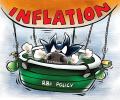
The Reserve Bank of India has increased its retail inflation projection for 2026-27 to 5.1 per cent, up from an earlier estimate of 4.6 per cent. This revision is primarily attributed to mounting input costs, driven by the pass-through of higher global energy prices to domestic petrol and diesel rates, which have seen significant increases since May.
Moody's Ratings has highlighted that Indian banks are among the most exposed in the Asia-Pacific region to the West Asia crisis, primarily due to India's high dependence on energy imports, which could lead to increased inflation, higher interest rates, and strained borrower cash flows.

'The MPC is likely to prioritise the key mandate, which is inflation, while relying on other instruments to stabilise the currency and bond markets.'

Nuh Police have arrested three alleged cyber fraudsters involved in sextortion and online fraud through fake messages. Police also recovered fake SIM cards, mobile phones, and digital data related to cyber fraud from their possession.
Gujarat police have uncovered cyber frauds worth Rs 2,289 crore and arrested 638 individuals as part of 'Operation Mule Account 1.0', a state-wide crackdown on online criminals launched in 2025.
An EY India report suggests that banks must compete on customer experience and evolve physical branches into phygital advisory hubs. The report highlights the importance of anticipating customer needs and blending digital tools with human interaction.

Foreign Portfolio Investors (FPIs) withdrew nearly Rs 33,000 crore from Indian equities in May, bringing the total outflow for 2026 to Rs 2.25 lakh crore, driven by weak earnings growth, rupee depreciation, and more attractive opportunities in other global markets.

An NRI from the US was arrested in Bengaluru for allegedly possessing live ammunition rounds after leaving them at a hotel. The accused, Arman Mutaahar, admitted to illegally possessing the ammunition and is now in judicial custody.

The National Payments Corporation of India (NPCI) is set to consider linking the ATM interchange fee to the Wholesale Price Index (WPI), alongside a potential hike from the current 19 to 21-22, which could impact customer charges for transactions beyond the free limit.

Major life insurers in India reported close to double-digit growth in the value of new business (VNB) last financial year, primarily driven by increased sales of high-margin protection and non-participating (non-par) products.

Rupert Lowe, leader of the far-right Restore Britain party in the UK, has sparked controversy with anti-immigration posts targeting Indian and Pakistani immigrants, leading to a social media backlash and raising concerns ahead of a crucial by-election.

The Uttar Pradesh Special Task Force (STF) has busted an alleged racket involved in rigging Staff Selection Commission (SSC) online recruitment examinations using proxy servers and dummy candidates, arresting seven people from Greater Noida.

Flows from overseas Indians into Non-Resident Indian (NRI) deposit schemes have fallen by 24.17 per cent to approximately $11.04 billion between April 2025 and February 2026, down from $14.56 billion in the previous year, according to Reserve Bank of India (RBI) data.

The Nizam's Institute of Medical Sciences (NIMS) in Hyderabad has achieved a significant milestone by completing 2,000 kidney transplants, making it one of the leading institutions in India for this procedure. The majority of these transplants were performed free of cost under government schemes.

Analysts predict that the ongoing US-Iran conflict, fluctuations in crude oil prices, and foreign institutional investor (FII) flows will be the primary factors influencing Dalal Street this week, with inflation concerns adding to investor anxiety.
The Uttarakhand Special Task Force has arrested the alleged mastermind of a cheating racket in an SSC recruitment examination from Saharanpur in Uttar Pradesh. The accused, Shubham Bhatnagar, allegedly provided remote access to candidates to solve papers illegally.
Mumbai police arrested a social media influencer, Abu Jabir Hussain Gayasuddin Talukdar, for allegedly making derogatory remarks about a Hindu religious leader in his videos, following a complaint by a Bajrang Dal activist.

Indian companies recorded their highest profit margins in 21 quarters during Q4FY26, reaching 11.3 per cent, primarily due to significant savings from lower employee costs and reduced interest payments, which offset rising raw material prices.

The Reserve Bank of India (RBI) is anticipated to make its highest-ever dividend payment to the government this year, providing a significant fiscal boost to address challenges, including those stemming from the ongoing Middle East crisis.
The Bank Nifty is currently trading at a 43.5 per cent discount to the Nifty 50, near its widest gap since 2015, reflecting investor pessimism despite the banking sector's strong earnings growth.

Credit card transactions in India have surged over 2.6 times between 2021 and 2025, reaching 570 crore volumes and Rs 23.2 lakh crore in value, with private sector banks significantly increasing their market share, according to a recent RBI report.
