
Lockdowns imposed by the states in April and May to contain the second wave of the deadly COVID-19 pandemic has likely led to the economy contracting 12 per cent in the June quarter as against 23.9 per cent contraction in the same quarter in 2020, says a brokerage report. The economy had its worst contraction on record in FY21 at 7.3 per cent as the 2.5 months of unplanned lockdown announced by the centre with just a four-hour notice had crippled the economy in the first quarter with a massive 23.9 per cent contraction, which improved to -17.5 per cent in the second quarter.

"The unsound analysis of the said article is based on the extrapolation of data without any epidemiological evidence," the ministry said, adding the studies used by the magazine to estimate the mortality are not validated tools for determining the death rate of any country or region.

SBI economists on Tuesday sharply slashed their FY22 GDP growth estimates to 7.9 per cent - the lowest among all analysts - from the earlier projection of 10.4 per cent growth. The economists at the state-run lender seemed to attribute the impact of the second wave of COVID-19 infections as a key factor for the revision in the growth estimate, and pitched for faster vaccination. "... our analysis shows a disproportionately larger impact on the economy this time and given that rural is not as resilient as urban, the pick-up in pent-up demand is unlikely to make a large difference in FY22 GDP estimates, and hence it could only be a modest pick-up," they said.

It is a difficult problem and will require the Union, state governments and civil society, meaning NGOs, to work together, points out Aakar Patel.

Over 200 world leaders, including former presidents, prime ministers and ministers have backed a campaign urging the Group of Seven (G7) rich nations to help vaccinate the world's poorest from low-income economies against COVID-19 by paying two-thirds of an estimated $66 billion required.

108 economists, social scientists said it was imperative that agencies like CSO and NSSO are not subject to political interference.
While the US-Iran conflict leading to a spike in global oil prices and trade war between the US and the EU topped the chart with 25 per cent, other major risks to the global economy include coronavirus, debt burdens causing a recess across emerging markets and Hong Kong protests causing an exodus from Asia's biggest financial centre.

What happens if China depreciates its currency. In that case, Chinese products will be cheaper and people will continue to buy their products: Abhijit Banerjee.
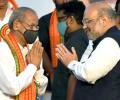
Actor-turned-politician and sitting MP Locket Chatterjee has been fielded from Chunchura and another MP Nishit Parmanik from Dinhata. Also, a number of film personalities have been nominated as candidates in the high-stakes battle for West Bengal.

The economist was also critical of demonetisation and the way Good and Services Tax was implemented.
'We have lived through 10% plus inflation in India and we are aware of the economic pitfall.' 'With the RBI now having formally adopted an inflation target range, they cannot turn a blind eye to the impending risks.'

It is our only chance of avoiding a repeat of our catastrophic second wave, asserts Naushad Forbes.

With no rate cuts on the table, the other monetary policy alternative could be to reduce the width of the asymmetric policy corridor or increase in reverse repo rate when the pandemic subsides, they opined.

The billions India invested in dams, schools, etc in Afghanistan will be gone. The Hindu and Sikh population of Afghanistan has already shrunk from some 200,000 to about 500, points out Rajeev Srinivasan.

So vaccinate employees and families, staff at home, rickshaw drivers, milkmen, service providers, shopkeepers and street vendors, says Naushad Forbes.

The economists who signed the letter included Jean Drze , Abhijit Banerjee, Ajit Ranade, Jayati Ghosh, Kirit Parikh, Mihir Shah, Rohini Pande, and Vijay Joshi

Biden's proposal also sets aside USD 20 billion for a national vaccination programme and USD 50 billion to scale up coronavirus testing.

Later, Sitharaman's office clarified that the FM had already met the industrialists, experts, and economists during the pre-budget consultations.

What do we know about India's devastating second wave, and can we assign responsibility for it?

"The space for dissent and debate is shrinking. People are jailed without trial through arbitrarily imposed charge of sedition," the Nobel laureate alleged.

Despite the relaxation of the one-child policy in 2016, the number of live births per 1,000 people fell to a record low of 10.48 in 2019, down from 10.94 in 2018.

Walmart is rumoured to be looking to listing Flipkart in a few years. At that stage, we'll get a better sense of what's going on in retail, says Devangshu Datta.
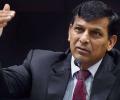
Former Reserve Bank of India governor Raghuram Rajan said that Rs 65,000 crore is required to help the poor affected by the coronavirus-induced lockdown. He also laid stress on the need to restart the economy while taking precautions.
A u-turn by the BJP will be an apocalyptic occurrence in Indian politics and society, argues Amulya Ganguli.
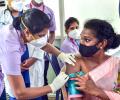
'Vaccination is very important for an economy to start functioning properly.'

They also warned that banks will start reporting higher non-performing assets after September, once the six-month moratorium on loan repayment ends.

Our precipitous decline is being noticed and recorded abroad with alarm. It is strange that within India we are carrying on as if it is business as usual, observes Aakar Patel.
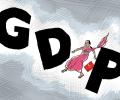
Though the ministry is considering 2017-18 as the new base year, no decision has been taken as the committees of experts are awaiting some more data before finalising their opinion.

Is India really one of the cheapest nations to live in?

Let's take a look at some countries that will see positive or negative economic growth next year.
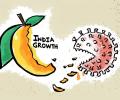
'In the real economy, the scars of the pandemic will continue to define 2021.' 'It is still hard to tell the effect on unemployment, migrant workers, poverty, and the informal sector of the lockdown and of the pandemic,' observes Mihir S Sharma.

You can make all the speeches you want, you cannot argue against 39 straight months of slowing, observes Aakar Patel.
Let's take a look at how many ATMs countries in emerging markets have and how many use mobile phone to receive money.
Let's take a look at some of these nations, including India.

That's why he is now finally focusing on the two things that alone can help: Fiscal expansion -- from December onwards -- and supply management via amended laws and rules that affect business, notes T C A Srinivasa-Raghavan
Video games industry is worth around $80 billion.
India has too many small companies and this is inefficient. It should instead have only a handful of very large players running its economy and these giants can then compete with the world, observes Aakar Patel.

State Bank of India's house economists on Monday said the recent farm sector reforms reek of parochial thinking and promote lazy farming as they only cater to cereal-producing states. In the recently concluded monsoon session, the government rushed through three legislation to change the way agricultural produce is marketed, sold and stored by dismantling the decades-old APMC (Agricultural Produce Market Committee) mandis.
The EIU said in a report on Wednesday forecast that the real GDP grew by 1.6 per cent quarter-on-quarter in India, but noted that this uptick was largely owing to base effect.

Of the Rs 20-lakh-crore package that Prime Minister Narendra Modi announced to defend the economy against coronavirus disruptions, fresh support may be only around 60 per cent of the offer as it counts the first financial stimulus and liquidity support that Reserve Bank has given already, and will overburden the bond market, says a report.
 © 2026 Rediff.com - Advertise with us - Disclaimer - Privacy Policy - Sitemap - Feedback - About us - Terms of use - Grievances