
A major 'deliverable' for Prime Minister Manmohan Singh's visit last fall to the United States was the launching of the Obama-Singh 21st Century Knowledge Initiative.
A new India-UK relationship would need to include an annual strategic dialogue, cooperation on counter terror and enlarging the role of the G-20, writes Rahul Roy-Chaudhury

Secretary of State Hillary Clinton on told the Pakistani leadership that the United States wants the continuation of dialogue between New Delhi and Islamabad so that the two sides can resolve their outstanding problems amicably, diplomatic sources said on Monday.
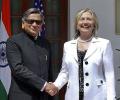
US Secretary of State Hillary Clinton after the second round of Indo-US Strategic Dialogue with her counterpart S M Krishna, made it very clear that there were "issues" which required to be resolved by the two sides in the civil nuclear field. But she did not go into the specifics.
The second round of the Indo-United States strategic dialogue, co-chaired by External Affairs Minister S M Krishna and US Secretary of State Hillary Clinton, has been postponed in view of the Assembly elections in India and ongoing developments in West Asia and North Africa.
"We are burning the midnight oil, working our fingers to the bone," he said, to ensure access to Headley for India, as it was "so important to India, the Indian people, the Indian government."
United States President Barack Obama's first National Security Strategy, unveiled in Washington, DC, on Thursday has reaffirmed that the US is building a strategic partnership with India (the US-India strategic dialogue begins next week) and has included India with other '21st century influencers.'
India and the United States will hold the second round of their strategic dialogue in New Delhi on April 6 during which US Secretary of State Hillary Clinton would lead the American side, Foreign Secretary Nirupama Rao has announced in Washington.
United States President Barack Obama and Prime Minister Manmohan Singh have vowed to strengthen the robust Indo-US relationship and discussed a wide range of bilateral and regional issues, including Afghanistan and nuclear terrorism.
The 'trust deficit' between the United States and Pakistan has seemingly evaporated after the strategic dialogue between Washington and Islamabad in March, that also featured Army chief General Ashfaq Kayani and Inter Services Intelligence director general Shujat Ahmad Pasha.If the remarks of Daniel Benjamin, the State Department's coordinator for counter-terrorism are anything to go by, the US no longer is suspicious of Pakistan playing a double game.
Shuja Nawaz, arguably the most authoritative expert on the Pakistani military, assesses the US-Pakistan strategic dialogue.
Rejecting India's concerns over the strategic dialogue between Pakistan and the United States, the Pakistan Foreign Office has said that New Delhi should not have any problem with Islamabad's relations with Washington.
The United States media on Thursday highlighted Foreign Minister Shah Mehmood Qureshi's assertion that the trust deficit between longtime allies US and Pakistan has seen a sharp drop, even though some key items on Islamabad's wish-list could not be fulfilled through the strategic dialogue.
Former ambassador to India Frank Wisner is convinced that "the United States cannot pursue its interests in the world without cooperation with India, and India will not achieve her essential interests without cooperation with the US."
Jonah Blank, former journalist and now policy director for South Asia on the powerful Senate Foreign Relations Committee, believes the Bush administration should have expended its political capital on strongly supporting India's bid for a permanent seat in the United Nations Security Council and being a catalyst in India securing this long-desired position in the world body, instead of the US-India civilian nuclear deal.
Special US Representative for Pakistan and Afghanistan Richard Holbrooke on Tuesday said that the Obama administration would soon announce a range of actions for Pakistan in the field of water, energy and security.
Pakistan is expected to object to 'India's growing role in Afghanistan' in its key strategic dialogue with the United States this week as Islamabad seeks to torpedo New Delhi's offer to train Afghan forces with a similar offer of their own.
India's 8 percent-plus growth has opened up opportunities where India is, for the first time, in a position to offer unprecedented opportunities to US businessmen in the nuclear power, space and manufacturing sectors.
The United States on Friday described as 'completely inaccurate' media reports that it had offered to mediate between India and Pakistan to resolve their differences over the sharing of river water.Reports in the Pakistani media on Friday suggested that the water dispute between India and Pakistan had come up during the first meeting of the Water Working Group of the US-Pakistan Strategic Dialogue, which was held on Thursday.
In an exclusive interview to Rediff.com, US Assistant Secretary of State Robert O Blake speaks about President Obama's trip to India, the recent US-India Strategic Dialogue and the fate of the nuclear liability bill.
The United States has put up stiff conditions on the sale of F-16 fighter jets to Pakistan, stipulating that they cannot be used against India in any future conflict. Pakistan is slated to receive 18 F-16s from the US by the end of this month.US Air Force engineers would accompany the F-16s and would supervise not only the airbase but also the operations to be carried out by the Pakistan Air Force against the Taliban and Al-Qaeda, The Nation reports.

The Pakistan army's present confidence -- that the US will not act against it for its inaction against Al Qaeda -- will encourage more acts of terrorism against the US.
The post-mortem on the United States-India Strategic Dialogue co-chaired by US Secretary of State Hillary Clinton and External Affairs Minister S M Krishna -- which also had the icing on the cake of President Barack Obama attending and delivering remarks at Clinton's reception for Krishna and the Indian delegation at the conclusion of the talks, where he pledged his unequivocal commitment to further US-India ties -- in the eyes of South Asia experts in Washington, DC, was mix
In the coming week, the United States and Pakistan will hold their third strategic dialogue since March this year and Pakistan is all set to renew its attempt to push for a civilian nuclear deal with Washington.

China on Monday assured the United States to reform its currency exchange regime but gave no timetable to address the key irritant in their bilateral ties.
An India-Japan civil nuclear pact would be critical in signalling that they would like to build a partnership to bring stability to the region at a time when China is going all out to reward Pakistan with civilian nuclear reactors, says Harsh V Pant.
As Washington tries to find its way out of Afghanistan, Pakistan has emerged as the central player dictating the terms of this emerging endgame in South Asia, notes Harsh Pant.
Ahead of the key strategic dialogue with Pakistan, the Obama administration on Wednesday shot down Islamabad's plea to help it resume peace talks with India and mediate on key disputes with New Delhi on issues including Kashmir.
Amid speculations that the United States might offer Pakistan a civil nuclear deal similar to India during the upcoming strategic dialogue on March 24, the US embassy in Islamabad has rejected such reports, saying there are no negotiations on between the two countries on the issue.
The United States has made it clear that its first strategic dialogue with Pakistan next week is not being held at India's expense, even as it said it is 'pleased' that Pakistan army chief Ashfaq Parvez Kayani is part of Islamabad's delegation as there can be no such talks without the military participation.
The Obama Administration has reiterated its strong commitment to the US-India civilian nuclear deal consummated during the tenure of the previous George W Bush Administration and said it's "embedded" in a broader strategic dialogue between Washington and New Delhi, but contended it's certainly not a template for negotiations with the likes of Iran.
Foreign Secretary Nirupama Rao reviewed the progress of India-United States strategic dialogue with top Obama administration officials, including US Secretary of State Hillary Clinton, and briefed them on the recent Indo-Pak talks as well as New Delhi's view point on Afghanistan.
Indian Finance Minister Pranab Mukherjee stresses on stronger Indo-US ties at the CEO meet in Washington, DC.
'India should strive to establish itself as a pole in a multi-polar world instead of being a satellite to a sinking America.'
The United States and Pakistan would hold their third ministerial-level Strategic Dialogue in Washington, DC, next week, against the backdrop of America pushing Islamabad to act firmly against terrorist safe havens and step up relief efforts in the wake of the devastating floods in the country
The Obama administration's point man for South Asia, Assistant Secretary of State Robert Blake has assured that there will be deliverables from the first US-India Strategic Dialogue that will be held in Washington, DC, on June 2-3.
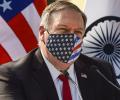
Severely critical of China, Pompeo, cited killing of Indian Army personnel in the Galwan Valley in eastern Ladakh in a clash with the Chinese military, and asserted that both India and the US are taking steps to strengthen cooperation against all threats and not just those posed by the Chinese Communist Party.
Pakistan has failed to secure a clear commitment for its much sought-after civil nuclear deal from the United States, which has decided to help in upgrading three of its thermal power plants.
Notwithstanding India's reservations, the US said on Tuesday that it would "consider" Pakistan's request for a civil nuclear deal as it wanted to help the country meet its immediate and long-term energy needs. Ahead of the crucial bilateral strategic dialogue between the US and Pakistan on Wednesday, Secretary of State Hillary Clinton made it clear that the issue of energy would be one of the subjects of discussion but refused to pre-judge the outcome of the talks.
The security situation in South Asia could get further complicated if the United States agrees to have a civilian nuclear deal with Pakistan, according to experts. Pakistan and the US are set to hold their first high-level strategic dialogue this week in Washington, co-chaired by US Secretary of State Hillary Clinton and Pakistan's Foreign Minister Shah Mehmood Qureshi. Pakistan wants a nuclear deal with the US on the lines of the ndo-US nuclear deal.
 © 2026 Rediff.com - Investor Information - Advertise with us - Disclaimer - Privacy Policy - Sitemap - Feedback - About us - Terms of use - Grievances