
The RBI's projections for consumer inflation over the rest of the year indicate some acceleration, with the rate reaching eight per cent in its baseline scenario.

The country's two biggest state-run lenders on Saturday pitched for treating a portion of their gold deposits as part of the mandatory cash reserve ratio (CRR) or statutory liquidity ratio (SLR), both of which banks consider as non-productive.

Economy improving but long way to full recovery, says FSDC.

The 30 share Sensex ended up 183 points at 27,470 and the 50-share Nifty gained 44 points to close at 8,295.

If net forex outflows turn out to be relatively high in the next few years, the rupee could depreciate beyond Rs 80 to a dollar by 2022. The causal reasons could, for example, include unmet expectations of FPI and FDI investors about the performance of the Indian economy, sharp rise in prices of imported oil and decrease in FX remittances. The RBI has to ask itself whether guaranteeing future rupee-dollar exchange rates on FX forward contracts is a reasonable way to use its risk-bearing capacity, says Jaimini Bhagwati.

'Policy was more in line with the expectations.'

Assocham expressed concern over the precarious situation that the manufacturing sector is in, observing that if the trend does not reverse with monetary and fiscal measures it would be difficult for the industry to generate jobs.

There is a narrow chance that the central bank may cut rates in the future, according to a poll of 15 economists and treasurers.

Their net NPA as a proportion of net advances were 2.2 per cent, compared with 1.7 per during the same period a year earlier.

The repo rate has been unchanged since January, when the RBI increased it by a quarter percentage point.

RBI Governor has been under pressure from Finance Ministry.

The committee's suggestion that existing commercial banks be allowed to hold payment banks as subsidiaries is also seen as unviable by RBI and the finance ministry.
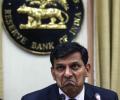
Arun Jaitley had proposed to set up a Public Debt and Management Agency.

The RBI will have to focus on constructive change to ensure growth.


RBI said inflation in the second half of the current fiscal is projected at 2.7-3.2%. It retained its GDP forecast for the current fiscal at 7.4%

Worried over a spike in interest rates in the wake of steps to support the falling rupee, the RBI on Tuesday announced a slew of measures, including Rs 8,000 crore bond buyback, to ease liquidity and ensure adequate credit flow to the productive sectors of the economy.

The most pressing issue facing the financial sector is the rising stock of non-performing assets in the banking system
He also affirmed that over time, as the government finances improve, the SLR will be brought down further.

Senior bankers are trying to impress upon the central bank that the shift to external benchmark-linked lending be postponed to April 1, 2020.

PS banks need to pull up their socks to improve cash flows.

With prices unlikely to run up sharply, genuine buyers can start readying deals before the festival season starts.

Any liquid money that gold replaces for CRR or SLR compliance will allow banks to use this 'extra' cash for lending to borrowers

The private discoms that join the scheme would only benefit in terms of operational efficiency and there will not be any financial bailout
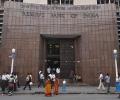
RBI had previously cut repo rate by 0.25% each in January and March.

The Finance Ministry has sought comments from stakeholders.

India's near-term growth has improved: IMF
India's banks rely on overnight borrowings to fund longer-term lending.

'My sense is that we should be braced for a correction.' 'It has already begun in the mid-caps for the past month, and will now spread to larger stocks as well.' 'Use the correction to upgrade the quality of your portfolio,' advises Akash Prakash.

Reserve Bank Governor Raghuram Rajan is widely expected to hold the key rates citing high inflation at the fourth bi-monthly monetary policy announcement on Tuesday, even though the pro-growth lobby has been wishing for a rate cut.
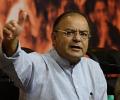
FM says government policies aim to contain inflation, spur growth.

The shares could continue to see outperformance if the Budget assumptions are proved correct
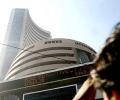
BSE Sensex ended at 25,549.72 up by 321 points or 1.27% and the Nifty ended 7624.40 up by 97.75 points or 1.30%.

Institutions will wait till there is more clarity on Budget.

Since mid-July, the RBI has taken steps to tighten cash conditions, which have failed to support the rupee but sent bond yields surging, posing a fresh threat to the already cooling economy.
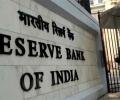
Headed by Urjit Patel, MPC for the fourth straight time kept the repo rate unchanged, at which it lends to the banks, at 6.25 per cent. The reverse repo, at which RBI borrows, will be 6 per cent.

After opting for status quo in policy rates, Reserve Bank Governor Raghuram Rajan on Tuesday said any more cut will depend on further transmission of previous rate cuts by banks, softening in inflation and progress of monsoon.

The RBI's reluctance to cut rates should be seen as a case of inability in the face of inflation.

However, the budget arithmetic is slightly optimistic.

Rajan strongly defends RBI's decision to hold the key rates in the absence of any new data points.
 © 2026 Rediff.com - Advertise with us - Disclaimer - Privacy Policy - Sitemap - Feedback - About us - Terms of use - Grievances