
For the entire 2015-16 fiscal, the factory output grew at 2.4 per cent, down from 2.8 per cent in the previous fiscal.
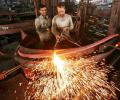
The manufacturing sector, a key indicator of economic activity, grew 10.6 per cent year-on-year in October.
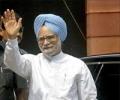
The term of the members of the Planning Commission is co-terminus with the Prime Minister and they would be submitting their resignations once the new government is formed after the ongoing general elections next month.

Retail inflation in March inched up to 8.31 per cent from 8.03 in February, mainly on account of a rise in fruit and vegetable prices.

GST rate cut for real-estate, income transfer scheme, farm loan waivers execution and recapitalisation of PSU banks have the potential to boost India's growth in a few months, says Neelkanth Mishra.

The change in the baseline for IIP and WPI, currently at 2004-05, is expected to bring in more accuracy in mapping the level of economic activity and calculating other numbers like national accounts.

This kind of growth will turn India into a $8 trillion economy.

There appears to be a growing perception among the political class that faster growth will not create jobs fast enough and, therefore, welfare spending needs to be drastically increased, says T T Ram Mohan.
N R Bhanumurthy, professor of economics at the National Institute of Public Finance and Policy, and the author of the series, presented in a report to the National Statistical Commission, explains to Abhishek Waghmare various aspects of the methodology.

The output, as measured by the Index of Industrial Production, had contracted by 2.5 per cent in the same month of last year.

The new numbers show India's economic growth rate averaged 6.7 per cent during the Congress-led United Progressive Alliance regime as compared to 7.3 per cent under the present government. Previous numbers had put the average growth rate during the 10-year UPA rule at 7.75 per cent.
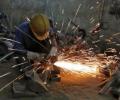
The positive numbers raises hopes of recovery.

If you looked back at 2018 and had to give it a name, the Year of Limitations might be the most accurate.
.jpg)
The growth has not been very robust in the first two financial years of the 12th Plan.

The previous high in quarterly GDP growth was recorded in the January-March quarter of 2015-16 at 9.3 per cent.

While it took the Congress nearly a half century to earn the hatred of other political outfits, the BJP appears set to reach there in around six years, says Arun Bhatnagar, former secretary to the GoI.

India's GDP is poised to accelerate to 5.5 per cent in 2014-15 on the back of improved performance in industry and services but it may take some time for the country to reach its potential growth rate, says an Asian Development Bank (ADB) report.
.jpg)
The marginal improvement in the index of industrial production was mainly on account of higher power generation and mining sector output, while manufacturing declined.
Data released earlier by CAG shows capital expenditure by the Centre had contracted 9.2 per cent in Q2

Govt has drawn list of PSUs for strategic sale: Jaitley
After assuming power in 2014 with a full majority of its own, the BJP-led NDA government started an ambitious process of reforming labour laws in the form of codes aimed at making the framework less cumbersome with a variety of alterations. It had planned four codes each for industrial relations, wages, social security and welfare, and occupational safety, health and working conditions. To this end, 35 central labour laws were to be converted into four codes that would have had the virtue of streamlining labour relations. But none of the proposed code Bills could be converted into a law principally because neither trade unions nor industry representatives came on board. They hold the key to India's low-growth-high unemployment paradigm but the government may struggle to push them through this time as well. Somesh Jha explains why

Here are the key decisions announced by the Reserve Bank of India on Thursday.

Growth in India is expected to remain strong and stable in 2015

'Whatever happens in any part of the world affects us.'

The previous high GDP growth of 8.1 per cent was recorded in April-June quarter of 2016-17.

Tamil Nadu now has India's lowest fertility rate - lower than Australia, Finland and Belgium - second best infant mortality and maternal mortality rate; records among the lowest crime rates against women and children; and has more factories and provides more industrial employment than any other Indian state.

This time there has been a rather peculiar criticism of the latest GDP numbers.

the GDP estimates incorporate new source data and modified compilation techniques

The GDP always has a base year, which defines the composition of the economy in that year. As the composition changes, the base year needs to be revised regularly. Abhishek Waghmare explains how that is done.

As against an annual average growth of 10-11 per cent envisaged for the industry during the period, the actual annual average growth stood at 7.2 per cent during the plan period.

India's growth slowed in three months through December from a revised 7.4% expansion in the previous quarter, but it was much stronger than expected.

For example, railways, roads and highways, and shipping could form a section within the Budget as an omnibus transport sector

India on track to be third largest consumer economy by 2025.

A recent data released by the Central Statistics Office (CSO) confirm that both the manufacturing and mining sectors shrunk in 2013-14 with fall in output.
India's GDP had recorded 7.5 per cent growth in the April-June quarter of last fiscal.

The combined share of customs and excise duties, service tax, and value-added tax in India's gross domestic product reached an all-time high of 10.5%.

On the revenue front, the finance ministry was expecting higher proceeds from non-tax revenue.

He is expected to invite German companies to invest in India and participate in 'Make in India' initiative

RBI projects GDP growth in FY16 at 7.8 per cent, 30 bps higher than FY15. However, this comes with a downward bias.

Industrial production growth slowed down to five-month low of 0.4 per cent in August mainly due contraction in manufacturing output and lower offtake of consumer goods.
 © 2026 Rediff.com - Investor Information - Advertise with us - Disclaimer - Privacy Policy - Sitemap - Feedback - About us - Terms of use - Grievances