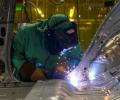
The manufacturing sector, which constitutes 77.63 per cent of the IIP, contracted by 0.4 per cent in March as compared to 5.7 per cent expansion in the year-ago month.

On overall basis, the inflation in the food segment increased to 4.42 per cent in November as compared to 1.9 per cent in the preceding month.

In terms of industries, 10 out of 23 industry groups in the manufacturing sector showed positive growth during November 2018.

Finance secretary Ajay Bhushan Pandey on Sunday hinted that the government was working on another stimulus package but he refrained from giving a timeframe.

The inflation in the food basket spiked to 7.89 per cent in October 2019 as against 5.11 per cent the preceding month.

In terms of industries, 17 out of 23 industry groups in the manufacturing sector have shown negative growth.

GVA growth in the manufacturing, farm and construction sectors tumbled.

Experts warn of over-interpreting the numbers and said their sustainability needed to be watched beyond November, says Indivjal Dhasmana.

However, the government has enacted an important change to the fixed-term employment framework that may help companies in handing out contractual jobs to its existing permanent workforce.

If the forecast materialises, it would mean the fourth successive quarter of economic growth below 5 per cent.
Quoting from the report of Central Statistics Office, the former deputy chief minister Sushil Kumar Modi said that Bihar's growth rate has reduced to half at 8.82 per cent in 2013-14 against 15.05 per cent in 2012-13.
Capital expenditure by private companies halved in FY13 from that in FY08; households put more money into gold, houses.

The first economic readings to be published in 2015 will be out on Monday, when the government releases industrial output data for November and the consumer price index for December.

'This encourages escapism through the politics and economics of nationalism, made worse by tribalism or nativism, the package accompanied inevitably by the erosion of institutional bulwarks and therefore State capture by powerful businessmen,' notes T N Ninan.
The economy is expected to grow 4.9 percent in 2013/14, marginally lower than the finance ministry's estimate of a 5 percent growth, dragged down by a contraction in the manufacturing sector, a government statement said on Friday.
The NCEAR has indicated some improvement in the fourth quarter of the current financial year.

Declining vegetable prices brought down the retail inflation to a 15-month low of 4.59 per cent in December and within the comfort zone of the Reserve Bank, government data showed on Tuesday. It is for the first time during the current fiscal that the Consumer Price Index (CPI) based inflation print is below 6 per cent or in the RBI's target range of 2 to 6 per cent. The central bank factors in the CPI-based inflation while arriving at its monetary policy. The inflation in December 2020 came down from 6.93 per cent in November, mainly on account of 10.41 per cent decline in vegetable prices over the year-ago period.

Ireland, a predominantly Catholic country, has recorded the death of Indian dentist Savita Halappanavar as the only maternal casualty in 2012, which a new report has found was not true.

Milk and its products too were less expensive with inflation print of 4.21 per cent, cereals and products at 2.10 per cent, meat & fish at 3.31 per cent while for eggs the prices grew at a slower pace of 8.51 per cent.

In terms of industries, 22 out of 23 industry groups in the manufacturing sector showed positive growth during July 2018.

'We will have to wait for one more year to cross the 7% mark, which should be possible in the absence of any disruptive reform,' points out CARE Ratings Chief Economist Madan Sabnavis.

Top Sensex gainers include Hero MotoCorp, Bajaj Auto, Asian Paints, IndusInd Bank, HUL, and Maruti, rallying up to 5.87 per cent. While, ICICI Bank, NTPC and ITC slipped up to 0.13 per cent.

After contracting for two quarters in a row, the Indian economy entered the positive territory with a growth of 0.4 per cent in the October-December quarter, mainly due to good performance by farm, services and construction sectors, official data showed on Friday. Trade and hotel industry registered a contraction of 7.7 per cent during the third quarter this fiscal, as the sectors continued to suffer on account of coronavirus pandemic. According to the data released by the National Statistical Office (NSO), the farm sector recorded a growth of 3.9 per cent, and the manufacturing sector output grew by 1.6 per cent in the quarter under review.

Items such as cereals and products, meat and fish, oils and fats became cheaper

In fact, India's investment activity growth is also estimated to touch a 17-year low in FY20. With overall demand not showing signs of revival, investment activity may take longer to recover, economists said.

Measures that quickly boost demand and increase employment are needed to push up growth. Moreover, without announcing new planss, the government should strengthen schemes such as PM KISAN, MNREGA and programmes to build rural roads.

The rate of price rise in the vegetable segment almost doubled to 7.47 per cent as against 3.92 per cent in September.

In the manufacturing sector, output is expected to decline by about 70 per cent as only food-processing, and drugs and pharma industries are allowed to operate while other segments, such as engineering and metals, have shut operations.

The Indian economy appears to have slowed down in 2018-19 due to lower private consumption, tepid growth in fixed investment and muted exports, a finance ministry report has said.

India's GDP is estimated to contract by a record 7.7 per cent during 2020-21 as the COVID-19 pandemic severely hit the key manufacturing and services segments, as per government projections released on Thursday. Amid overall decline in economic activities, some respite was provided by the agriculture sector and utility services like power and gas supply, which have been projected to post positive growth during the current fiscal ending March 2021.

The Seventh Pay Commission had decided to choose the CPI-IW as the index for adjusting inflation for central government employees.

Capital goods production, a barometer for investments in the economy, contracted by 2 per cent in August.

India's economy recovered faster than expected in the September quarter as a pick-up in manufacturing helped GDP clock a lower contraction of 7.5 per cent and held out hopes for further improvement on better consumer demand. The gross domestic product (GDP) had contracted by a record 23.9 per cent in the first quarter of the 2020-21 fiscal (April 2020 to March 2021) as the coronavirus lockdown pummelled economic activity.

Corporate results confirm worst fears about growth trajectory.

The panel noted that the macro-economic fundamentals of the economy are sound but challenges remain, several of which are structural in nature.
India's problem cannot be blamed on external considerations alone.

The NSE index Nifty ended above the 10,500-mark.

In terms of industries, 16 out of 23 industry groups in the manufacturing sector have shown positive growth during December 2017 as compared to the same month year ago.
When FM was that the third-quarter GDP data was not in line with his ministry's optimism, he had said he relied on the advice of his advisors.
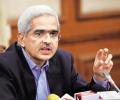
Softening inflation, Das said would make available more policy space to the central bank to address risks to the growth going forward.
 © 2026 Rediff.com - Investor Information - Advertise with us - Disclaimer - Privacy Policy - Sitemap - Feedback - About us - Terms of use - Grievances