
Senior Congress leader Shashi Tharoor welcomed the revival of long-stalled India-UK FTA negotiations, posting a selfie with Union Commerce and Industry Minister Piyush Goyal and the UK's Secretary of State for Business and Trade Jonathan Reynolds. Tharoor's post comes amid a row over his recent article praising the Kerala government's investment climate, which drew criticism from some Congress leaders.

While welcoming Prime Minister Narendra Modi's announcement on Saturday to celebrate January 16 as National Start-up Day, six years after the Start-up India Action Plan was launched by the government, stakeholders in the ecosystem say that more needs to be done at the policy level to unleash the next phase of growth in the sector. "The Start-up India programme's launch in 2016 was a turning point - that is when the promoter came to be known as the founder in the country and the word 'entrepreneur' entered the common lexicon. "But now we need a Start-up India 2.0 now for the next phase of growth of the ecosystem", said Siddarth Pai, managing partner of venture capital (VC) firm 3one4 Capital. Pai says that Startup India 2.0 must look at promoting Startups headquartered in tier II,III & IV cities and solving the problems of Bharat.

Organisations that reward constant optimism and penalise negativity create environments where employees feel pressured to hide their struggles, notes Sonica Aron, founder of HR consultancy firm Marching Sheep.

The move followed after certain startups complained about facing harassment and the taxman breathing down their neck on the angel tax issue.

The Stayzilla episode raises questions over the regulations around the closure of a business, says Sudipto Dey.

The process of discovering and developing a new drug can take decades and costs hundreds of millions or even billions of dollars. However, technological advances like artificial intelligence can help speed up and transform the time-consuming and labor-intensive exercise. In India, Peptris Technologies, a Bangalore-based AI drug discovery company, has announced $1 million in pre-seed round investment led by Speciale Invest.

India witnessed a record-breaking surge in deal activity in February, with 226 M&A and private equity deals totaling $7.2 billion -- the highest monthly deal volume in the last three years, according to the Dealtracker report of Grant Thornton Bharat. "This represents a 67 per cent increase in volumes and a 5.4-fold increase in values compared to February 2024, while a 14 per cent increase over the previous month," it said.

The journey of life will always come with its temptations; it is the ability to stick to your goal that will eventually lead you to success. A fascinating excerpt from Manish Vij's must-read book, Brick by Brick.

According to a survey by community platform LocalCircles, early-stage start-ups, funding dependent start-ups and many small businesses will soon be fighting for survival as the spurt in coronavirus cases hits them hard.

'We give them problems so that they can come up with solutions using the technological skills they have learnt.' 'In fact, changemaking and problem solving are interchangeable, in a way.'

'Because the same stupid questions are repeated year after year when an exam should provoke the students to think and not ask repetitive questions.' 'So, what do coaching institutes do? They teach students to memorise these questions and answers without understanding the subject.'

The start-up story appears to be losing its sheen due to corporate misgovernance, financial mismanagement and gender discrimination.

'Can we give young India the tools to solve the problems the country or society faces and uplift the community?'

The country's top three venture debt firms -- Alteria Capital, Innoven Capital, and Trifecta Capital -- combined deployed about $300 million (Rs 2,200 crore) in start-ups such as BigBasket, Cure.fit, Ninjacart, Dunzo and Lendingkart till April end, according to the government's Investindia website.

A strong start-up ecosystem can propel investment, jobs, and demand creation, and for that, substantial growth capital is required.

From the launch of the 'Startup India' initiative in 2016, to the abolition of angel tax and easing of reverse flipping norms, the startup ecosystem is evolving.

Karnataka Chief Minister Siddaramaiah announced reservation for Muslims in supplying goods and services up to a value of Rs 1 crore to various government departments, corporations and institutions in the state budget for 2025-26. The budget also increased the value limit of government contracts in which Muslims can avail reservation to Rs 2 crore. The reservation to Muslims under 2B category is in addition to the Scheduled Caste, Scheduled Tribe, and Castes coming under Category-1, Category-2A. The budget also included various welfare schemes for minorities, including Rs 50,000 to support simple marriages and Rs 1,000 crore under the Chief Minister's Minority Colony Development Programme.

UP Warriorz, facing elimination in the Women's Premier League, will aim to spoil Royal Challengers Bangalore's playoff hopes in a crucial encounter on Saturday.

'To access our satellite, you don't need any IQ test, you don't need to write an examination.' 'You can be a Class 1 student, an engineering student, a 60-year-old person, anybody can access our satellite.'

Demonstration of seed germination in outer space, a robotic arm to catch a tethered debris there, and testing of green propulsion systems are some of the experiments planned on the POEM-4 -- the fourth stage of ISRO's PSLV rocket that remains in orbit after launching a satellite.

With its age-old fascination for education, southern states have done better than the North. Start-ups, IT hubs, and industry majors setting up shop have changed the face of the South. Nearly 79% of global offices set up by international conglomerates in India are in the South. Almost 46% of tech unicorns are from the South. The GDP per person in the South is 4.2 times higher than the North. None of these indicators can be ignored by any central government, whatever the political compulsions, notes Ramesh Menon.

Read this and rest assured you can be on your own against venture capitalists and angel investors

Billionaire and Mahindra Group chairman Anand Mahindra along with top Silicon Valley investors Naval Ravikant and Balaji Srinivasan are backing space tech start-up Agnikul as part of a new funding round. Chennai-based Agnikul said, on Thursday, that it has raised $11 million in Series A funding round led by Mayfield India. It is the largest funding round for a private Indian space technology company in the country. Existing investors pi Ventures, Speciale Invest and Artha Venture Fund also invested in this round.

Family offices are increasingly looking to invest directly in start-ups rather than through investment in venture capital (VC) firms. The shift is happening because of multiple reasons. Next-generation scions of wealthy families are conversant with how the start-up world works after they have spent time in Silicon Valley; start-up investment is rising to 10-15 per cent of family offices' portfolios from single digits; and they do not want to share gains of investment with VC firms. "While earlier they would prefer to invest in this asset class via venture capital (VC) funds as LPs (limited partners), now they are making direct investment in start-ups.

Tech start-ups will continue to take the lead in bolstering the regional economy, says Murali Talasila.

The Chinese government is imposing severe restrictions on their tech companies - whether it is on data security, marketing practices or floating an IPO. Should this be music to the ears of Indian start-ups and home-grown private equity (PE) funds? Ask Indian start-ups and the answer is a resounding "yes".

Prime Minister Narendra Modi met United States President Donald Trump at the White House in Washington, DC on Thursday.

'Start-ups that generate a majority of their income in India are likely to opt for an Indian listing.'

'Gyanendra back on the throne would be bad news for the Nepali people. He may not have learnt from his experience, but we have.'

Over the years, start-ups are struggling more to garner funds as they pass the elementary stages of growth.

The move is expected to create space for more budding entrepreneurs in the country to be eligible for self-certification, relaxed public procurement norms, rebate in patent filing, start-up funding, investment and easier closure compliance.

'At Aero India 2025, be prepared to be inspired, awed, and educated,' says Air Commodore Rohith Vijayadev, Air Officer Commanding Yelahanka. 'Aero India 2025 promises to be more than just an air show; it is a celebration of innovation, collaboration, and India's growing leadership in global defence and aviation,' notes Air Commodore Nitin Sathe (retd).

Investing in start-ups can be highly rewarding, but direct investing is not meant for everyone. For the majority of wealthy investors, taking the private-equity route could still be the better option.

Various start-ups have raised concerns on notices sent to them under the Section 56 of Income Tax Act to pay taxes on angel funds received by them.

E-commerce startup Dukaan has replaced 90 per cent of its customer support team with an artificial intelligence (AI) chatbot, founder and CEO Suumit Shah informed on Tuesday. Attributing the decision to prioritising profitability, he said customer support costs reduced by 85 per cent while resolution time went down from over two hours to three minutes. "We had to lay off 90 per cent of our support team because of this AI chatbot. Tough? Yes. Necessary? Absolutely," Shah tweeted.
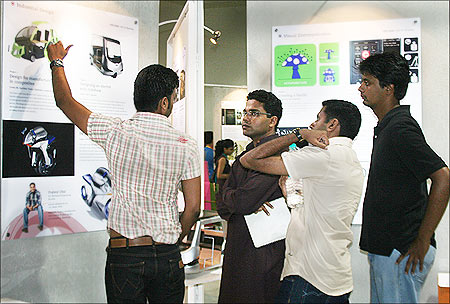
Perhaps, the most misunderstood aspect is the role of the state.

While participation of start-ups in the space sector has largely been minimal so far, their involvement will be key towards building India's very own aerospace companies such as Maxar, Elon Musk's SpaceX and Rocket Labs, according to experts.

Companies that do not know why they are doing good also do not know why they are failing when they are on a downward slide, notes Baqar Iftikhar Naqvi, founder and CEO, Upriver, a sales accelerator firm.
'As much as $4 billion in India's start-up companies has come from Chinese funds.' 'Government policy must not remain indifferent to the problems India's start-up ventures are likely to face after the change in FDI rules,' says A K Bhattacharya.
Also, a dedicated cell, headed by a member of the Central Board for Direct Taxes (CBDT), will be set up to address concerns faced by start-ups.
