
The Supreme Court on Friday ordered mediation to settle the Ram Janmabhoomi-Babri Masjid dispute by a three-member panel comprising of Justice Kalifulla, advocate Sriram Panchu and spiritual guru Sri Sri Ravishankar. The panel has been given eight weeks by the Supreme Court to arrive at a conclusion and four weeks to give a status report. Here's all you need to know about the panel of mediators:

Former judges of the Supreme Court and high courts and some senior advocates have written a letter to the Chief Justice of India NV Ramana requesting the top court to take suo motu cognisance of the detention of protestors and demolition of their houses by the Uttar Pradesh authorities following protests against objectionable remarks made by BJP spokespersons.

The interesting fact was revealed to public for the first time by the Supreme Court Bar Association president and senior advocate Vikas Singh during his address on occasion of the farewell ceremony for the CJI.

Here are some of the reactions to the apex court's decision.
The bench on October 16 had reserved the judgment after marathon hearing of 40 days.
Sources said the parties have sought settlement under the provisions of The Places of Worship Act, 1991 which provides that no dispute with regard to any mosque or other religious places, which have been constructed after demolition of temples and are existing as in 1947, would be raised in a court of law.

The apex court had on July 11 sought a report on the mediation process and said that a day-to-day hearing might commence from July 25 if the court decides to conclude the mediation proceedings.
A five-judge Constitution bench headed by Chief Justice of India Ranjan Gogoi, which started the day-to-day proceedings on August 6 after mediation proceedings failed to find an amicable solution to the vexatious dispute, has revised the deadline for wrapping up the proceedings and has fixed it on October 17.
The Supreme Court constituted three-member mediation committee, tasked with exploring the possibility of an amicable settlement in the decades-old, politically sensitive, Ayodhya's Ram Janmabhoomi-Babri Masjid land dispute case, has submitted its interim report in a sealed cover.

The arguments in the matter were the second longest after the landmark Keshvanand Bharti case in 1973 during which the proceedings for propounding the doctrine of basic structure of the Constitution continued for 68 days.
The bench directed that the mediation will be held at Faizabad in Uttar Pradesh and the process should start within a week from Friday.
The apex court requested the committee to inform it by August 1 about the outcome of the proceedings held till July 31.
The lawyers said the mediation panel's report was leaked to the media and they do not approve the procedures adopted in the process and the suggested compromise formula of withdrawal of the lawsuit.
The litigants and their counsels -- altogether over 50 people -- met the three-member mediation panel on the Avadh University premises in Faizabad.
The counsel appearing for both the Hindu and Muslim parties expressed confidence over the ongoing mediation proceedings and said they are fully cooperating with the process.
The SC also said that if parties to the case want to amicably resolve the matter through mediation, they can still go ahead with it.
The bench said after perusing the report, if it came to a conclusion that an amicable solution through mediation was not possible, then the apex court would commence day-to-day hearing in the matter from July 25.
The judgment in the matter is to be pronounced by November 17, the day the CJI will retire.
The bench, which was hearing the politically sensitive case on 34th day, asked Parasaran as to whether 'it has been held that any Hindu temple, including the land has been accorded the juristic personality'.
The apex court said the parties in the matter should be ready to start the hearing on the appeals which are before it.
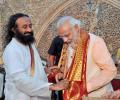
'Earlier, Sri Sri told me we (Muslims) must give up our claim to the Babri Masjid site and be large-hearted.' 'Sri Sri has always taken sides on this issue, and isn't neutral at all.'

Senior advocate Rajeev Dhavan, representing the Muslim parties in the case, tore up a pictorial map.
 © 2026 Rediff.com - Investor Information - Advertise with us - Disclaimer - Privacy Policy - Sitemap - Feedback - About us - Terms of use - Grievances