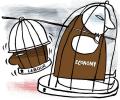
Union Labour Minister Bhupender Yadav has exuded confidence that four labour codes, which would bring another wave of reforms, will soon be implemented as around 90 per cent of states have already come out with draft rules. In 2019 and 2020, 29 central labour laws were amalgamated, rationalised and simplified into four labour codes, viz, the Code on Wages, 2019; the Industrial Relations Code, 2020; the Code on Social Security, 2020; and the Occupational Safety, Health & Working Conditions Code, 2020, noted the Survey. During an interaction, Yadav told reporters that around 90 per cent of the states have already published draft rules on four labour codes and he expects the four legislations would become operational soon.
The law firms will provide legal opinion on matters related to interpretation of various statutes, such as the Employees' Provident Funds and Miscellaneous Provisions Act, 1952, among other things.
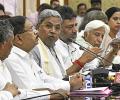
The Cabinet held a detailed discussion regarding the five guarantees and its implementation, and has arrived at decisions, Siddaramaiah who headed the meeting told reporters.

The Bharatiya Janata Party has released its manifesto for the upcoming Nagaland assembly elections, promising a special package for the eastern part of the state and establishment of a board for the holistic development of the region if the party returns to power for the second time in a row.

Finance Minister Nirmala Sitharaman will be presenting her fifth Budget that may do a tightrope walk between staying fiscally prudent and meeting general public expectations of lower taxes and a wider social security net, while at the same time firing the engines of the economy.

There are over 1.36 lakh employees, including employees and pensioners under the new pension scheme.
The four labour codes on wages, social security, industrial relations and occupation safety, health and working conditions are likely to be implemented by the next fiscal year as at least 13 states have pre-published draft rules on these laws, a senior official said. The Centre has already finalised the rules under these codes and now states are required to frame regulations on their part as labour is a concurrent subject. A senior official said that the four labour codes are likely to be implemented by the next fiscal year.

Finance Minister Nirmala Sitharaman will have to do a tight-rope walk between staying fiscally prudent and general public expectations of lower taxes and a wider social security net, while at the same time firing the engines of the economy before general elections. Sitharaman will on Wednesday present her fifth straight Budget at a time when the economy is slowing due to global headwinds and specific sectors need attention. In the run-up to the Budget presentation, expectations are rife that she may tweak income-tax slabs to provide relief to the middle class and increase spending on the poor through programmes such as the rural job scheme while ramping up financial incentives for local manufacturing.

Gehlot made the announcement in the presence of Congress president Mallikarjun Kharge and former party chief Rahul Gandhi at a rally here on the sidelines of the "Bharat Jodo Yatra".

'Welfare schemes are not a necessary evil, they are a necessary good.'

The Code on Social Security, 2020 gives a lot of comfort to gig firms which recognise cab drivers or food delivery executives as 'independent contractors' who directly do business with customers with the help of their digitised platforms.

The Railways has also partially cancelled two mail/express trains, thus the total number of trains affected during the day is 371, the officials said.
The Union government will take a bit longer to introduce the much-awaited labour codes even as the majority of states and Union Territories (UTs) have framed rules on them. There were speculations that these would be introduced from July 1. While 30 states and UTs have framed rules on the code on wages, 25 of them have done so on industrial relations. Of the two remaining codes, 24 states and UTs have framed rules on social security and 23 on occupational safety, health, and working conditions (OSH), sources said.

Experts say, these leave many matters to the discretionary powers of bureaucrats, rather than providing them explicitly in the rules.

India's gig workforce is expected to expand to 2.35 crore by 2029-30 from 77 lakh in 2020-21, a NITI Aayog report said on Monday, and recommended extending social security measures for such workers and their families in partnership mode as envisaged in Code on Social Security. The report titled 'India's Booming Gig and Platform Economy' further said gig workers are expected to form 6.7 per cent of the non-agricultural workforce or 4.1 per cent of the total livelihood in India by 2029-30. Gig workers can be broadly classified into platform and non-platform workers.
'We are worried for the workers because in the private sector, jobs are not secure, there is no decent work condition and there is no social security.' 'That's why we are opposing the economic policies of this government.'
Finance Minister Nirmala Sitharaman will present the Union Budget for 2023-24 in Parliament on February 1. The Budget is a statement of the government's estimated receipts and expenditures for a fiscal year (April 1 to March 31). It's divided into Revenue and Capital Budget. The Revenue Budget includes the government's revenue receipts and expenditures while the Capital Budget includes its capital receipts and payments.

Ten ministers were inducted into the Mann-led cabinet on Saturday.

"There has been a 0.05 percentage points decline in the share of allocation for child budget to the Union Budget from 2.35 per cent (2022-23 BE) to 2.30 per cent (2023-24 BE).
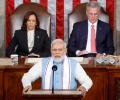
Here's the full text of Prime Minister Narendra Modi's address to a joint session of the United States Congress, delivered on Thursday.

The richest one per cent in India now own more than 40 per cent of the country's total wealth, while the bottom half of the population together share just 3 per cent of wealth, a new study showed on Monday.
Both prime ministers believed in crafting schemes to help the common man. Modi used quite effectively the instruments Dr Singh introduced. In assessing Modi's success with many schemes, Dr Singh's fundamental work should not be ignored, points out A K Bhattacharya.

In many states, aggregators operate without a licence; in others, with the risk of the licence being revoked by any regional transport office on the slightest pretext.

Labour Minister Santosh Gangwar said, the purpose of labour reforms is to provide a transparent system to suit the changed business environment.

The richest one per cent in India now own more than 40 per cent of the country's total wealth, while the bottom half of the population together share just 3 per cent of wealth, a new study showed on Monday. Releasing the India supplement of its annual inequality report on the first day of the World Economic Forum Annual Meeting in Davos, rights group Oxfam International said that taxing India's ten-richest at 5 per cent can fetch entire money to bring children back to school. "A one-off tax on unrealized gains from 2017-2021 on just one billionaire, Gautam Adani, could have raised Rs 1.79 lakh crore, enough to employ more than five million Indian primary school teachers for a year," it added.

Avoid clicking on any unknown links from strangers. Use a different, secure password for each social media account you have.
The implementation of four labour codes in one go from April 1 next year will usher in a new wave of reforms in industrial relations and also help in attracting more investments but employment generation will remain a key challenge in 2021. This year has also been a challenging year for the work force as well as for employers due to the outbreak of the COVID-19 pandemic. The government imposed a nationwide lockdown from March 25, which had an adverse impact on economic activities and resulted in exodus of migrant workers from large cities to their homes in the hinterland. Many migrant labourers lost their jobs and it took months for them to return back to their work places from their native places.

Fairwork focuses on five principles of fair gig work: Fair pay, fair conditions, fair contracts, fair management, and fair representation.
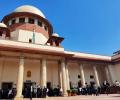
The National Judicial Commission Bill, 2022, was introduced after the majority of voice votes were in its favour.

Since jobs will remain scarce for the foreseeable future, an unemployment allowance should be the next big social-security initiative, suggests T N Ninan.

It is a trend that economists and researchers say might continue. The data shows the share of this age group in the net EPF accounts created - a proxy for net new formal jobs created - fell from 37.9 per cent in 2018-19 to 24.1 per cent in 2021-22.

The Centre has increased the premium rates for its flagship insurance schemes, Pradhan Mantri Jeevan Jyoti Bima Yojana (PMJJBY) and Pradhan Mantri Suraksha Bima Yojana (PMSBY), for the first time in seven years due to "long-standing adverse claims experience", and to make them economically viable. The premium for PMJJBY would increase from Rs 330 to Rs 436 a year effective June 1, and the PMSBY premium would rise from Rs 12 to Rs 20, the Ministry of Finance said in a statement. PMJJBY provides life insurance cover worth Rs 2 lakh to all account holders aged 18-50 years.
Retirement fund body EPFO net added 14.81 lakh subscribers in August 2021, reflecting a growing trend in net payroll for the first five months of this fiscal. The provisional payroll data of Employees' Provident Fund Organisation (EPFO) released on Wednesday highlights that it added around 14.81 lakh net subscribers during the month of August 2021, a labour ministry statement said. The data reflects a growing trend in net payroll for the first five months of the current financial year, it added.

The Delhi Commission for Women has issued a notice to Indian Bank seeking withdrawal of its new recruitment guidelines which prevents a woman, who is three or more months pregnant, from joining service.
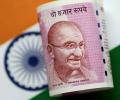
Blame the voter, who invariably chooses the promise of hand-outs today in preference to a vague promise of, say, better schools tomorrow. Getting the Supreme Court to issue an edict, or Parliament to pass a law, is no solution, observes T N Ninan.

Human Development -- a measure of a nation's health, education, and average income -- has declined for two years in a row.

Planet Earth welcomed its 8th billion inhabitant on Tuesday, a remarkable milestone for humanity that is set to propel India to become the world's most populous country next year, surpassing China amid rising global challenges.

Indian billionaires saw their combined fortunes more than double during the COVID-19 pandemic, and their count shot up by 39 per cent to 142, while the wealth of the ten richest is enough to fund school and higher education of children in the country for 25 years, a new study showed on Monday. In its annual inequality survey released on the first day of the World Economic Forum's online Davos Agenda summit, Oxfam India further said that an additional one per cent tax on the richest 10 per cent can provide the country with nearly 17.7 lakh extra oxygen cylinders, while a similar wealth tax on the 98 richest billionaire families would finance Ayushman Bharat, the world's largest health insurance scheme, for more than seven years. The COVID-19 pandemic saw a huge rush for oxygen cylinders and insurance claims during the second wave last year.
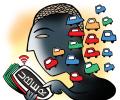
With a report on Uber by the International Consortium of Investigative Journalists (ICIJ) opening a Pandora's box, the company is in a damage-control mode. Distancing itself from the actions of its management pre-2017, Uber, while acknowledging the "mistakes" of the past, has said that under CEO Dara Khosrowshahi, it "is a different company". "There has been no shortage of reporting on Uber's mistakes prior to 2017.

Their implementation is expected to create investment owing to improving ease of doing business as well as initiating pro-worker measures.
 © 2026 Rediff.com - Investor Information - Advertise with us - Disclaimer - Privacy Policy - Sitemap - Feedback - About us - Terms of use - Grievances