
The government will unveil a second stimulus package to give the economy traction through measures aimed at aiding specific sectors, including auto, realty and small and medium enterprises.

Google India, the Indian unit of the global internet giant, said on its official blog that it has launched an 'India Get Your Business Online' programme to provide website, internet domain and web hosting services to small and medium businesses (SMBs) in the country.
It's a difficult time for banks both at home and abroad. But Sanjay Nayar, Chief Executive Officer, Citi India, shrugs off Citigroup's problems in the US saying they haven't really impacted the Indian operations. Nayar admits there have been a few problems with the consumer finance business but tells Business Standard that Citi's India operations are well-positioned to see double digit growth over the next few years.
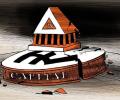
S&P Global Ratings on Monday said systemic risk in Indian banks is likely to remain high in the wake of the second wave of COVID-19 and high proportion of weak loans. S&P estimates the weak loans in banks at 11-12 per cent of gross loans.
Since the burden of 'reserve' tax has fallen primarily on SMEs as they depend on bank finance, a further hike in its Cash Reserve Ratio will definitely hit the SMEs and small savers.

The government said it had received many representations seeking extension of time citing many difficulties due to the second wave of Covid-19 and the subsequent lockdowns. MCA has asked the registrar of companies to approve the extension of the time limit to hold the AGM.

The India arm of the 50.9-billion, France-based, Orange Business Services (OBS), offering integrated communication services, is looking at quadrupling its sales in India over the next five years.
The Bombay Stock Exchange, Asia's oldest stock exchange, plans to launch a separate trading platform for small and medium enterprises. Sources close to the development said the BSE was preparing a strategy for an SME exchange.
The National Stock Exchange is chalking out a strategy to launch a separate trading platform for small and medium companies.
Budget 2007-08 has been a mixed bag. The small scale sector has received some attention

'India's manufacturing will take 10-15 years to catch up with China.'
Asserting that India had removed many barriers in trade and investment

The minister added that the exchanges should not be discouraged by the failure of past attempts at launching such a dedicated platform for small exchanges.

The US department of commerce's first Aerospace Supplier Development Trade Mission to India is currently on a five-day trip to the country. The mission has 11 aerospace companies, many of which are suppliers to Tier-I and Tier-II aerospace companies in US and different parts of the world.

The accelerating pace of digitalisation, fuelled by the COVID-19 pandemic, has led to a record-breaking year for cybercrime with ransomware attacks rising 151 per cent in 2021, and an average of 270 cyberattacks per organisation being faced, a new study showed on Tuesday. The World Economic Forum's 'Global Cybersecurity Outlook 2022', released during its online Davos Agenda summit, further said that each successful cyber breach cost a company $3.6 million (nearly Rs 27 crore) last year, while the average share price of the hacked company underperformed NASDAQ by nearly 3 per cent even six months after the event in case of the breach becoming public. The WEF said the global digital economy surged on the back of the COVID-19 pandemic, but so has cybercrime and nearly 80 per cent of cyber leaders now consider ransomware a 'danger' and 'threat' to public safety.
And the response it received was tremendous: About 7,200 memoranda of understanding, worth Rs 7,000 crore (Rs 70 billion), have been signed. The MoUs aim to generate more than 2,80,000 jobs in Gujarat. What's more, four major banks, including State Bank of India and Commonwealth Microfinance India from the UK, signed MoUs worth Rs 60,000 crore (Rs 600 billion) with the Gujarat government to support the SME sector.
This meeting assumes importance pursuant to the fiscal stimulus package announced last Sunday mentioning package for housing loans below Rs 20 lakhs (Rs 2 million). The government had earlier said that public sector banks would soon announce a package for borrowers of home loans up to Rs 500,000 and between Rs 500,000 and Rs 20 lakhs (Rs 2 million).

The proposal in the Finance Bill to amend provisions of Section 179 of the Income Tax (I-T) Act relating to tax liability of directors of private limited companies from April 1, 2022, could increase risks for directors of medium and small-sized firms in case of non-payment, said experts. While the language of the provision is quite broad, the title of the section limits itself to 'liability of directors of private companies in liquidation'. The Bill proposes to align the title with the scope of the provision, thereby ensuring that orders under this section can be issued even if the relevant company is not under liquidation.
With little clarity on the list of companies that have mark-to-market losses on derivatives transactions, banks are now asking their corporate banking departments to scan the books of borrowers and also seek details of their foreign exchange exposure. Within this pie, banks are segregating companies with turnover of Rs 30-40 crore (Rs 300-400 million) to Rs 100 crore (Rs 1 billion) and those which are above this threshold.

If India wants to become a globally competitive manufacturing hub, it will have to rethink the notion that the traditional SMEs will form the manufacturing backbone, argues Prosenjit Datta.

According to industry sources, domestic toy manufacturers are seeing a sharp rise in sales during the current financial year. On January 1, 2021, India had banned the sale of toys that are not certified by the Bureau of Indian Standards (BIS). This meant that all factories churning out toys to be sold in India had to be certified by the bureau along with mandatory product testing, including for units abroad.

The Deutsche report said though India must move to a GST regime, the transition is likely to be disruptive for large sections of the economy and SMEs

The traffic tells a story. During the lockdown, it took 45 minutes to zip through the deserted 35-km stretch from Chennai to reach the automobile heart of Sriperumbudur-Oragadam, where the big names of the car industry - Hyundai Motor India, Renault-Nissan India, Daimler India Commercial Vehicles, Apollo Tyres, and Royal Enfield - are based.

The social media giant is planning to launch roadshows in these locations as part of its 'SMB Boost' programme.

Personal loans have about 80 per cent share in exposures restructured under regulatory package 2.0 by eight banks who have declared results for the second quarter. The remaining 20 per cent are loans to individuals used for business and credit to MSMEs. The total recast exposure of these banks under One Time Restructuring (OTR 2.0) was Rs 27,708 crore.

According to a survey by community platform LocalCircles, early-stage start-ups, funding dependent start-ups and many small businesses will soon be fighting for survival as the spurt in coronavirus cases hits them hard.
The government and the Reserve Bank are discussing the matter on a constant basis and is likely to come out with a decision in the near future, secretary to the ministry of micro, small and medium enterprises, Dinesh Rai told reporters. Presently, banks are required to keep atleast 40 per cent of their total loan disbursal to the priority sector which includes the micro-institutions in the country.
Global IT firms are taking a cue from consumer firms, which revolutionised marketing tactics in the FMCG segment with the shampoo-in-a-sachet concept by appealing to semi-urban as well as rural consumers.

As many as 2,000 chips are annually designed in India by semi-conductor and fabless companies, Intel India managing director Prakash Mallya said in a conversation with Business Standard. Mallya was reiterating the importance of India in the semi-conductor sweepstakes. "As much as 90 per cent of the semi-conductor companies have a design footprint in India.
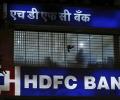
With the banking regulator lifting restrictions on HDFC Bank's digital initiatives, the largest private sector lender is now girding up to launch a clutch of customer-facing applications (apps), which will act as stepping stones in its journey to morph into a technology (tech)-led bank from a conventional one. Following repeated outages in its digital offerings, the Reserve Bank of India (RBI) had barred HDFC Bank from issuing new credit cards in December 2020 and prevented it from going ahead with its digital launches. The embargo on issuing credit cards was lifted in August 2021 and the ban on digital launches was lifted last week.

The study covers 3,234 SMEs, with sales turnover ranging from Rs 1 crore (Rs 10 million) to Rs 500 crore (Rs 5 billion). It includes manufacturing, trading and service companies in 30 industries across 20 states.

'Overall, compared to the previous episode, we are in a better shape because the vaccine is already out there and vaccination drives are proceeding'

Ramos took to Twitter and posted a series of tweets. "Applause of recognition to all health professionals. You are our heroes. Thanks from my heart," Ramos tweeted in Spanish.

Under GST, the small and medium industries would have to handle things on their own, says V S Krishnan.

E-commerce firms and sellers including Amazon and eBay have made recommendations to the government for a differentiated policy framework for e-commerce in the revised Foreign Trade Policy (FTP) which is expected to come into effect from April 1, 2021. This is because the existing policies on exports have catered largely to traditional, offline and business-to-business exports. Suggestions have been made to the government that through the FTP, it is important to create a conducive policy framework for e-commerce exports that lowers the entry barrier for small businesses to start exporting, according to the industry sources.
