
Sachin Tendulkar marvelled at India's rise in newer disciplines, while Abhinav Bindra paid tribute to all those who "silently carry the athletes forward" as the two icons offered their views on India's sporting growth on National Sports Day.

Are you looking for a new smartphone that fits your budget? Look no further! Here are top best smartphones under Rs 15,000.

Are you looking for a new smartphone that fits your budget? Look no further! Here are top best smartphones under Rs 15,000.

At the stroke of midnight, live dashboards lit up simultaneously across Amazon India's World Trade Centre headquarters and Flipkart's Outer Ring Road office in Bengaluru. In sprawling "war rooms" at both the companies, executives monitored real-time data streams tracking payment speeds, inventory levels, and delivery logistics as millions of shoppers flooded online platforms.

Here's why the snooze button on your alarm clock costs you precious sleep every month.

'The earlier a child is given a smartphone, the worst it becomes when they are 17, 18.' 'Every year you delay in giving a smartphone to child, the outcome becomes better.' 'The behavioural changes that are very specific to smartphones are aggression and anger.'

Factors that cause severe distress include early smartphone usage, consumption of ultra-processed foods, exposure to environmental toxins, and a growing sense of loneliness.

West Bengal Chief Minister Mamata Banerjee accused the BJP of 'linguistic terror' and plotting to delete Bengali voters from electoral rolls, vowing to protect voting rights.

The Foxconn move may have been prompted by the Chinese government's focus on strengthening its supply chain.

Are you planning to change your smartphone and waiting for affordable and best phone, then check out here are phones which are going to launch in February.

In 2023, the share of US electronics imports from India was a mere 1.9 per cent of the $520 billion they imported, while the total Indian electronics exports to the US was pegged at only $10 billion.

Xiaomi India on Tuesday announced its partnership with Reliance Jio to offer the telco's 'True 5G' experience to its consumers. Smartphone models supporting the Standalone (SA) network have received a software update to work seamlessly on Reliance Jio's network, according to a statement. The enabled devices include Mi 11 Ultra 5G, Xiaomi 12 Pro 5G, Xiaomi 11T Pro 5G, Redmi Note 11 Pro+ 5G, Xiaomi 11 Lite NE 5G, Redmi Note 11T 5G, Redmi 11 Prime 5G, Redmi Note 10T 5G, Mi 11X 5G, Mi 11X Pro 5G, Redmi K50i 5G, Xiaomi 11i 5G and Xiaomi 11i HyperCharge 5G.

Poco has recently launched the Poco F7 Ultra, a smartphone designed to cater to mid-range consumers in India. This device offers a blend of high-end features and performance at a competitive price point.
Oppo launched the F29 series, which includes the Oppo F29 and Oppo F29 Pro smartphones, in India.

A new report highlights the financial dependence, health challenges, and social isolation faced by India's elderly population, calling for greater support and inclusion.

The launch price of Galaxy S23 series in India is in the range of Rs 75,000 to Rs 1.55 lakh per piece. At present, Galaxy S Series smartphones are being manufactured at Samsung's Vietnam factory and the company imports them for sale in India.
The Samsung Galaxy F16 5G is a budget-friendly smartphone packed with future-proof features, offering six generations of Android upgrades.

Vivo has introduced a new smartphone in India, expanding its Y series lineup. The newly-launched Vivo Y39 has come up with an array of great features, making it a noteworthy addition to the brand's portfolio.

Security agencies in Jammu and Kashmir are facing a new threat from 'bedroom jihadis' who use social media to spread misinformation and incite communal discord. These individuals, operating from their homes, are part of a sophisticated cross-border effort to destabilize the region by disseminating inflammatory content and propaganda.

The United States action of levying 25 per cent additional tariff on Indian goods is 'unfair, unjustified and unreasonable', India said on Wednesday in a firm reaction, signalling increasing tensions between the two strategic partners over New Delhi's energy ties with Moscow.
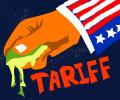
US President Donald Trump on Wednesday slapped an additional 25 per cent tariff on goods coming from India as penalty for New Delhi's continued buying of Russian oil.
Samsung launched mid-segment smartphone with great AI features.

Screen time expert Emily Cherkin discusses the risks you must consider.

The restructuring of tariffs by the US has led to a shift in the list of key product suppliers to the American market, with India emerging as one of the beneficiaries at the expense of China and Canada, an official said on Monday. As per an analysis, India's share in the USA's electronics exports has increased to 7.2 per cent to 3.5 per cent year-on-year in May, while China's share dipped to 11 per cent from 22 per cent during the same period.

The 25 per cent US tariffs, plus a penalty for Russian imports, could dent India's GDP growth by 30 basis points in the current fiscal, but the higher duty is unlikely to significantly affect India's domestic demand-driven economy, Barclays said on Thursday. If the 25 per cent tariff, announced by US President Donald Trump on Wednesday, is implemented from August 1, the effective average US import tariff on Indian goods will rise to 20.6 per cent in trade-weighted terms, as per Barclays estimates.


The trade relationship between India and the United States has been strained by the imposition of 25% tariff by the US on Indian goods.

"We currently manage collections for over 98 million retail and small-business loan accounts, covering a loan book of about $250 billion," says Rishabh Goel, cofounder and chief executive officer (CEO) of Credgenics, a software-as-a-service platform for debt collection. With more than 700 million smartphone users and over 450 million UPI users, digital access is everywhere.

Bharti Airtel sees opportunity in raising tariff for data services as it feels that rich are paying less and poor are not required to pay anymore, a senior official of the company said. During the company's earnings call for the first quarter of the current fiscal, Bharti Airtel vice-chairman and MD Gopal Vittal said that the company has written to the government for a relief on adjusted gross revenue and has demanded that it should be given benefit at par with other telecom operator, without naming Vodafone Idea.

'Story-telling is at the core of everything I do.'

In a world that needs more connection, learn how to break free from loneliness, build meaningful relationships, and improve your health.

Driven by smartphone, electronics exports have reached $22.5 billion in value in the first eight months of the current financial year (FY25), a near 28 per cent growth over the $17.66 billion electronics exports during the corresponding period of FY24.

The country's largest carmaker Maruti Suzuki India is recalibrating production of its upcoming model e-Vitara due to the shortage of rare earth magnets, industry sources said. The auto major is looking to produce around 8,000 units of the model by September as against the earlier stated plan of rolling out over 26,000 units during the period.
There are new choices for you this month, if you're a gaming enthusiast and need a new smartphone under 30,000.

Terror groups are using online war games to communicate with recruits in Jammu and Kashmir, bypassing traditional social media channels, officials said.

From labelling India the 'Tariff King' to slapping sweeping import duties, US President Donald Trump has steadily hardened his trade stance on India. These announcements are being seen as a pressure tactic to get New Delhi to agree to demands made by the US in the proposed Bilateral Trade Agreement (BTA).

The Uttar Pradesh government and iPhone maker Foxconn have started discussions to set up an electronics manufacturing unit in the state, sources aware of the development said. The investment pitch was made by Invest UP to Foxconn at the time of the final land allocation for the HCL-Foxconn chip joint venture Vama Sundari.
Apple has launched the iPhone 16e, a more affordable, pocket-friendly smartphone in the iPhone 16 series.

From smartphones to smartwatches, we've got you covered on Valentine's Day.

Telecom operator Bharti Airtel posted about a five-fold jump in consolidated net profit to Rs 11,022 crore in the March 2025 quarter, mainly due to the tariff hike impact and one-time gain on tax benefits. Bharti Airtel had posted net profit (attributable to owners of the parent company) of Rs 2,071.6 crore a year ago.
