

If India caves in to US pressure as Trump hopes it will, he will further try to blackmail it into submission, points out Ramesh Menon.

When Donald Trump slapped a 50 per cent tariff on Indian exports, it wasn't just another trade dispute. He was signalling that America, under him, would punish any country that dared to act independently.
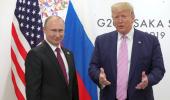
Unable to rein in Russian President Vladimir Putin from ending the protracted war against Ukraine, Trump turned his wrath on India, saying that there was a massive trade deficit as Indian goods in the US had high tariffs, and he was punishing it for importing oil from Russia.
India imported around 1.75 million barrels a day from Russia between January and June 2025.
If American consumers have to pay 50 per cent more for Indian goods, they will likely opt for cheaper products from other countries, such as China, Vietnam, South Korea, and Bangladesh.
Ironically, the European Union and China imported goods and energy from Russia, but were not subjected to such high tariffs.
China stood its ground when Trump threatened to impose heavy tariffs, saying that it would do the same.
Since 2022, NATO, an intergovernmental military alliance of 32 countries, has imported more Russian oil than India. 30 of them are from Europe.
Interestingly, the US was initially keen on India ramping up oil imports from Russia so that oil prices could stay stable.
During Joe Biden's presidency, US government officials acknowledged that India's oil purchase from Russia had worked to balance the international oil market.
Eric Garcetti, then the US ambassador to India, had acknowledged that India's purchase of Russian oil had not violated anything, as the US wanted it to be so to keep oil prices low.
However, it is now, it is a sticky issue as the US weaponises it to checkmate an adamant Russia that also exports substantial defence equipment to India.
Before the Russia-Ukraine war in February 2022, India's oil imports from Russia were less than two per cent, as the majority of its oil came from Iraq and Saudi Arabia. It can go back to them.
When the US slammed sanctions on Russia, Russia offered attractive discounts on its oil.
Indian refiners jumped at the offer, importing as much as 35 to 40 per cent of the country's oil imports.
While Europe shunned imports of refined oil from Russia, India refined the crude, exporting it to hungry markets abroad.
According to the US trade representative, India had a trade deficit of $45.7 million in 2024.
In a normal world, countries cannot trade without having a deficit. Zero deficit is illogical and impractical.
In today's bipolar world, one country should not be allowed to dictate the trade policies of other countries.
India must loudly reiterate that its national interests cannot be compromised. That should signal to the world that Trump cannot lord over the international political theatre. Let us see it for what it is: Trump is threatening the world.
The US has weaponised market access solely to protect its interests, adroitly exempting tariffs from India's services sector, as it benefits from it and badly needs it.
India's major products that will be affected due to the US tariff are smartphones, electronics, pharmaceuticals, iron, steel, diamonds, petroleum oils, plastic articles, and clothing.
The US is a critical market for India, accounting for nearly a fifth of Indian exports.

To make up for the losses, India must move fast, unleashing bold structural reforms, deepening trade diversification, and asserting sovereignty in global trade governance.
Indian entrepreneurs should be aided and coached by the government to survive initial losses, assess competitive markets, and recalibrate their marketing and manufacturing strategies.
It also needs to go in for domestic reforms to ensure its educated have the skills and mental bandwidth to get jobs, improve local infrastructure to boost manufacturing, and finally use its greatest dividend of having a youthful population.
Time and again, Trump has pointed out that India is one of the most protectionist countries in the world and has high trade and non-trade barriers. India needs to be circumspect on that and correct if required.
Too much protectionism can lead to substandard products and a lazy ecosystem that does not respect innovative thinking and risk-taking capabilities.
Of late, Trump has been making shrill statements against India about its tariff being very high on US goods, how he stopped the war between India and Pakistan, how India is a dead economy, and how India is helping Russia's war with Ukraine by trading with it.
India can easily do without billions of dollars worth of American almonds, apples and motorcycles by creating the environment for it to be available locally.
India also buys oil from the US and could instead turn to others like Iran.
If India also imposes similar tariffs on US goods entering India, none of these will sell as cheaper alternatives are available in India and elsewhere.
Defence Minister Rajnath Singh has indefinitely postponed his US visit, where he was to strike a multi-billion dollar deal to buy drones and fighter engines for aircraft. That should send a signal that we could look at shopping elsewhere.
India should continue to protect farmers through protectionism in the dairy and agriculture industry, as millions would be affected if American products are allowed into India.
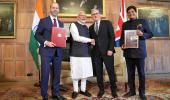
India needs to quickly implement the recent deal with the United Kingdom, hasten the pending trade agreement with the European Union and build new relationships with Gulf countries to make up for the losses.

Analysts predict that Indian merchants could face a 30 to 35 per cent competitive disadvantage from other countries that have lower tariffs, like China and even Bangladesh.
India must focus on building local talent in crucial sectors that both India and the world want so that Indian goods stay relevant and wanted.
India should also consider its interests while negotiating with the US hereafter, and not create optics among voters.
Indian statecraft should make a difference and make a strong point that it is no longer requesting a seat at the table, but asking for a fair deal that will help all.
If India caves in to US pressure as Trump hopes it will, he will further try to corner it and blackmail it into submission.
That is his style of functioning. See how he dealt with Vietnam, first slapping the highest tariffs and then bringing them down after getting zero tariffs on US goods sold in Vietnam.
India needs to look at its tariffs too with a new eye to make its exports more attractive and therefore open new windows of opportunity.
The time to whip in manufacturing reforms has come, as that is the only way to build resilience.
India must act quickly, as the fallout on markets and jobs is real.
Thirty per cent of India's gem and jewellery sector's exports, worth $10 billion, go to the US.
Stakeholders are rightly worried about job losses, rising production costs, shrinking margins, and the threat of supply chain rerouting to lower-cost nations like Vietnam or Turkey.
India needs to overhaul logistics, fast-track reforms in customs and GST, upgrade quality standards, and improve access to finance and export incentives for Micro, Small, and Medium Enterprises.
India could consider offering tax breaks, special incentives for exports, and credit support for affected exporters from medium and small-scale enterprises.

All this could bolster investor confidence in India and create a better and more confident nation that is planning to insure itself against global shocks.
Rare earth minerals, or it is magnets, exported from China to the US have been stopped.
China also slapped tariffs as a tit for tat measure. Trump immediately backed down on his measures against China.
He can't stop China from buying oil from Russia.
Trump has not gone after China, though it also imports around two million barrels of oil from Russia, as the US is very dependent on Chinese goods.
It is time India learnt from the China playbook, stops playing the victim, and emerges stronger.
There is no need to be over-dependent on any country anymore, as geopolitics is changing and is closely linked to trade.
The energy of the political bureaucratic system should now be singularly focused on building national capabilities.
There is no time for street-level mediocre politics involving caste and creed or manipulating elections.
These ploys have wasted a lot of time in the last decade.
The wisdom is in seeing the pointlessness of it all and changing track into becoming a manufacturing hub and a vibrant, forward-looking economy that can look any country in the eye.
It can do that only if it works towards being self-reliant, diplomatic with a purpose, bind with new emerging markets, and help weaker countries and emerge strong.
India's growth story should not be now stymied with communal or caste wars or petty politics of changing history books and launching new language wars.
Any political party that focuses on the growth of all kinds will ride back to power. That is the truth, and, amazingly, political parties do not see the logic.
Ramesh Menon is an author, award-winning journalist, educator, documentary filmmaker, and corporate trainer. He authored Modi Demystified: The Making of a Prime Minister.
Feature Presentation: Aslam Hunani/Rediff








 © 2026