
S&P Global Ratings on Tuesday cut India's GDP growth projections to 6.5 per cent for the next fiscal as it expects that economies in the APAC region will feel the strain of rising US tariffs and pushback on globalisation. In its Economic Outlook for Asia-Pacific (APAC), S&P said despite these external strains, it expects domestic demand momentum to remain solid in most emerging-market economies.

Domestic rating agency ICRA on Monday said Indian companies are likely to clock 7-8 per cent revenue growth during the March quarter of the current fiscal year, led by revival in rural demand and uptick in government spending. ICRA expects the private capital expenditure (capex) cycle to remain measured in view of the uncertainties around geopolitical developments and relatively subdued outlook on merchandise exports from India.

India's Venture Capital (VC) ecosystem exhibited robust growth in 2024, with funding surging 43 per cent year-on-year to $13.7 billion, according to a report. This recovery was fuelled by a 45 per cent rise in deal activity, with 1,270 transactions recorded, reinforcing India's position as the second largest market for venture capital and growth funding in the Asia-Pacific region, the report by Bain & Company and IVCA said.

'The size of the investments is important, but equally crucial is the number of jobs that these proposals create.'

Prime Minister Narendra Modi said he had a 'fruitful meeting' with United States National Security Advisor Michael Waltz and they discussed defence, technology and security areas, which are important aspects of the India-US ties.

Union Minister of Heavy Industries and Public Enterprises, H D Kumaraswamy on Saturday clarified that he was misquoted on his purported remarks regarding the United States semiconductor firm Micron.

Commerce Minister Piyush Goyal's scathing remarks on Indian startup ecosystem and its innovation priorities have drawn sharp reaction from the industry, with Zepto CEO Aadit Palicha putting up a strong defence citing the company's contribution to jobs, FDI and terming it a "miracle in Indian innovation".

Investors should tilt their portfolios towards domestic-facing defensive sectors, which should help provide stability and shield them from geopolitical and tariff risks.

India may not have got the timing right about nurturing two or three semiconductor plants even as the government finally has a policy that it hopes could put the country on the world map of semiconductor (wafer fab) manufacturing.

The worldwide semiconductor market is expected to total $314 billion, even though the rate of growth will be slower as compared to 2010. According to the latest outlook by Gartner, the semiconductor revenue in 2011 is expected to grow 4.6 per cent from the 2020 estimated revenue.

In a move to deepen manufacturing in electronics in India, the Centre is targeting 35-40 per cent value-addition through the yet-to-be launched production-linked incentive (PLI) scheme for electronics components, sources in the government
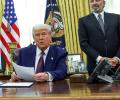
An hour before his bilateral meeting with Prime Minister Narendra Modi, Trump again commented on India's tariff structure, saying 'they have the highest tariffs' and 'it is a hard place to do business'.

Trump may temper his approach from time to time, but to think that he will change his basic philosophy is delusional, asserts T T Ram Mohan.

The sweeping tariffs proposed across sectors by US President Donald Trump are scheduled to be imposed starting April 2, with most analysts worried about their impact on companies, and in turn the financial markets. Recently, the US administration signaled that it will impose sectoral tariffs on energy, pharmaceuticals, semiconductors, agriculture, copper, and lumber.

Here is a list of Q & As to explain these issues and implications of the US move.

Siemens's share price has lost ground in the past few sessions following weak management commentary. The management indicated challenges to the growth outlook due to stagnant private capex and concerns over semiconductor shortages for digital industries. Government infra-spending may regain momentum from January 2025.
For semiconductor manufacturing (wafer fabs) plants, the threshold Net Present Value of investments would be Rs 2,500 crore and the NPV of investments for manufacturing other products would be Rs 1,000 crore.

Prime Minister Narendra Modi urged CEOs of US majors to take advantage of India's growth story as the country is making all efforts to become the third largest economy of the world in his third term. India is currently the fifth largest economy of the world after the US, China, Germany and Japan with a GDP of around $3.9 trillion. India has been the fastest growing large economies of the world with GDP growth rate of over 7 per cent for the last three consecutive years.
BITS Connect, a global 'movement' of Birla Institute of Technology and Science alumni and the industry, on Friday announced a Rs 200 crore (Rs 2 billion) initiative to conduct semiconductor R&D in India.

Earlier, Trump has already talked about slapping "100 per cent tariffs" on the BRICS grouping, a bloc that includes India as well.
Roughly 40% of this projected outlay is expected to go towards emerging industries, including green hydrogen, clean energy, semiconductors, and electric vehicles.

India is among the three least-favoured Asian stock markets, according to BofA Securities whose survey found that 10 per cent of fund managers are underweight on Indian equities from a 12-month perspective.
India is all set to make its presence felt in the $47 billion global outsourced semiconductor testing and packaging market, an arena where Malaysia and Vietnam have been way ahead so far. The Cabinet last Thursday cleared two projects, the Tata's assembly testing and packaging plant (ATMP) and the Murugappa-owned CG Power with Renesas from Japan as its tech partner. These, together with Micron's assembly and testing plant which is already being constructed in Sanad in Gujarat, will collectively invest Rs 47,300 crore to set up the factories.
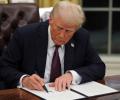
Dr Jaishankar is expected to discuss the dates for the fifth Quad leaders' summit in India later this year.

Cheaper ripoffs was how China powered its way as an economic superpower but hitherto the tech realm had remained out of bounds. With DeepSeek's AI model the West, it seemed, was about to lose its competitive edge in cutting edge generative AI technology. And this is what is causing deep furrows in the forehead of tech titans in Silicon Valley.

'The startup ecosystem, the government, and the owners of large pools of Indian capital need to actively support the creation of these local champions, not pull down the teams that are trying hard to get there.'

Both new and completed project values as of December 2024 remain below pre-pandemic levels seen in 2019.

'If the almost literally heart-stopping Suez block has any positive outcome, it is to be hoped that it will accelerate the setting up of a fab (perhaps Taiwanese) in India,' asserts Rajeev Srinivasan.
Two full-fledged semiconductor fabrication plants are going to come up in India very soon entailing multi-billion dollar investment besides several chip assembly and packaging units, Minister of Electronics and IT Rajeev Chandrasekhar said. In an interview with PTI, the minister confirmed that the two projects include a $8 billion proposal submitted by Israel-based Tower Semiconductors and the other from Tata Group. "I am happy to share this with you and you are probably the first one I'm sharing this with.

Engineering and construction major Larsen & Toubro (L&T) reported a 25 per cent rise in net profit attributable to the owners of the company for the January-March quarter of 2024-25, owing to higher revenues and an exceptional gain. For the quarter under review, L&T posted a consolidated net profit of Rs 5,497.3 crore, while revenue rose 10.9 per cent year-on-year (Y-o-Y) to Rs 74,392.28 crore.

The tech community, which was getting ready to use the ChatGPT fever and raise unlimited capital for their businesses, is going to face tougher obstacles now, predicts Ajit Balakrishnan.
Industry insiders in India warn that any such move in the pharmaceutical sector could be counterproductive for the US as it may face increased drug shortages if tariffs are imposed on such imports.
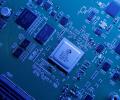
Taiwan is keen to collaborate with India and help it become a leader in the semiconductor space, Jason Ho, chairman of the Taiwan Chamber of Commerce in India, said, asserting that the Taiwanese companies have the supply chain for things that the Indian market needs. Manufacturing semiconductors - used in electric and hybrid cars, drones, and communication devices - is fairly complicated, entails huge investment, and can be a cumbersome process.

'India needs many more job creators, both in manufacturing and services, to make it big.' 'For that, the red carpet must be rolled out fully and for all investors without holding back,' suggests Nivedita Mookerji.

Reliance Jio, the telecom business of the Mukesh Ambani-promoted conglomerate, is expected to go for an initial public offering (IPO) of over $6.25 billion either in the second or the third quarter of the calendar year 2025, sources said. Reliance Retail is likely to be listed around the same time with a short gap, it is learnt. The timing of the two IPOs, however, will depend on the company's assessment of the market conditions among other factors.

Out of 24,230 IIT and NIT grads, about 8,000 students didn't find any takers during campus placement drives this year.
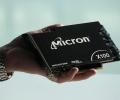
US-based chipmaker Micron Technology is expecting demand for semiconductors to rise significantly in the next few years, globally and in India, as memory consumption is going up, largely driven by the widespread adoption of technologies like artificial intelligence (AI). "Memory consumption is expected to double by the end of the decade and the biggest driver in this is AI. "While it's natural to talk about compute and GPUs (graphics processing units) in the context of AI, it is not to be forgotten that the true enabler for AI is memory ... in all the AI engines that we talk about, there is a lot of need to access memory quickly," Anand Ramamoorthy, managing director, Micron Technology India, told Business Standard.
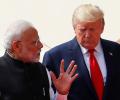
'While criticising India's high tariffs, Mr Trump stated he would impose reciprocal taxes on Indian products if re-elected.' 'However, since India's tariffs follow WTO rules, Mr Trump's actions would violate these rules,' Ajay Srivastava points out.
