

For India, the challenge is to strike a balance between tactical necessity and economic priorities, point out Pravin Krishna and Monil Sharma.

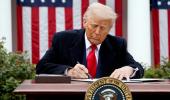
On April 2, United States President Donald Trump announced a broad set of bilateral tariffs that stunned the world.
The tariffs were high and uneven: India faced a 26 per cent tariff; China, 34 per cent; and the European Union, 20 per cent.
Soon after, they were suspended for 90 days, with a blunt message: Unless the US' trading partners agreed to 'fair and reciprocal' trade deals during the pause until July 9 (now extended to August 1), the punitive tariffs would take effect.
The announcement marked a hard pivot away from the rules-based trade architecture of the World Trade Organization and its insistence on non-discrimination, placing many economies under pressure.
Several countries began negotiating bilateral trade deals with the US -- from advanced economies like the United Kingdom to export-dependent partners like Vietnam.
Others, including India, are compelled to do the same, lest they face exclusion from one of the largest consumer markets.
This moment marks a deeper shift in the global trade order. For decades, the US advocated multilateralism, spearheading the General Agreement on Tariffs and Trade (GATT) and the WTO.
It pushed for tariff reductions, rule-setting, and dispute settlement mechanisms aimed at making trade fair, transparent, and predictable.
But in recent years, that vision has eroded. Throughout the 1990s, the US gradually shifted from multilateralism to bilateral trade agreements.
Mr Trump's first term was defined by unilateral tariffs and trade wars. The US systematically blocked appointments to the WTO's appellate body, leading to its paralysis by 2019.
Domestic political-economy concerns about inequality, geopolitical fragmentation, and post-pandemic supply chain anxieties have further discredited the global trade system.
The 'July 9 ultimatum' crystallises this evolution. The US is no longer trying to fix multilateralism, it is bypassing it entirely.
What we are witnessing is the rise of 'coercive bilateralism'.
The US is using its market access as a blunt instrument: 'Either lower your tariffs, or we will raise ours to match.'
For developing economies, this presents a dilemma: Either concede on sensitive sectors or face a tariff shock that could destabilise exports and investment inflows.
This approach has seen some success for the US: On July 2, Mr Trump announced a deal with Vietnam that slashed the proposed 46 per cent tariff on Vietnamese goods to 20 per cent (while trans-shipped goods, especially from China, would face a 40 per cent levy).
In return, Vietnam would offer zero-tariff access to US goods, including large-engine cars, though the details remain unclear.
For Mr Trump, this was a political win and a message to others: A deal is possible but only on Washington's terms.
India, meanwhile, continues to negotiate under pressure. American and Indian officials are scrambling to resolve key differences, particularly over dairy and agricultural imports.
India is reportedly resisting broad concessions in these politically sensitive sectors, even as the threat of steep new tariffs looms.
While Mr Trump has expressed optimism about a deal with New Delhi, many sticking points remain. With nearly 18.3 per cent of Indian exports headed to the US, the stakes are high.
A targeted agreement may be necessary to shield key industries from abrupt hikes.
The European Union, too, has sought a middle ground.
While it is prepared to accept a universal 10 per cent tariff on most exports covering over Euro 380 billion in trade -- Brussels is pushing for exemptions in sectors like pharmaceuticals, semiconductors, aircraft, and alcohol.
The UK had earlier agreed to a 10 per cent tariff on cars in exchange for improved access for its beef and aircraft engine sectors.
Even China has negotiated a limited truce, restoring some rare earth exports to the US, though core disputes remain unresolved.
The consequences of coercive bilateralism are profound. First, multilateralism is unravelling. The WTO, once the anchor of the global trading system, is being sidelined.
Second, power asymmetry is growing. Smaller economies are now forced to negotiate individually with a superpower, weakening their leverage.
Third, the consistency of global trade rules is breaking down. Countries are being pulled into a web of inconsistent standards, digital provisions, and tariff exceptions, threatening the predictability that businesses depend on.
For India, the challenge is to strike a balance between tactical necessity and economic priorities.
It is conceivable that changes sought by the US may work to India's benefit by forcing tariff reforms that domestic politics have long delayed.
But concessions -- especially on sectors like agriculture or data governance -- must be weighed against their long-term economic, political and national-security implications.
Beyond the bilateral equation, India must also think multilaterally: Revitalising regional trade pacts, expanding South-South cooperation, and contributing to WTO reform.
While Mr Trump's deadline has shifted again, the precedent his approach sets could define global trade for a generation.
The danger is not just in the content of the agreements being signed but in how they are being signed: Under duress and at speed.
This shift from multilateral rule-making to coercive deal-making forces the world to confront a basic question: Will we normalise a power-based trade order, or recommit to rebuilding a fair, rules-based system?
Pravin Krishna and Monil Sharma are associated with the Johns Hopkins University, Washington, DC, and NCAER, New Delhi. The views are personal.This column was written before Trump imposed 25% tariffs on India on Wednesday, July 30, 2025.
Feature Presentation: Aslam Hunani/Rediff








 © 2026