
The sale is to generate the bail money for the release of Sahara Group chief Subrata Roy.

Thermax reported 13 per cent Y-o-Y revenue growth with operating profit margin decline in Q1FY25. It took a hit of Rs 70 crore on specific projects. The company enjoys a strong order pipeline across sectors like power, steel, refining and petrochemicals.

State Bank of India, NTPC, Nestle, Sun Pharma, JSW Steel, ITC, Mahindra & Mahindra and HCL Technologies were among the other major gainers.

The broader NSE Nifty cracked below the key 10,400-mark to touch a low of 10,336.30, before finally ending 15.95 points, or 0.15 per cent, down at 10,410.90.
The 50-share NSE Nifty settled lower by 94.05 points, or 0.87 per cent, at 10,666.55 after shuttling between 10,586.80 and 10,702.75.

FMCG major Godrej Industries Ltd will sell off its foods division to Godrej Tea Ltd, an associate company for over Rs 85 crore (Rs 850 million).

'The structural story of India is a multi-decadal story.' 'One should stay invested in that story and avoid reacting to what is happening globally.'

Since the Budget announcement on July 5, FIIs have been busy unloading their stock.

Call Me Bae is a spirited new addition in guilty pleasures for the fashion-loving, rom-com starved soul, applauds Sukanya Verma.
Arun Shourie, Union Minister for Divestment, said that the next meeting of the Cabinet Committee on Divestment would discuss the sell-off modalities of HPCL and BPCL.

'If their allocation to certain segments have become high due to strong returns over the past three-four years, they should rebalance their portfolios and bring them in line with their long-term asset allocation.'

Equity benchmark Sensex tumbled over 273 points on Tuesday, tracking losses in index majors Reliance Industries, Dr Reddy's and Axis Bank amid a massive selloff in Chinese markets. Despite opening on a positive note, the 30-share BSE index turned red to end 273.51 points or 0.52 per cent lower at 52,578.76, while the broader NSE Nifty fell 78 points or 0.49 per cent to 15,746.45. Dr Reddy's was the top loser in the Sensex pack, plunging over 10 per cent, after the company reported s 36 per cent decline in consolidated net profit at Rs 380.4 crore for the quarter ended June 30, 2021, on account of higher expenses.
The Divestment Ministry is moving fast to restart the sell-off process and go ahead with divestment in oil PSUs -- HPCL and BPCL.\n\n\n\n
The country's largest private lender HDFC Bank on Saturday reported a 6.51 per cent decline in its consolidated net profit to Rs 16,474.85 crore in the April-June quarter compared to the previous January-March quarter. The city-headquartered lender, which merged its mortgage major parent HDFC into itself in July last year, had reported a net profit of Rs 17,622.38 crore in the March quarter. On a standalone basis, the net profit declined to Rs 16,174.75 crore in April-June 2024-25 from Rs 16,511.85 crore in January-March 2023-24.

IT shares lost ground tracking a sell-off in tech stocks on Nasdaq on Friday

In May, MFs were the net sellers in several PSUs, as they deployed Rs 47,600 crore in equities during the month.

Among Sensex firms, Power Grid and Tata Steel fell more than 2 per cent. HDFC Bank, State Bank of India, IndusInd Bank, Hindustan Unilever and NTPC were among the major laggards. Nestle, Bajaj Finserv and Bajaj Finance were among the gainers.

The market capitalisation of BSE-listed companies jumped to a lifetime peak of Rs 404.18 lakh crore on Thursday helped by a five-day rally in benchmark indices, making investors richer by Rs 11.29 lakh crore. Recovering after a sell-off in early trade, the 30-share BSE Sensex climbed 486.50 points or 0.66 per cent to settle at 74,339.44 on Thursday. During the day, it surged 718.31 points or 0.97 per cent to 74,571.25.
Benchmark Sensex rebounded by 167 points in a volatile trade on Friday amid buying in ICICI Bank, State Bank of India and Reliance Industries. The 30-share BSE Sensex climbed 167.06 points or 0.23 per cent to settle at 71,595.49. During the day, it hit a high of 71,676.49 and a low of 71,200.31.

'When I called the HR department, they abused me.'

World Bank lowered its global economic growth outlook for 2016 to 2.9% from 3.3% earlier.

Sustained foreign funds outflows and the rupee depreciating 68 paise to hit a three-month low of 64.88 (intra-day) against the dollar affected investor sentiment

Among the 30 Sensex companies, Larsen & Toubro, Power Grid, NTPC, State Bank of India, Reliance Industries and HDFC Bank were the biggest laggards. Sun Pharma and Nestle were the only gainers.

Most brokerages are betting that the new government will shift to a policy focussing on boosting rural incomes and consumption since that has clearly been a pain point.
From the Sensex basket, Tech Mahindra, Tata Steel, JSW Steel, HCL Technologies, Tata Consultancy Services, Larsen & Toubro and Kotak Mahindra Bank were the biggest laggards. Mahindra & Mahindra, Power Grid, Bajaj Finance, IndusInd Bank and Maruti were the major gainers.
From the Sensex pack, HCL Technologies, Infosys, Wipro, Bharti Airtel, Larsen & Toubro, Mahindra & Mahindra, Tata Consultancy Services and Asian Paints were the major gainers. Axis Bank, IndusInd Bank, Bajaj Finance, JSW Steel, State Bank of India and Tata Steel were among the major laggards.

Through Manorathangal, M T Vasudevan Nair makes himself available to a whole new generation of uninitiated viewers, who can familiarise themselves with his rich body of work and hope to learn a thing or two about life in all its messy grandeur and flawed imperfections, notes Arjun Menon.
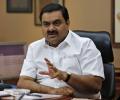
The clarification by the National Securities Depository (NSDL) - which is tasked with monitoring foreign portfolio investor (FPI) investment in domestic stocks - that the accounts of top investors in Adani group stocks remain 'active' has helped prevent a $500-million selloff of shares. Analysts said a freeze of the FPI accounts, as reported by some media outlets, could have prompted global index providers to cut weighting of four Adani group companies from their global indices. Brian Freitas, an analyst at independent research provider Smartkarma, said if the FPI accounts were indeed frozen, FTSE and MSCI would have reduced weighting of Adani group companies at the next rebalance, since it would have meant that the large part of the free float was not tradeable.

The NSE Nifty settled the day 38.85 points or 0.37 per cent lower at 10,500.90 after shuttling between 10,590.55 and 10,456.65, intra-day.

Sun Pharmaceutical Industries reported a 34 per cent year-on-year (Y-o-Y) jump in net profit to Rs 2,654.6 crore in Q4FY24.
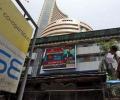
Shares of Avenue Supermarts (DMart) have rallied 15 per cent in the past month, even as the benchmark National Stock Exchange Nifty has remained flat. The stock has garnered favourable commentary from both fundamental and technical analysts after three years of poor performance. "DMart has reached its first 52-week high since October 2021, taking off from solid base formations.

Among the Sensex firms, Larsen & Toubro, Bharti Airtel, HCL Tech, Tata Motors, Sun Pharma and Tata Steel were the major gainers. On the other hand, Nestle, Asian Paints, Bajaj Finserv, HDFC Bank and Axis Bank were among the laggards.

Hong Kong has regained its spot as the world's fourth-largest market following a broad market rout in Indian equities. Currently, the Chinese territory's market capitalisation stands at $4.9 trillion versus India's $4.75 trillion, according to data compiled by Bloomberg. In January, the domestic equity markets' market capitalisation had surpassed that of Hong Kong following a spectacular rally in the small- and midcap stocks.

Among the Sensex firms, Kotak Mahindra Bank, UltraTech Cement, Mahindra & Mahindra, Larsen & Toubro, ICICI Bank, IndusInd Bank, Wipro and Hindustan Unilever were the major laggards. Sun Pharma, Bajaj Finance, Bharti Airtel, Reliance Industries, Bajaj Finserv and Titan were among the winners.

The court will now decide whether to accept the report or direct the agency to continue the investigation and file a chargesheet.

The number of dematerialised (demat) accounts - required to hold shares and other securities in electronics format - crossed the 150-million mark for the first time in March. In March, 3.12 million new demat accounts were added despite a spike in market volatility, taking the total count to 151.4 million. The milestone has come 19 months after the total number of demat accounts hit the 100-million mark, a sign that more domestic households are taking to direct equity investing.

Officials say a fall in global oil prices will reduce the government's subsidy burden, giving it a greater chance of hitting its ambitious fiscal deficit target of 4.1 percent of gross domestic product in the fiscal year to March.

From the Sensex basket, Tata Consultancy Services, Nestle, Bajaj Finserv, Wipro, Maruti Suzuki India, Reliance Industries, Larsen & Toubro and NTPC were the major laggards. Tata Steel, Bajaj Finance, JSW Steel and Bharti Airtel were among the gainers.

'From a risk-return perspective, large-cap funds may generate lower-than-historical average returns in 2024, whereas mid-, and small-cap funds hardly have any upside left.'
