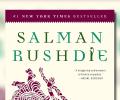
The Supreme Court of India has refused to entertain a plea seeking a ban on Salman Rushdie's controversial novel 'The Satanic Verses'. The court noted that the plea effectively challenged a previous Delhi High Court judgement.

Salman Rushdie's book The Satanic Verses was banned by India four months before Iran's Supreme leader late Ayatollah Khomeini issued a fatwa for his killing without any proper examination or a judicial process, writes the controversial author in his memoirs.
In what could further stoke the Salman Rushdie controversy, a section of authors at the Jaipur Literature Festival on Friday launched a campaign demanding immediate lifting of the 23-year-old ban on the controversial writer's book The Satanic Verses.
Salman Rushdie may have skipped the ongoing Jaipur Literature Festival, but his controversial novel The Satanic Verses continued to create a buzz at the event.
The Salman Rushdie row refused to die down on Sunday with a police complaint being filed against the four authors who read out portions from the controversial author's banned book Satanic Verses at the Jaipur Literature Festival.
Rushdie's comments came at a time when extremists have again driven a literary figure into hiding -- this time Martin Rynja, a Dutch-born London publisher who had agreed to release The Jewel of Medina, a controversial novel about the Prophet Muhammad.
Over two decades after 'Satanic Verses' sparked a never-ending controversy and provoked a 'fatwa' for his head, author Salman Rushdie has only one thing to say to his detractors: 'I did not write it for the mullahs'.

Cheered on by the audience, authors read out passages from The Satanic Verses on the first day of the Jaipur Literature Festival, reports Abhishek Mande.
Attacking Salman Rushdie, Press Council of India Chairman Markandey Katju on Monday said that the "sensationalism" depicted by his book Satanic Verses has deeply hurt Muslim sensitivities and that an individual's freedom of speech has to harmonised with the public interest.
Days after his reading from The Satanic Verses created a furore and resulted in a police case, author Hari Kunzru on Sunday said he did not believe he had broken the law by reading from a downloaded segment of the book and had no intentions to hurt the feelings of anybody.
Mohammed Saleem Engineer is the National Secretary of the Jamaat-e-Islami-e-Hind, the hardline Islamic organisation that has its headquarters in New Delhi. The organisation is an offshoot of the Jamaat-e-Islami party whose objective it is to establish an Islamic state in Pakistan that is ruled by the Shariah law.
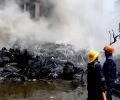
Why not stream all the data in real time to multiple recipients? It would make the investigation of aviation incidents much easier and far more transparent, recommends Devangshu Datta.

The attack during a lecture in western New York left the prizewinning writer blind in one eye.

"I have no hesitation in saying that the ban on Salman Rushdie's book was wrong," Chidambaram, who was MoS, home affairs, when the ban was imposed in October 1988, said speaking at the Times LitFest in New Delhi.
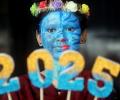
Razvi continued, urging young Muslim people to avoid participating in New Year celebrations, stressing that Muslims should instead focus on religious practices that align with their faith.

Singh, 91, rejected as "rubbish" the charge by critics the Rajiv Gandhi government's decision to ban the book was driven by appeasement towards Muslims.
When asked if Rushdie was still in the hospital, Wylie said he cannot give any information about the celebrated author's whereabouts.

'I'm lucky. What I really want to say is that my main overwhelming feeling is gratitude'
'I actually thought he punched me very hard. I didn't realise it was a knife in his hand, and then I saw the blood, and I realised there was a weapon'
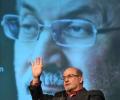
As he struggles in hospital, I wonder why anyone, especially someone who was not even born when The Satanic Verses was published, would want to harm a 75-year old man and a literary treasure, wonders Subhash K Jha.

In its first reaction to the stabbing of Salman Rushdie, India on Thursday condemned the "horrific attack" on the celebrated novelist and wished him a speedy recovery.
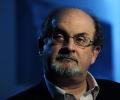
Salman Rushdie, the Mumbai-born author of the Booker Prize-winning novel Midnight's Children, was attacked by a man who stormed the stage during an event in New York on Friday while he was getting ready to deliver a lecture.

The Iranian regime issued a fatwa against the legendary novelist for his novel The Satanic Verses in February 1989.

The attack on Rushdie sent shock waves around the world, with world leaders and literary stalwarts saying they were appalled at the attack on the author who championed free speech and lived under the threat of assassination for nearly half his life.

Rushdie said he was in "two minds" about whether to face his alleged attacker, who has pleaded not guilty, in court.
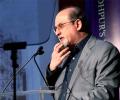
Salman Rushdie has been taken off a ventilator and was able to talk, a day after the Mumbai-born author was stabbed, in what US authorities said was a 'targeted, unprovoked, preplanned' attack.
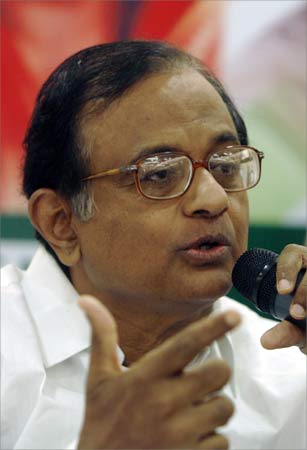
The Congress on Monday distanced itself from former Finance Minister P Chidambaram's statement that the banning of Salman Rushdie's controversial novel 'The Satanic Verses' by the Rajiv Gandhi government was wrong.
Following the attack on Friday, questions were raised about the security precautions -- or lack thereof -- at the host institution, which sits in a rural lake resort about 110 km south of Buffalo, New York.

Authorities were still looking into Matar's nationality and his criminal records, if any.

Wouldn't it be better to join the celebrations with the vast Hindu majority while at the same time criticising Mr Modi/BJP/RSS for politicising it? notes Shekhar Gupta.
In a video message from New York on Monday night, the 75-year-old Mumbai-born author who has lived under the shadow of a fatwa since The Satanic Verses was published in the 1980s said it was important to continue to fight for the freedom to express and to publish.

Salman Rushdie has been honoured with the PEN Centenary Courage Award as the Mumbai-born writer made his first in-person public appearance since being stabbed and severely wounded in a knife attack at a literary event in New York last year.

The New York Times reported that according to Rushdie's agent, Andrew Wylie, the Mumbai-born controversial author was on a ventilator and could not speak.

The family expressed gratitude to the audience members who bravely leapt to Rushdie's defence and administered first-aid after he was stabbed multiple times at the Chautauqua Institution in western New York.
Leading Islamic seminary Darul Uloom Deoband on Wednesday demanded that "controversial authors" be kept away from the Jaipur Literature Festival in the PinkCity.
Ahead of the Jaipur Literature Festival, Muslim groups on Monday warned organisers against inviting authors who hurt religious sentiments of the community, including the four who had read out passages from Salman Rushdie's banned Satanic Verses at the event last year.
Two months after being forced to skip the Jaipur Literary Festival, controversial author Salman Rushdie on Saturday hit out the Congress, suggesting that his presence there was blocked because of "useless electoral calculations". Participating in the India Today Conclave, he said India "deserves to be led by better leaders".
Kavita Srivastava, national secretary of People's Union for Civil Liberties, has revealed that six complaints have been registered against four authors: Amitava Kumar, Hari Kunzru, Jeet Thayil and Ruchir Joshi, besides the organisers of the Jaipur Literture Festival, for hurting religious sentiments and conspiracy.
Several authors and artists on Tuesday voiced their outrage over the cancellation of a video address by Salman Rushdie at the Jaipur Literature Festival, accusing the Rajasthan government of "abject surrender" to threats of violence by "fringe elements".
 © 2026 Rediff.com - Advertise with us - Disclaimer - Privacy Policy - Sitemap - Feedback - About us - Terms of use - Grievances