
Unified Payments Interface (UPI) clocked over 6 billion transactions in July: the highest ever by India's flagship digital payments platform since its inception in 2016. UPI reported 6.28 billion transactions amounting to Rs 10.62 trillion, according to data released by the National Payments Corporation of India (NPCI), which operates the platform. Month-on-month, the volume of transactions was up 7.16 per cent and value increased 4.76 per cent.
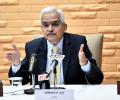
Key lending rate (repo) raised by 50 basis points to 4.9 per cent; 2nd increase in 5 weeks
The Reserve Bank on Wednesday allowed credit cards to be linked with the unified payments interface (UPI), which will enable more people to make payments using the popular platform. At present, UPI facilitates transactions by linking savings or current accounts through users' debit cards. "...it is proposed to allow linking of credit cards to UPI," RBI Governor Shaktikanta Das said while announcing the regulatory moves, along with the bi-monthly policy review.

Debit card payments remained sluggish due to the surge in digital transactions after the pandemic, and the Unified Payments Interface (UPI) has emerged as the most popular mode of money transfer, particularly for small value transactions, according to RBI data. In July 2020, the total debit card spends stood at Rs 2.81 trillion, as compared to Rs 3.15 trillion in July 2023, reflecting a growth of 11.96 per cent. UPI spends have seen a whopping growth of 428 per cent, zooming from Rs 2.90 trillion to Rs 15.33 trillion during the same period, the data revealed.

Modi was honoured with the 'Order of Zayed', the UAE's highest civilian award, in 2019 as a mark of appreciation for his efforts to boost bilateral ties between the two nations.

India and Saudi Arabia on Monday called on states to reject the use of terrorism against other countries and prevent access to weapons, including missiles and drones, to commit acts of terror.

The Indian startup ecosystem has lauded the inclusion of startups in the New Delhi Leaders' Declaration for the first time ever in the history of G20. Industry stakeholders say that the move will lead to easier access to capital, reduce regulatory hurdles, and may revive funding activity. The Declaration, through the Startup20 initiative, recognised startups as "natural engines of growth" and key to socio-economic transformation by driving innovation and creating employment.
India's flagship payment platform, the Unified Payments Interface (UPI), ended the 2022 calendar year on a high note as the volume of transactions touched a record 7.82 billion in December, amounting to Rs 12.82 trillion, again a record high. Data released by the National Payments Corporation of India (NPCI), the umbrella body for retail digital payments in the country, showed volume of transactions in December was up 7.12 per cent compared to November, while value of transactions was up 7.73 per cent during the same period.
The Centre on Sunday said there are no plans to levy charges for making payments through Unified Payments Interface (UPI) while saying the service is a "digital public good with immense convenience". The ministry of finance said the concerns of service providers for cost recovery have to be met through other means. "UPI is a digital public good with immense convenience for the public & productivity gains for the economy.

The next meeting of the GST Council will be held on September 28-29 in Goa.

The two sides also inked four pacts to expand cooperation in areas of railways and energy.

'We want to achieve overall profitability, and then we would go for an IPO.'

In March this year, Worldline India launched Vabox (Voice Alert Box): merchants will now get instant audio alerts on the settlement of UPI (Unified Payments Interface) payments via QR codes in languages of their choice when customers check out. "They needn't worry whether the amount has been credited to their account," says Gulshan Pruthi, the firm's executive vice-president. The French payments giant will roll out 500,000 Vaboxes in the initial phase.

The Union Cabinet on Wednesday approved a Rs 76,000 crore policy boost for semiconductor and display manufacturing ecosystem in the country in an bid to position India as a global hub for hi-tech production. Announcing the decision of the Cabinet, IT and Telecom Minister Ashwini Vaishnaw observed that electronics plays an important role in everyday life, and semiconductor chips forms a crucial part of electronics. Outlining the details of the scheme, he said the Rs 76,000 crore programme has been approved for the development of semiconductors and display manufacturing ecosystem.
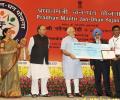
As per the latest finance ministry data, the total balance in over 36.06 crore Pradhan Mantri Jan Dhan Yojana (PMJDY) accounts was at Rs 1,00,495.94 crore as on July 3.

This is prime minister's second visit to Bhutan and the first since his re-election.

Nepal witnessed political turbulence in 2022 that dramatically turned rivals into allies and throned former guerrilla leader Pushpa Kamal Dahal 'Prachanda' as the prime minister for a third time, as Kathmandu made efforts to balance ties with immediate neighbours India and China with high-profile talks and visits.

Move over Visa, MasterCard and American Express. Here's an indigenous, cheaper alternative that will not only benefit Indian banks but Indian who use debit cards and credit cards to make payments.


The Reserve Bank of India (RBI) on Wednesday announced to increase the policy repo rate by 50 basis points to 4.9 per cent, the second hike in five weeks aimed at quelling the inflation. The MPC vote was unanimous and has decided to keep stance withdrawal from accommodative, RBI Governor Shaktikanta Das said in a press conference on Wednesday. The decision was taken during a three-day meeting of the RBI's Monetary Policy Committee (MPC) to review the interest rates in the country. The MPC voted unanimously to increase the policy repo rate by 50 bps to 4.90 per cent," Das said.

Tokenisation is the process of replacing debit and credit card numbers with a set of characters or tokens.

The Jan Dhan scheme restricts the scope of life insurance cover to bring down burden on the exchequer.

He said digitisation was aimed at bringing in accountability and added that more cash would bring with it social evils.

The recent Reserve Bank of India (RBI) norms on tokenisation services, which will be offered by card networks, are likely to result in merchants and payment aggregators incurring a cost as they have to pay a fee to the networks. The merchants and the payment aggregators, in turn, may pass on the cost to the customers. The norms, which were issued by the banking regulator released on September 7, allow card networks like Visa and Mastercard to offer the tokenisation service.

Apart from Gujarat, Shah claimed that co-operative movement is still active in many other states, such as Maharashtra, Karnataka and Rajasthan.

The facelift for the Shreenathji temple in Manama will kick off later this year.

In a business friendly move, the Reserve Bank of India on Friday said that the Real Time Gross Settlement (RTGS) system, used for large value transactions, will be made available round-the-clock in the next few days. In December 2019, the National Electronic Funds Transfer (NEFT) system was made available on a 24x7x365 basis. Currently, RTGS is available for customers from 7.00 am to 6.00 pm on all working days of a week, except second and fourth Saturdays of every month.

As the Jan-Dhan scheme completes a month since its official launch, reports coming in from various parts of the country suggest the stated target of 75 million new accounts will be achieved much before January 26 next year.

In the excitement over the allocation of bank licences for the private sector, a new category of licence offered by the Reserve Bank of India (RBI) last year went almost unnoticed. That was when the RBI consolidated the rules for prepaid payment instruments (PPI), popularly understood as e-wallets or gift cards. In the process, the regulator has fast-forwarded a bottom-up card usage industry in India that is completely different from the world of bank-linked credit and debit cards.

PM extended some old schemes and finally said yes to one that was legally mandated for past 2 years.
Around 10 crore bank accounts opened under the Jan Dhan scheme.
Lack of awareness about the scheme, especially in villages, has created a situation where expectations are turning into disappointment.

'The digital trust level has drastically gone up due to Covid, not only in tier-I and II cities, but also in tier-III, IV and V geographies,'
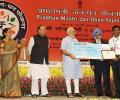
Against National Democratic Alliance's 75 million target, United Progressive Alliance added 61 million in 2013-14.

Modi's visit to Bahrain is significant as it will be the first visit of an Indian prime minister to the country.

More than three weeks have passed since the Reserve Bank of India's (RBI's) new guidelines on e-mandates for recurring payments came into effect but consumers are still taking to social media platforms to complain about the disruptions they are facing. This comes as most stakeholders in the ecosystem have not put in place systems in accordance with the new rules, resulting in many transactions not going through. Industry sources said most banks are still not ready, especially the smaller ones.

The data show close to 72.5 million accounts have been opened till November 10 with an average 500,000 opened every day.

Department of Financial Services is regularly emphasising the early issuance of RuPay Debit Cards, e-KYC based account opening, Aadhaar seeding, financial literacy and the progress in survey made.

"The PMJDY has been the foundation stone for the Modi government's people-centric economic initiatives. "Whether it is direct benefit transfers, Covid-19 financial assistance, PM-KISAN, increased wages under MGNREGA, life and health insurance cover, the first step was to provide every adult with a bank account, which PMJDY has nearly completed," Nirmala Sitharaman said on the sixth anniversary of the scheme.
