
A new report by BinQle indicates India will face a significant demand-supply gap of artificial intelligence professionals by 2026, requiring 1.4 million AI experts against an available pool of 400,000. This shortage could hinder growth for enterprises and GCCs, driving up salaries and necessitating continuous reskilling and strategic talent development.

Infosys co-founder Nandan Nilekani has dismissed fears that artificial intelligence will lead to job losses in India's IT services sector, calling such concerns "hogwash" and "disaster marketing." Speaking at the Bloomberg New Economy Forum 2026, Nilekani argued that AI will actually increase demand for IT firms as it necessitates complex business transformations and creates new types of jobs, particularly in small businesses.

Union Minister Ashwini Vaishnaw announced that the Indian government will release a draft consultation paper on Artificial Intelligence (AI) regulations within the next 30 days, focusing on safety, a human-first approach, skilling, inclusivity, and harm restriction.
A joint report by Dell Technologies and Zinnov reveals that despite high ambition, nearly 70% of India's Global Capability Centres (GCCs) are stuck at the pilot stage for AI adoption. Foundational gaps in data, infrastructure, and governance are identified as key bottlenecks preventing the scaling of AI initiatives into enterprise-wide production. The report highlights the need for significant reskilling of the workforce and robust foundations for industrialising AI responsibly.

A career break does not erase the experience that came before it. But the labour market can act as though it does. The more women invest in building professional careers, the more costly an interruption can become. How, then, do we enable women to make a comeback? Whose responsibility is it? asks Radha Roy Biswas.

In the next 36 months nearly 25 to 40 per cent of jobs will be under threat from AI and job losses are inevitable.

A new report by CIEL HR indicates a massive 260 per cent year-on-year surge in demand for Agentic AI engineers in India by 2026. This growth highlights AI's increasing role in automating routine tech functions and the evolving landscape of technology skills, prompting organisations to invest in reskilling and talent development to meet the rising demand for AI, cloud, and cybersecurity expertise.
TeamLease EdTech Founder and CEO Shantanu Rooj states that the AI-driven world transition is irreversible, with regulation and cost being crucial factors determining its speed and depth. He emphasizes that while AI will transform jobs, not eliminate them, continuous learning, domain expertise, and adaptability will be key for individuals and businesses to thrive in this evolving landscape. Rooj also highlights the need for universities to adapt their curricula to prepare a future-ready workforce.

Salesforce executives, including South Asia CEO Arundhati Bhattacharya, predict a significant shift in India towards wider enterprise AI adoption, moving from experimentation to production deployments. The company plans to invest in physical infrastructure and talent upskilling in India. Salesforce's vision for the "agentic enterprise" involves a four-layer architecture, emphasising the need for robust security and governance for autonomous agents. Executives also highlighted the evolving nature of jobs, with AI handling repetitive tasks and creating new specialised roles, positioning India as a potential leader in agentic innovation by 2030.

A Niti Aayog report reveals that an estimated 8.7 crore Indian youth aged 15 to 29 are not engaged in education, employment, or training (NEET), underscoring the critical need for subsidised training programmes focused on self-employment and emerging sectors.

Salesforce is concentrating on developing 'digital labour platforms' and using AI to augment human capabilities rather than replace them, according to a senior company official.

'Hiring within IT services firms is going to be very specialised.'

Veteran banker K V Kamath stresses the importance of reskilling and education reforms to leverage artificial intelligence (AI) in India, advocating for practical applications over expensive foundational models.

'Policy consistency combined with timely and calibrated reforms are expected to ensure that India not only maintains macroeconomic stability, but also emerges as a globally competitive and inclusive economy.'
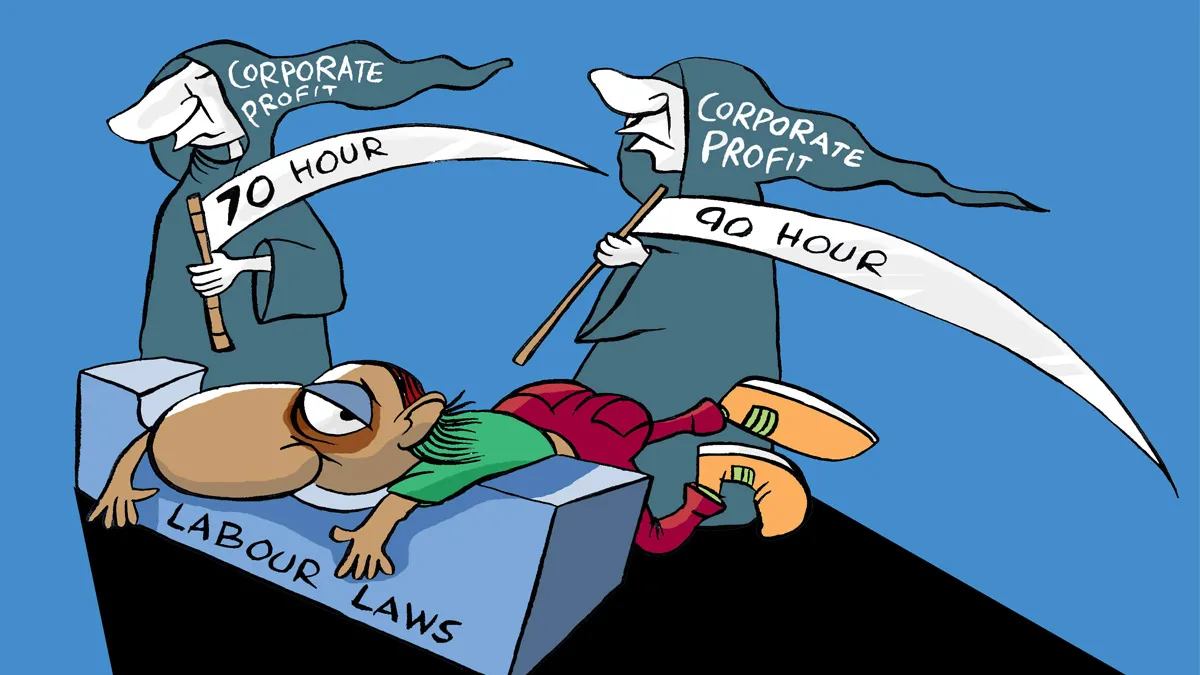
The Indian government has notified final rules under four labour codes, potentially enabling a four-day workweek in certain sectors by capping weekly working hours at 48 while allowing daily flexibility. This move also introduces significant changes to wage fixation, compliance obligations, and social security norms.

'Why not aspire for 8 or 9 or even 10 per cent?'

'Investors shouldn't let fear dictate their decisions. The most important step is simply to begin investing.'

India's newly formed Artificial Intelligence Governance and Economic Group (AIGEG) is set to advocate for a unified legal framework for AI companies, including developers of large language models and chatbot systems, alongside broader operational rules.

TeamLease Digital CEO Neeti Sharma discusses how AI is driving a structural reset in the tech industry, leading to layoffs, reshaping hiring practices, and increasing job insecurity.

AU Small Finance Bank has launched its first AI-native loan origination system, built on the Broccoli platform, in partnership with Amazon Web Services. This deployment marks a significant step towards becoming a fully AI-native bank, replacing traditional systems with a hyper-personalised sales and servicing platform.
Agilisium has invested Rs 50 crore to help pharmaceutical, biotech, and medical technology companies operationalise artificial intelligence, introducing a new professional standard called Forward Deployment Experts (FDX).

'When it comes to enterprise context, there is a big lag between how fast technology is evolving and how it is getting deployed at the end of the day. That is where the challenge is going to be.'

A section of industry may need to begin compliance immediately, even as most states are yet to notify their rules.
A key industry leader acknowledged the India IT services sector faces a "painful" transition due to AI, but emphasized the industry's resilience and ability to adapt through reinvention and focusing on complex enterprise technology.
A key industry leader acknowledged the India IT services sector faces a "painful" transition due to AI, but emphasized the industry's resilience and ability to adapt through reinvention and focusing on complex enterprise technology.

The message is becoming clearer: Employees who fail to meaningfully integrate AI into their work risk falling behind in performance assessments.

Karnataka is prioritizing the AVGC sector in its AI-driven creative economy, emphasizing IP creation, responsible AI adoption, and large-scale skilling, according to Minister Priyank Kharge.

'The reality is that every one of us will be pushed to learn and relearn faster than ever before. Some people will rise to that challenge. Some may not. But the opportunity itself is massive,' says Noshir Kaka, senior partner, McKinsey.

Amid growing concerns over artificial intelligence (AI) disrupting jobs, top technology industry leaders have a clear message for employees -- "stay calm and upskill".

Andhra Pradesh is set to launch India's first indigenously built, open-access quantum computers, marking a significant step towards building a sovereign quantum hardware ecosystem. The initiative aims to position the state as a global hub for quantum technology and enable applications in various sectors.

Learners in India prefer to pursue newer courses, such as Gen AI by building apps and code using the technology, along with learning about it.

'Perhaps unlike any previous era of software, this one requires a rethink in even the lifecycle of how we build.'
Artificial Intelligence (AI) is placing professionals who rely on cognitive skills at the highest risk of job replacement, a fundamental change from previous technological shifts, MeitY Secretary S Krishnan said on Thursday.

Infosys on Wednesday reported a one-time exceptional hit of Rs 1,289 crore on account of the impact of the implementation of new labour codes, as India's second-largest IT services firm announced its December quarter earnings.

Concerns have emerged about the impact of AI adoption on young workers, particularly those seeking their first job in high-skilled occupations.

If retrenched workers are unable to reskill within a fixed period of time, they will have to return the money given to them by the government. Moreover, they may be asked to pay back an interest on the sum transferred.

For Krish Shankar, executive vice-president & group head of human resource (HR) development at Infosys, the defining moment of the pandemic on the HR department has been the importance that reskilling and learning have managed to get. For Infosys, the focus on reskilling started three to four years back as business saw a shift towards digital, and the pandemic has really brought the importance of reskilling to the fore. "In the past, certification courses or taking up an e-learning course was just a way towards promotion, and was not taken too seriously.

'We frequently discuss AI, but we're waiting for other countries to develop solutions rather than creating intellectual property ourselves.' 'We haven't yet produced comprehensive AI solutions developed in India for global markets.'

'Unless you have openness when it comes to accepting what is coming your way and learning afresh, it is not going to be easy.'

Infosys commits to hiring 20,000 graduates amid industry-wide layoffs and uncertainty.
