
From the Sensex pack, Adani Ports & Special Economic Zones, Mahindra & Mahindra, Reliance Industries, HDFC Bank, Larsen & Toubro, NTPC, State Bank of India, UltraTech Cement and Kotak Mahindra Bank were the major gainers. In contrast, Tata Steel, Titan, Bajaj Finserv, JSW Steel, Bajaj Finance, Hindustan Unilever, ITC, Tata Motors and Tata Consultancy Services were among the laggards.

Frequent weather shocks caused by climate change pose challenges for the monetary policy as well as downside risks to economic growth, a Reserve Bank report said. Global average temperatures are on a rise, with accompanying increase in extreme weather events (EWE), and the economic and social impact of global warming is becoming increasingly evident, said RBI's Monetary Policy Report - April 2024. The report said that climate change has increased the frequency and ferocity of weather shocks, posing challenges for monetary policy.

'If you see another 1000-point correction, people may start panicking.'

RBI's interest rate decision, macroeconomic data, global trends and trading activity of foreign investors are the crucial factors to drive equity markets in a holiday-shortened week ahead, analysts said. Markets would remain closed on Monday for Gandhi Jayanti. "While global cues will continue to dictate trends in local markets, focus will shift to RBI's monetary policy announcement on Friday. "Although the market is expecting a status quo on interest rates, global concerns like rising US dollar index and bond yields coupled with surging crude oil prices continue to weigh on investors' minds.

'The real repo rate is very high in terms of core inflation.'

Wholesale inflation rate declined marginally to 0.2 per cent in February compared to 0.27 per cent in the preceding month despite a slight uptick in the food basket. The Wholesale Price Index (WPI)-based inflation was in the negative zone from April to October and had turned positive in November at 0.26 per cent. The inflation in February 2023 was 3.85 per cent.

"It is heartening to note that the RBI has chosen growth over monetary tightening and inflationary fears," FICCI president Harsh Pati Singhania said.

Among the Sensex constituents, 20 stocks ended the session in green with HDFC Bank, Titan, Tech Mahindra, and Asian Paints being the major gainers. TCS, Maruti, Kotak Mahindra Bank and Bajaj Finserve were the other gainers. In contrast, SBI, Bharti Airtel, JSW Steel, PowerGrid, ITC and Reliance closed the trading with losses.

Investors' wealth soared by Rs 10.58 lakh crore in three days of the market rally, where the BSE benchmark jumped over 2 per cent, and hit an all-time high on Monday. Extending its winning momentum to the third day running, the 30-share BSE Sensex jumped 363.20 points or 0.49 per cent to settle at 74,014.55. During the day, it zoomed 603.27 points or 0.81 per cent to hit its record high of 74,254.62.
The Reserve Bank of India's interest rate decision, macroeconomic data and global trends will drive investors' sentiment this week, with markets hoping to continue the positive momentum after ending FY24 on a buoyant note, analysts said. In addition, the trading activity of foreign investors, the rupee-dollar trend and the movement of global oil benchmark Brent crude would also influence trading in equity markets. The 30-share BSE Sensex climbed 14,659.83 points or 24.85 per cent in the 2023-24.

JSW Steel was the biggest gainer on the Sensex chart, rising 2.68 per cent, followed by Tata Motors, Mahindra & Mahindra, Tata Steel, Titan, ITC, Tech Mahindra, NTPC, Reliance Industries and Larsen & Toubro. In contrast, Bajaj Finance, Maruti, ICICI Bank, Power Grid, Asian Paints and Axis Bank were major laggards.

Among the Sensex firms, Adani Enterprises and Adani Ports sustained their gaining momentum and traded higher by 4.40 per cent and 4.37 per cent, respectively. BPCL, Axis Bank, Mahindra & Mahindra and SBI were the other major gainers. On the other hand, HCL Tech, Infosys and Bajaj Auto traded in the negative zone with a loss of up to 1.54 per cent.

As the policy rate has seen a steady increase since May 2022, the percentage of loans offered at interest rates below 8 per cent have declined sharply, dropping from 53 per cent in March 2022 to 18 per cent by June 2023, according to a report by the Reserve Bank of India (RBI). The share of bank loans with interest rates of 10 per cent or higher rose from 22 per cent to 34 per cent during this period, reflecting the impact of a 250 basis point (bps) hike in the policy repo rate by the RBI's Monetary Policy Committee. In response to the rise in repo rate, 32 domestic banks have made corresponding upward revisions to their repo-linked external benchmark-based lending rates (EBLRs), aligning them with the magnitude of the rate hike.

Volatility is likely to continue in the stock market this week amid Omicron uncertainty and the RBI monetary policy meeting will be a key driver for benchmark indices going ahead, say analysts. It will be an event-packed week for the markets, with RBI policy and several macroeconomic numbers scheduled to be announced, they added. "Volatility is likely to continue amid Omicron uncertainty, RBI credit policy, and macroeconomic numbers. "There are lots of news flows on the Omicron variant which are causing volatility in the market while on the domestic front we will have the outcome of an important monetary policy of RBI that is scheduled on December 8. "We will also have our IIP and inflation numbers this week however they will be released on Friday after market hours," said Santosh Meena, Head of Research, Swastika Investmart Ltd.

Less-than-expected rainfall and a poor spatial distribution, experts say, can rekindle fears of a rise in food and fuel inflation that can have an impact on the RBI's monetary policy. The fear of less than optimal rainfall due to El Nino this year, analysts believe, is the biggest short-term risk for the markets, which they said has not been fully priced in yet by them. Monsoon set over Kerala on June 08, a week later than its scheduled date.

'Investment creates capacity and reduces inflation. Income, employment, and savings rise.'

The RBI interest rate decision, industrial production data for June and the ongoing quarterly earnings from corporates would largely drive the stock markets this week, analysts said. Other major factors such as global market trends, the movement of oil prices and the trading activity of foreign investors would also influence trading, they added. "The market will have an eye on the RBI Monetary Policy Committee (MPC) meeting, which will be announced on August 10, 2023. We are heading towards the last batch of Q2 earnings of key companies such as Adani Ports, Coal India, Hero MotoCorp, Hindalco and ONGC, among others, which will lead to stock-specific movement," said Pravesh Gour, senior technical analyst, Swastika Investmart Ltd.

Hikes benchmark lending rate by 35 basis points to 6.25 per cent Cuts growth projection for this fiscal to 6.8 per cent from 7 per cent estimated in September Inflation to come down below 6 per cent in March quarter, to average 6.7 per cent this fiscal

India's services sector activity eased in August but growth rates for new orders remain elevated, as services firms indicated the sharpest upturn in new export business which acted as a catalyst for firms to expand their workforces as well as output, a monthly survey said on Tuesday. Despite falling from 62.3 in July to 60.1 in August, the seasonally adjusted S&P Global India Services PMI Business Activity Index indicated one of the strongest increases in output seen since mid-2010. For the 25th straight month, the headline figure was above the neutral 50 threshold.

From the Sensex pack, IndusInd Bank, NTPC, Asian Paints, Hindustan Unilever, JSW Steel, Tech Mahindra, Bajaj Finance, Infosys, Wipro, ICICI Bank, Bajaj Finserv, HDFC Bank and Tata Motors were among the major laggards. HCL Technologies, Power Grid, Titan, Reliance Industries, UltraTech Cement, Tata Steel, State Bank of India and Mahindra & Mahindra were the gainers.

Retail inflation rose to three-month high of 4.81 per cent in June, mainly on account of hardening prices of food, according to the government data. Inflation based on the Consumer Price Index (CPI) stood at 4.31 per per (revised upward from 4.25 per cent) in May and 7 per cent in June 2022. The inflation, however, remains within the RBI's comfort level of below 6 per cent.

Retail inflation dipped marginally to 6.44 per cent in February, mainly on account of a slight easing in prices of food and fuel items though it remained above the Reserve Bank's comfort level of 6 per cent for the second month in a row. As per the government data released on Monday, the Consumer Price Index (CPI)-based inflation was at 6.52 per cent in January and 6.07 per cent in February 2022. The retail inflation rate for the food basket worked out to be 5.95 per cent in February, marginally lower than 6 per cent in January.

India's economic growth will be above 6 per cent in the current fiscal as the country has managed to strengthen its macroeconomic stability and performance even in a period of large global shocks, RBI Monetary Policy Committee (MPC) Member Ashima Goyal said on Monday. Goyal further said that a global slowdown reducing India's export growth, geopolitics fueling oil and food prices, and erratic weather are some of the continuing risks that the country faces. "India has managed to strengthen its macroeconomic stability and performance even in a period of large global shocks.

Markets continued to fall on Monday, with the Sensex declining 94 points as investors remained cautious amid unabated selling by foreign funds and elevated crude oil prices ahead of the RBI's policy decision later this week. The 30-share BSE Sensex declined 93.91 points or 0.17 per cent to end at 55,675.32. During the day, it tanked 473.49 points or 0.84 per cent to 55,295.74.

Inflation to peak in the current quarter within tolerance band, moderating in the second half of next fiscal, says central bank.
In the Sensex pack, Hero MotoCorp, IndusInd Bank, Bajaj Auto, Maruti and M&M were the top gainers, spurting up to 2.66 per cent.
ICICI Bank, the second-largest private sector lender and state-owned Indian Bank on Monday raised their lending rates across all tenors in anticipation of a rate hike by the RBI later this week. The rates have been increased across all tenors under the marginal cost of funds-based lending rate (MCLR) system, a move that will make EMIs expensive for those who availed loans benchmarked against the MCLR. Under the revised rates, effective August 1, ICICI Bank's one-year MCLR has increased by 15 basis points or 0.15 per cent to 7.90 per cent, while the overnight MCLR rose to 7.65 per cent, as per information posted on the bank's website.
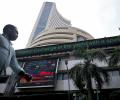
RBI policy, macro data, company earnings to decide market course this week: Experts

The domestic stock market may face volatility amid the monthly derivatives expiry scheduled this week, while investors would mainly await the outcome of RBI's interest rate decision on Friday, said analysts. Global market movement would also continue to drive sentiment amid a bearish trend recently following rate hikes by the US Federal Reserve and other central banks. The Reserve Bank of India (RBI) may take cues from its global counterparts to raise interest rate for the fourth time in a row to control inflation.

The RBI's policy decision would be the major event driving trading sentiment in the equity market this week, while global cues, foreign funds movement and crude oil prices will be the other key factors to watch out for, analysts said. Markets have been witnessing a rebound recently. However, the move lacks decisiveness amid lingering challenges like global policy tightening due to soaring inflation and geopolitical tensions, they added. "RBI policy, global macro numbers and crude oil prices will set the trend for this week.

Rajan was expected to join the search committee to appoint three external members of a new six-member RBI Monetary Policy Committee

Retail inflation fell to a 15-month low of 5.66 per cent in March, mainly due to a decline in food prices, government data showed on Wednesday. The inflation figure in March is within the RBI's comfort zone as it is below 6 per cent. The retail inflation based on Consumer Price Index (CPI) was 6.44 per cent in February 2023 and 6.95 per cent in the year-ago period.
The government on Monday ruled out making public the RBI report detailing the reasons why the central bank could not keep inflation within the targeted 6 per cent upper limit for the three consecutive quarters. "Yes sir, RBI has furnished a report to the central government, as mandated under Section 45ZN of the RBI Act, 1934 and Regulation 7 of RBI Monetary Policy Committee and Monetary Policy process Regulations, 2016," minister of state for finance Pankaj Chaudhary said in a written reply. The said provisions of the RBI Act, 1934, and regulations therein does not provide for making the report public, he said.
Fitch Ratings on Tuesday retained India's economic growth forecast at 7 per cent for the current fiscal, but cut projections for the next two financial years saying the country is not impervious to global developments. In its December edition of the Global Economic Outlook, Fitch projected India's GDP to grow at 7 per cent in the current fiscal, at a slower rate of 6.2 per cent in 2023-24 and at 6.9 per cent in 2024-25. In September, Fitch projected 7 per cent growth for the current fiscal, followed by 6.7 per cent in 2023-24 and 7.1 per cent growth in 2024-25.
Bajaj Finance was the top gainer in the Sensex pack, rising around 4 per cent, followed by Maruti, SBI, Bajaj Finserv, Sun Pharma and Asian Paints. NSE Nifty rallied 293.05 points to 17,469.75.
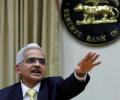
The MPC headed by RBI Governor Shaktikanta Das will announce the resolution of the meeting at around noon on Thursday.

Whether this remains under control in the coming months will depend on the future intensity and spread of the Russia-Ukraine war, and the effectiveness of the Indian government's response, points out A K Bhattacharya.
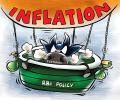
The RBI's Monetary Policy Committee brainstormed the impact of any future shocks on the inflation trajectory and stressed monitoring the cumulative effect of monetary policy actions over the past one year, which is still unfolding, revealed minutes of the rate-setting panel released on Thursday. The minutes of the meeting of the Monetary Policy Committee (MPC), headed by Reserve Bank Governor Shaktikanta Das, also indicated it would be premature to declare an end to the monetary tightening cycle, which started in May 2022 to check high inflation following the outbreak of the Russia-Ukraine war. The central bank, which effected six back-to-back hikes in the key short-term lending rate (repo) since May 2022 to check high inflation, decided to take a pause early this month.

Days after the US Fed raised the interest rate, the RBI may go in for its third consecutive policy rate hike by at least 35 basis points to check high retail inflation, experts said. The central bank has already announced to gradually withdraw its accommodative monetary policy stance. The Reserve Bank of India's rate-setting panel -- the Monetary Policy Committee -- will meet for three days from August 3 to deliberate on the prevailing economic situation and announce its bi-monthly review on Friday.

Finance Minister Nirmala Sitharaman is scheduled to address the post-budget meeting of the RBI's central board on Monday and highlight key points of the Union Budget 2022-23, including the fiscal consolidation roadmap and high capex plan. It has been a custom that the finance minister addresses the RBI board, consisting of RBI Governor and existing four deputy governors, after the Budget. The meeting has been scheduled for February 14 where she would be addressing the board members and talk about announcements made in the Budget to perk up growth hit by three waves of COVID-19, sources said.
 © 2026 Rediff.com - Advertise with us - Disclaimer - Privacy Policy - Sitemap - Feedback - About us - Terms of use - Grievances