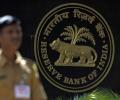
Reserve Bank Deputy Governor S S Mundra on Friday said that he expects banks to cut interest rates

Decision to hinge on Q3 GDP, Feb inflation data and supply-side reforms in the Budget

The sharp fall in rupee since the beginning of May will make things difficult for the central bank which is on the path of easing the monetary policy to revive growth.

Reserve Bank of India Governor Shaktikanta Das on Friday said the central bank will ensure adequate liquidity in the system to ease the financial stress caused by the Covid-19 pandemic. The central bank reduced the reverse repo rate -- the rate at which banks park their fund with the central bank -- by 25 basis points to 3.75 per cent.

Broader markers outperformed their larger peers.

The combined market capitalisation of BSE-listed companies hit an all-time high of Rs 343.48 lakh crore on Monday, amid a rally in equities after the BJP registered victory in assembly polls in three Hindi heartland states. Following the sharp uptick in the market, investors became richer by over Rs 5.81 lakh crore on Monday. The 30-share BSE Sensex jumped 1,383.93 points, or 2.05 per cent, to close at a lifetime high of 68,865.12.

Banks led the decline with Nifty Bank and BSE Bank index dropping over 3% each.

Gains in IndusInd Bank, HCL Tech, TCS, Tech Mahindra, NTPC, ITC, JSW Steel and Tata Steel helped the barometer scale a fresh high. Axis Bank fell the most by 1.26 per cent, M&M by 0.99 per cent and Hindustan Unilever by 0.67 per cent. Maruti, Bajaj Finserv, Bharti Airtel and HDFC Bank and Infosys also declined.

Life Insurance Corporation of India (LIC) February 8 for the first time ever crossed the Rs 7 trillion market capitalisation, as the stock price of state-owned insurer hit a new high of Rs 1,144,45, on rallying 10 per cent on the BSE. The board of directors of the Corporation are scheduled to meet today i.e. February 8, 2024, to consider a proposal for declaration of interim dividend for the financial year 2023-24 (FY24). The board will also consider and approve the unaudited financial results for the quarter and nine-month period ended on December 31, 2023.

RBI has brought down forecasts of both year-end inflation and growth.

The mutual fund (MF) industry had an action-packed 2023 as it tackled the scrapping of tax benefits for debt fund investors and surging flows into equity funds.

The RBI expects non-food credit growth to pick up marginally to 15 per cent in 2013-14 from 14 per cent achieved in the previous fiscal and deposit mobilisation to be flat at 14 per cent.

After a sharp fall in the share prices of HDFC Bank and other private sector lenders in the past three days, the BFSI (banking, financial services and insurance) sector weighting in the Nifty50 has slipped to a seven-year low of 32.03 per cent, down from nearly 36.6 per cent at the end of March 2023 and 34.5 per cent at the end of December 2023.

This time, RBI can cut rates to reflect the improved fundamentals and to further shrink the arbitrage window.

'We are cautious only on sub-sectors that have seen massive melt-up during the past six months.'

The message to bankers from Raghuram Rajan was clear.

Bharat Sanchar Nigam Ltd said on Tuesday that its customers would continue to avail of the 47 per cent domestic long distance rate cut on fixed-to-fixed line call beyond 500 km, for another month, till May.

Shaktikanta Das said in Washington, DC, that there was nothing sacrosanct about the 25 bps rate cut and that monetary policy could be well served by calibrating the size of the policy rate to the dynamics of the situation, and the size of the change itself could convey the stance of policy.

A combination of strong earnings and economic growth, and hopes of the Federal Reserve ending the rate-hike cycle have pushed gross buying of Indian equities by foreign portfolio investors (IPO) to a new high. In 2023, FPIs have been gross buyers of shares worth Rs 25.5 trillion, the highest ever in a calendar year. FPIs also sold shares worth Rs 23.9 trillion. On a net basis, they were net buyers to the tune of Rs 1.6 trillion, the highest since 2020.

Foreign portfolio investors' (FPIs') net investments in the domestic debt market surged in December, marking a 77-month high, that is, since July 2017. According to market participants, this significant uptick in FPI inflows can be attributed to the post-domestic policy outcome and the US Federal Reserve's dovish stance at the December policy. FPI inflows into debt stood at Rs 18,393 crore in December against Rs 14,106 crore in November, according to data on the National Securities Depository Limited.

Prices may go up because of higher energy costs, caused by the rise in shipping charges, with commercial vessels taking a longer route to avoid the troubled Red Sea region, the finance ministry said on Monday. Iran-backed Houthi rebels of Yemen are repeatedly attacking ships in the Red Sea. While the global economy is grappling with challenges such as sticky inflation, sluggish growth, and mounting fiscal pressure, India's external sector could face "potential risks" due to the ongoing geopolitical tensions, according to the finance ministry's report on the review of the Indian economy.

'Higher valuation remains the only spoiler for equities.'

The change from wholesale to retail inflation as an anchor means that the weightage of diesel in inflation has decreased

Reversing a six month declining trend, WPI inflation moved up marginally to 0.11 per cent in December mainly because of increase in prices of food items.
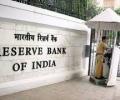
Finance Minister Arun Jaitley last month pointed to the high cost of capital for India's businesses as a key factor behind a manufacturing slowdown.

The rupee on Tuesday gained 14 paise to close at 61.88 against the dollar.

A reading above 50 means the sector is expanding, while a reading below 50 means contraction.

In a recent note, the global brokerage firm said India now commands a weight of 19 per cent in the above-mentioned portfolio as compared to 18.2 per cent in September 2023. India, it said, is a large liquid market and remains a counter-weight to North Asia if a slowdown in the West occurs and China's recovery disappoints.

Most Asian stock markets steadied on Wednesday.

Even if interest rates go down, they may continue to offer better returns than fixed deposits.

'We have a plan to plough back a 'This year in the first half we had profits of more than Rs 31,000 crore.' significant amount of profits this financial year.' 'We have seen this organic plough back of profit is one of best ways to support the equity of the bank.'

Notwithstanding concerns about lofty valuations, smallcaps recorded their most significant monthly gain in nearly three years in November. The National Stock Exchange Nifty Smallcap 100 finished the month with a 12 per cent gain, the most since February 2021 when it rose by 12.2 per cent. After declining by 4.1 per cent in the preceding month, the Nifty Midcap 100 rose by 10.4 per cent, the most since July 2022.

'They can transition from short to long-duration funds when the yield curve normalises.'

Global disinflation has finally caught up with India's high-cost economy.

Says current interest rates are a disincentive for growth, especially in the construction sector

Recent rates cuts by most banks may not have a significant impact on margins, say analysts.

As the fight for deposits intensifies, the cost of money will rise and the margin will be under further pressure, points out Tamal Bandyopadhyay.

The rise in consumer price index (CPI) inflation could see the Reserve Bank of India (RBI) in an extended pause mode as regards interest rates, and in turn, keep the market rally in check, believe analysts. Signs of inflation cooling off in the US, however, is likely to provide some cushion as the expectations of a change in stance by the US Fed as regards interest rates is likely to aid sentiment. Back home, CPI inflation surged for the first time in five months to 4.81 per cent in June 2023, and was higher than the street's expectations of 4.58 per cent.
 © 2026 Rediff.com - Investor Information - Advertise with us - Disclaimer - Privacy Policy - Sitemap - Feedback - About us - Terms of use - Grievances