
A day after Maoists gunned down the founder of anti-Maoist militia Salwa Judum, Mahendra Karma, Prasanna D Zore spoke with Rahul Pandita, author of 'Hello, Bastar: The Untold Story of India's Maoist Movement', for his insights into what he terms as the ageing Maoist leadership's "one final push to their war against the State in their lifetime."
'Killing 40, 50 or 100 Maoist leaders will not solve the issue. If there were no Maoists tomorrow it does not mean that violence will go away. And that is what the government should worry about,' says Rahul Pandita, author of Hello, Bastar: The Untold Story of India's Maoist Movement.
The biggest session of the day on Day 3 of the Jaipur Literature Fest was one titled 'Kashmir Kashmir'. Held at the largest area in the venue -- the front lawns -- the session was the most attended one of the day, leaving behind even the Af-Pak one which had journalist Barkha Dutt as its star attraction.

From the many large communal riots across decades to the six-hour mass cull of Muslims in Nellie, 1983; Sikhs in Delhi and elsewhere, 1984; Kashmiri Pandits, 1990; selective massacres of Hindus in Punjab, 1983-93; and Gujarat, 2002, we have failed to bring perpetrators of our biggest tragedies to account, asserts Shekhar Gupta.

'This is for the first time that a strong, solid evidence-based investigation has happened.' 'It can meet international standards and put the onus on the Pakistanis.'

'Everything they read on social media, they believe, is the truth.' 'One of the biggest challenges in the country today is how to counter fake news and propaganda.'

But why should India be talking to the Taliban in the first place? There is no love lost there. India will never forget or forgive the humiliation to which the Taliban subjected it in the IC-814 hijack, notes Shekhar Gupta.
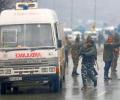
'We know how to kill a terrorist, but we do not know how to stop an innocent boy getting radicalised.'

'The movie seeks to strike a long-awaited conversation. A story that the screen should have told long ago.' 'It is an attempt to cure that epidemic of social media opinion and provoke us to leave our rhetorical positions for once and see the issue purely as a great tragedy which happened for more reasons than we give to ourselves,' says Utkarsh Mishra.

The kin of several of those killed by militants in the late '80s also say they do not have enough resources now to buy back the properties they had left behind after the killings at that time.

'There is an effort of painting the entire problem as religious one.' 'That Jammu and Kashmir is the way it is because the valley has radicalised.' 'I would be the first person to accept that there is a greater element of radicalism today than it was 25 years ago, but to suggest the entire valley of Kashmir is radicalised and everything you see on the ground is because radical Islam has suddenly taken over is not true.' Omar Abdullah, former J&K chief minister, explains why 'the situation in J&K is very worrisome.'
 © 2026 Rediff.com - Investor Information - Advertise with us - Disclaimer - Privacy Policy - Sitemap - Feedback - About us - Terms of use - Grievances