
'Leadership is about understanding how a business works, how it is shaped, built, and expanded.'
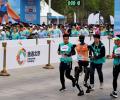
Twenty-one humanoid robots joined thousands of runners at the Yizhuang half-marathon in Beijing on Saturday, the first time these machines have raced alongside humans over a 21-km (13-mile) course.

Hari Balakrishnan, an Indian-origin MIT professor, has received the prestigious Marconi Prize for his fundamental discoveries in wired and wireless networking, mobile sensing, and distributed systems.
Meet Professor V S Subrahmanian, who has made predicting acts of terrorism his business.

India should piggyback on mobile phones to increase penetration and speed of Internet.
People on the move may not need to carry laptops and may not need desktops at all like they did earlier.
Imagine if people could use gestures to run computers and household appliances? Now, global information technology giant Hewlett-Packard has named two Indian-Americans researching this technology as recipients of its innovation research award.
Guggenheim Fellows are appointed on the basis of distinguished achievement in the past and exceptional promise for future accomplishment.
Debasis Chaudhuri, 41-year-old professor of computer science at the University of Nebraska, Lincoln, sat in the courtroom before his name was called with his elbows on his knees and his head resting on cupped hands.
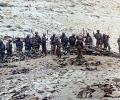
In the 15-year dataset, the researchers noted an average of 7.8 incursions per year even though the Indian government's estimates are much higher.

Four Indian-American professors are among 13 mathematicians, theoretical physicists and theoretical computer scientists selected for the Simons Investigators awards for their cutting edge research.

Three Indian-American researchers have shown that the fingerprint-based security systems used in smartphones and other gadgets are way more vulnerable to hacking than we imagined.

Harvard scientists, including one of Indian-origin, have created the world's largest robotic swarm -- 1,024 little bots standing on pin-like legs -- that can assemble into predetermined shapes.

US cybersecurity researchers have developed a technique that fights the 'Heartbleed' virus, and detects and entraps hackers who might be using it to steal sensitive data.

Robo Brain -- a large-scale computational system that learns from publicly available Internet resources -- is currently downloading and processing about 1 billion images, 120,000 YouTube videos, and 100 million how-to documents and appliance manuals.

Norman Matloff, professor of computer science at the University of California, Davis, believes that the US has enough highly skilled engineers and raising the cap on H-1B would hamper the wages of senior workers already in the industry.

The terror group, which suffered a major blow after the arrest of its founder Yasin Bhatkal, is all set to make a comeback with a 'sticky' bomb usually used to target government officials. Vicky Nanjappa reports

A 25-year quest by nearly 1,000 scholars to document and present one of the world's oldest living traditions came to fruition when the 'Encyclopedia of Hinduism' was unveiled in Columbia.
