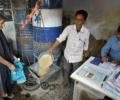
The Pradhan Mantri Garib Kalyan Anna Yojana (PMGKAY) was launched in March 2020 to provide free 5 kg foodgrains per person per month to about 80 crore beneficiaries covered under the National Food Security Act (NFSA) to reduce their hardship during the lockdown period. This was over and above the general allocation under the NFSA.
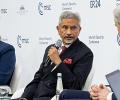
India's External Affairs Minister S Jaishankar countered a US senator's claim that democracy does not put food on the table, citing India's PMGKAY program which provides food to 800 million people. Jaishankar argued that different parts of the world have different experiences with democracy and that the model of globalization has contributed to issues with democracy in some regions. He emphasized that India's democratic system effectively delivers food security, highlighting the PMGKAY program as an example.

The government has extended the PMGKAY scheme to provide 5 kg free foodgrains per month to around 80 crore poor people for another five years. A decision in this regard was taken in the meeting of the Cabinet, chaired by Prime Minister Narendra Modi, on Tuesday. Giving details on Wednesday, Information and Broadcasting Minister Anurag Thakur said the Pradhan Mantri Garib Kalyan Anna Yojana (PMGKAY) has been extended for another five years from January 1, 2024.

The government has extended the Pradhan Mantri Garib Kalyan Anna Yojana (PMGKAY) scheme to provide 5 kilogrammes of free foodgrains per month to around 80 crore poor people for another five years.

Is it a case of poor targeting of a welfare scheme, or is it a reflection of the government's desire to expand the scope of this benefit to secure greater electoral dividends? asks A K Bhattacharya.
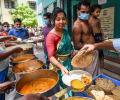
The government on Wednesday extended by three months its programme to provide free rations to the poor at a cost of Rs 44,762 crore as it looked to ease pain from high inflation and make political gains in the upcoming Gujarat elections.

The Union Cabinet on Wednesday approved a proposal to extend distribution of 5 kg foodgrains per month for free under the Pradhan Mantri Garib Anna Yojana (PMGKAY) to over 80 crore ration card holders for four months till March 2022, a decision that will cost an additional Rs 53,344 crore to the exchequer.
Initially, the additional free benefit under the PMGKAY was provided for a period of three months (April-June 2020) to ameliorate distress caused by the COVID-19 pandemic. However, with the crisis continuing, the programme was extended for another five months (July-November 2020).

Prime Minister Narendra Modi on Saturday said the government will extend for five years the free ration scheme, Pradhan Mantri Garib Kalyan Anna Yojana, covering 80 crore poor people.
In times of global challenges, G-20 presidency gives an opportunity to strengthen India's role in the global order, she added. The government is implementing scheme to supply free foodgrains to poor under Pradhan Mantri Garib Kalyan Ann Yojana (PMGKAY) with expenditure of Rs 2 lakh crore from January 1, the finance minister said.

'The decision to supply free food grains is not an economically sound decision because the government will find it very difficult in future to charge anything for food grains.'
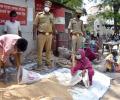
In the three months leading up to the Assembly elections, Chief Minister Yogi Adityanath's government distributed over 1.4 million tonnes (MT) of wheat, 0.95 MT of rice, 0.10 MT of chana (gram), 101.9 million litres of soybean oil and 100,000 tonnes of salt as free ration. This was part of the Covid relief package, officials said.

But the government will present a second tranche of Supplementary Demands for Grants during the Budget session of Parliament in February, when it can seek additional spending.

This is the first Budget in Amrit Kaal, she said.
5-kg free food grains per person per month would be given to around 80 crore people for the two months.
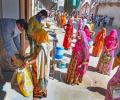
The government's food subsidy in the ongoing fiscal year is expected to be a little less than Rs 4 trillion.
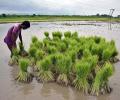
The area under paddy - the biggest foodgrain during the kharif season - was almost 13 per cent lower in the week ended August 5 as compared to the same period last year despite a slight pick-up in rains in the main growing regions, triggering fears of a 10-12 million-tonne drop in final output. Sources said with the peak sowing season for paddy almost coming to an end in the big-growing states, any uptick in coverage from here onwards may not give the desired yields. With 30 per cent of normal average area in which paddy is grown every year remaining unsown till early August, there is a limited chance of a big uptick in output, trade and market sources said.
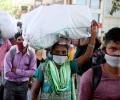
The government on Monday ruled out the possibility of free food-grains distribution to migrants saying there is no panic situation and no complete national lockdown unlike last year.

India has put curbs on wheat exports through the government route, starting November last year. This comes amid a surge in domestic prices of the cereal. In December, India exported 391 tonnes of wheat to Bangladesh and Bhutan. In November 2022, it had exported 375 tonnes of wheat only to Bhutan.
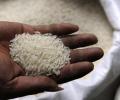
A 6-7 million tonnes shortfall in rice production due to a fall in paddy sowing area is likely to keep rice prices at elevated levels, adding to the inflationary pressure that the slowing economy is already grappling with. Elevated food prices, including that of cereals, had led to retail inflation reversing a three-month declining trend, to touch 7 per cent in August. Similarly, the wholesale price inflation, which declined to 11-month low, also showed price pressures from cereals resulting from wheat output being impacted by severe heat waves in some parts of the country.
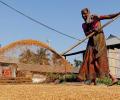
Stating that the food subsidy bill is becoming "unmanageably large", the Economic Survey 2021 on Friday suggested the government to increase the selling price of foodgrains provided through ration shops to over 80 crore beneficiaries. Foodgrains via ration shops are supplied at highly subsidised rates of Rs 3 per kg for rice, Rs 2 per kg for wheat and Rs 1 per kg for coarse grains through Public Distribution System (PDS) as per the National Food Security Act (NFSA). "While it is difficult to reduce the economic cost of food management in view of rising commitment towards food security, there is a need to consider the revision of central issue price (CIP) to reduce the bulging food subsidy bill," the survey said.
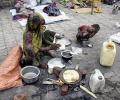
Extreme poverty in India declined by 12.3 percentage points between 2011 and 2019, with rural areas doing better than urban centres, according to a working paper of the World Bank. India has not released a new household consumption survey since the NSS from 2011. By extension, the country has not released any official estimates of poverty and inequality for over a decade now, added the paper co-authored by economists Sutirtha Sinha Roy and Roy van der Weide.

'It has been an ongoing process, talking to the relevant ministries about eliminating leakages and curbing non-core expenditure in various schemes.'

Reacting sharply to the Global Hunger Report 2021, the Women and Child Development Ministry said it is 'shocking' to find that it has lowered the rank of India on the basis of FAO estimate on proportion of undernourished population which is found to be 'devoid of ground reality and facts, and suffers from serious methodological issues'.

Union finance secretary T V Somanathan recently said the Centre had saved Rs 10,000 crore in FY22 on interest payments after adopting new accounting mechanisms for central government agencies and centrally sponsored schemes (CSS) for state governments. Speaking at an event, Somanathan said due to these, there was an unspent balance of Rs 1.2 trillion with state agencies from CSS as on March 31, 2022. This means this amount will be reduced from the Centre's borrowing for now and it can be considered a short-term saving for the exchequer.
A decision in this regard was taken in the Cabinet meeting chaired by Prime Minister Narendra Modi.

They say that a stimulus package may not be necessary because, unlike last year's total lockdown, public transport, including the railways and airlines, is running and the restrictions on movement are localised and, in some cases, are partial rather than total.
The government's subsidies on food, fertilisers and petroleum are estimated to decline by 39 per cent to Rs 4,33,108 crore this fiscal and fall further by 27 per cent to nearly Rs 3.18 lakh crore in 2022-23. In its revised Budget (RE) estimate for the 2021-22 fiscal, the government has pegged total subsidies to be at Rs 4,33,108 crore against the actual Budget estimate of Rs 7,07,707 crore in the previous financial year. Out of which, the food subsidy is estimated to decline to Rs 2,86,469 crore in the current fiscal from Rs 5,41,330 crore in 2020-21, while petroleum subsidy is estimated to fall to Rs 6,517 crore from Rs 38,455 crore in the said period.

Prime Minister Narendra Modi's announcement of providing free inoculation to all adults will entail total spending of anywhere between Rs 45,000 crore and Rs 50,000 crore. This is higher than Rs 35,000 crore that the government had budgeted.

Speaking during a video interaction with Pradhan Mantri Garib Kalyan Anna Yojana beneficiaries from Madhya Pradesh, he also said that there was 'vikriti' (distortion) in the system of the previous government.
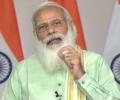
"India is not a country to lose courage. We will fight and win," he said.

Gadkari said, infrastructure sector including highways, airports, inland waterways, railways, logistic parks, broad gauge and metro, apart from MSMEs can attract large scale foreign investment.

While the likelihood of these states going the Lanka or Greece way may be an alarming assessment, the financial situation of some states such as Punjab and West Bengal is indeed quite weak.

To help revive the economy battered by COVID-19, Finance Minister Nirmala Sitharaman on Monday announced a slew of measures, including Rs 1.1 lakh crore credit guarantee scheme for improving health infrastructure, and enhancing the limit under the ECLGS by 50 per cent to Rs 4.5 lakh crore for the MSME sector facing liquidity crunch. Sharing the details of stimulus package, the finance minister said this comprises eight relief measures and other eight measures to support the economic growth. She announced Rs 1.1 lakh crore loan guarantee scheme for COVID-affected sectors, including health sector, which includes guarantee cover for expansion or for new projects. Besides, she said, additional Rs 1.5 lakh crore limit enhancement done for Emergency Credit Line Guarantee Scheme (ECLGS) scheme.
 © 2026 Rediff.com - Advertise with us - Disclaimer - Privacy Policy - Sitemap - Feedback - About us - Terms of use - Grievances